+1 470-229-2076
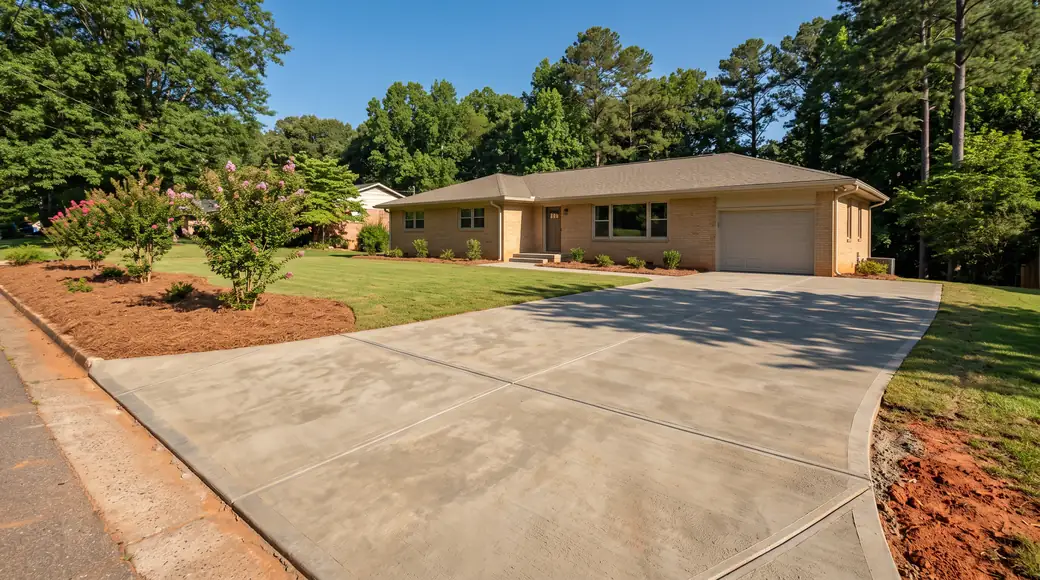
Wide view of finished concrete flatwork across the front of a home at a buff-brick ranch home in Lawrenceville, GA, in clear late-morning sun.

Commercial Concrete for Retail & Shopping Centers in Lawrenceville, GA

We pour concrete for retail property: the parking areas, the sidewalk that runs the length of a storefront, the loading zones behind the building, the pads under dumpster enclosures. Most of what a shopping center needs is flatwork, and nearly all of it gets walked on or driven over every hour the center is open. We work for owners, property managers, and the general contractors handling tenant buildouts. Some jobs are repair, one lifted panel or a broken section of curb. Others are a full tear-out and replacement of an entry drive that has stopped holding together.

Lawrenceville has about 30,954 people, and the retail serving them runs from single-tenant pads to centers with twenty doors under one roof. What we find most often is cracked walkway at the storefronts, curb ends knocked apart by delivery trucks, and drive lanes broken up where cars turn in off the road. Stamped concrete comes up on entry courts and outdoor seating areas, usually when an owner wants the surface to read as something other than plain gray. A good concrete contractor should be able to tell you which of those problems is cosmetic and which one is going to spread. Call for a free estimate.

Call +1 470-229-2076

Licensed, Bonded, and Insured ยท A combined 15 years of experience

Get a FREE Quote

We warranty all of our work because we believe in what we do.

What Commercial Concrete for Retail & Shopping Centers Involves

Commercial concrete at a retail center is mostly flatwork people walk on and drive over all day: parking bays, entrance aprons, loading areas, dumpster pads, curb and gutter, and the walkways that run the length of the storefronts. A concrete sidewalk in front of a busy shopping center takes more foot traffic in a week than a house walkway sees in a year, and it gets shopping carts, hand trucks and salt besides. Stamped concrete belongs at the entries and courtyards where a property wants a finish that reads as deliberate.

Most of this work happens while the center stays open, which shapes every decision on the site. Tenants need their doors reachable, delivery trucks need a path to the back, and a drive lane closed for three days is three days of business a store does not get back. We section the work, pour what will cure before the next stretch has to open, and keep barricades tight enough that nobody strolls across green concrete on the way to a storefront.

Failures almost always start under the slab rather than in it. Base that never got compacted, a soft spot where a utility trench crossed, water running beneath the pad instead of off it: any of those will telegraph through four inches of good concrete inside a couple of seasons. Thin pours crack under truck wheels. Rebar or wire mesh left out of the drive lanes to save an afternoon costs far more than the afternoon. Joints cut late let the slab crack where it wants.

Getting it right is paid for in the parts nobody sees once the forms come off: thickness matched to the actual loads, subgrade compacted and proof rolled, steel where it earns its place, joints cut on schedule, and a finish that still has traction when it rains. That is the standard we hold as a concrete contractor, and it does not change with the address. We do commercial concrete and sidewalk work across Lawrenceville, a city of 30,954, and throughout metro Atlanta, including Snellville, Suwanee, Duluth and Sugar Hill.
Commercial Concrete for Retail & Shopping Centers in metro Atlanta

We pour and replace the concrete that retail property carries: parking pads, entry aprons, sidewalks along the storefronts, dumpster pads, curb and gutter, loading areas behind the building. Most of it is flatwork, reinforced with rebar or wire mesh depending on what the slab has to hold. Some of it is stamped or colored concrete at the entrance, where a center wants the walk to read as something other than plain gray. All of it takes traffic every day.

Lawrenceville has 30,954 people, and the housing that holds them has a median build year of 1987 and a median value around $335,100. Retail serving neighborhoods of that age is usually working on concrete that has been under cars and delivery trucks for a long stretch. Old slabs tell you plenty: where water sits, where a section has dropped, which panels are still sound and can stay. We read the slab before we decide what comes out. Not every bad panel means the whole lot.

Our work runs across metro Atlanta, from centers here in Lawrenceville out to properties in Duluth and the retail on the corridors between them. A shopping center does not close for concrete, so we stage the pours in sections and keep entrances, walkways and parking reachable while each one cures. Tenants stay open. Customers still park. When a slab is beyond patching, we say so, and when it has years left in it, we say that too. Call for a free estimate on commercial concrete.

How the Work Runs

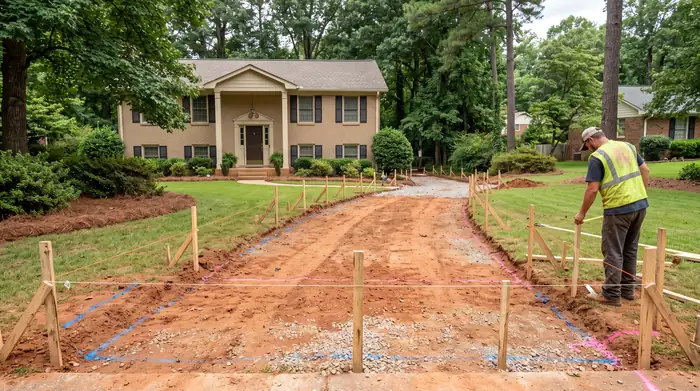
String lines and grade stakes laid out across a yard before a pour at a tan-brick colonial in Lawrenceville, GA, under bright midday cloud.

Step 1: Site Evaluation

We walk the property with you and look at what is already there: the existing slab, how water drains off the lot, where trucks can reach, and what the subgrade looks like once we probe it. Cracked or heaving concrete usually points to a base problem, not a mix problem. We measure the area, note thickness at broken edges, and check whether the pad ties into sidewalks, curbs or a neighboring driveway that has to stay put.

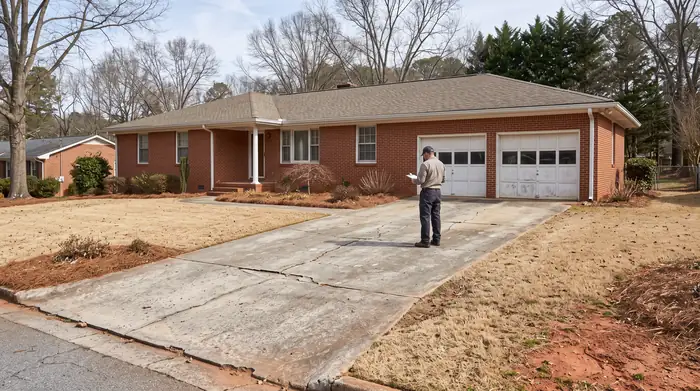
Concrete driveway and walk at a home, the kind of job an estimate covers at a red-brick ranch home in Lawrenceville, GA, under bright midday cloud.

Step 2: Written Estimate and Permits

You get the scope in writing: square footage, slab thickness, reinforcement (rebar or wire mesh), finish, joint layout, and how we handle the demolished material. Nothing starts before you have read it. For work in Lawrenceville, permitting runs through the City of Lawrenceville, and we handle that paperwork ourselves. Where a retail pad touches a public sidewalk or a right of way, the review takes longer, so we file early.

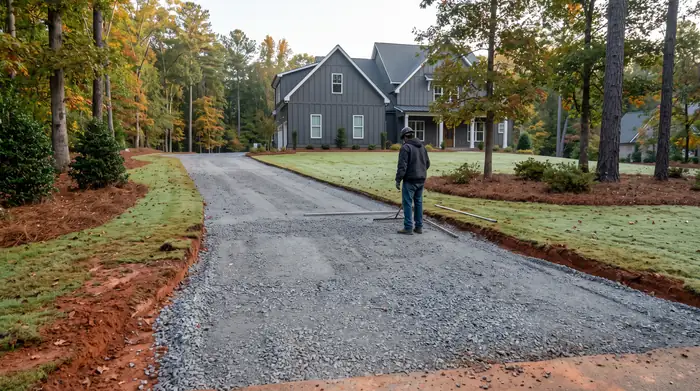
Broken-out concrete removed and the base rebuilt before a new pour at a charcoal farmhouse-modern home in Lawrenceville, GA, in early morning light.

Step 3: Demolition and Base Prep

Old concrete comes out in sections, gets loaded, and leaves the site. Then the real work starts. We cut the subgrade to depth, remove soft or organic material, and bring in graded aggregate base, compacted in lifts with a plate compactor or roller depending on the area. Base is where most driveways fail. Skipping compaction here is why a good mix still cracks two winters into its life.

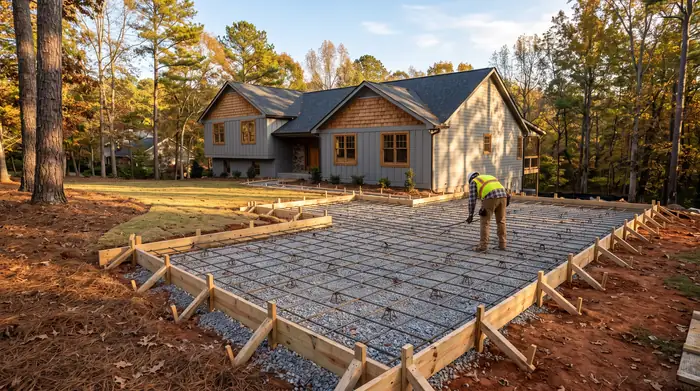
Wooden forms and rebar grid set and tied, ready for concrete at a grey split-level home in Lawrenceville, GA, in late afternoon light.

Step 4: Forming, Steel and the Pour

Forms go in set to grade and pitched to drain away from buildings and door thresholds. We set rebar on chairs for a commercial concrete driveway or heavy traffic pad, wire mesh for lighter flatwork, both held up in the slab rather than lying on the ground. Concrete installation happens in one continuous pour where the layout allows it, screeded, bull floated, then edged before the surface tightens.

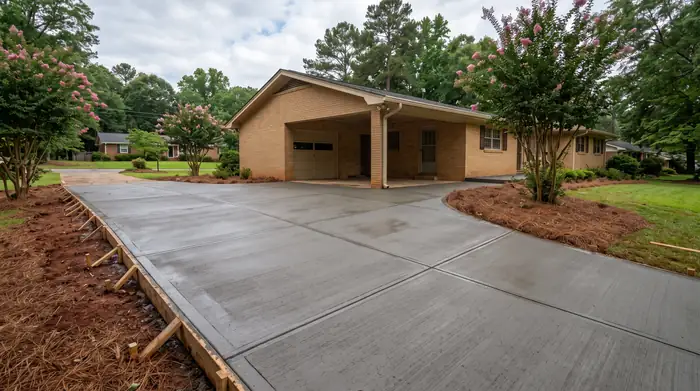
Freshly finished concrete slab curing under a clean broom texture at a buff-brick ranch home in Lawrenceville, GA, after a rain shower.

Step 5: Finishing, Curing and Final Walkthrough

Finish depends on what you picked: broom for traction on sidewalks and driveways, stamped or colored for a storefront entry, exposed aggregate where you want texture underfoot. We cut control joints early so the slab cracks where we tell it to. Curing gets a compound or wet cure, and we tell you when to walk it and when to drive it. Then we walk the whole job with you.

What Decides the Price

Most of what sets a bid apart is visible from the parking lot. Walk the area before you call anyone, and note these.

What changes the priceWhich wayWhy
Old slab or asphalt already thereCosts moreIt gets broken out, loaded and hauled off before new concrete goes down.
How close a mixer can parkCosts less when closeConcrete moved by buggy or pump across a lot adds hours and hands.
Thickness the traffic calls forCosts more when thickerA delivery lane or dumpster pad carries loads a sidewalk never sees.
Rebar instead of wire meshCosts moreRebar tied on chairs is slower to set than mesh, and holds a slab together longer.
Soft or wet subgradeCosts moreBad ground gets undercut and replaced with compacted stone, or the slab cracks.
Where the water runsCosts more when it fights youPitch, drains and curb tie-ins have to be built in, not corrected later.
Stamped, colored or exposed aggregate finishCosts moreDecorative flatwork takes extra material, timing and finish labor.

Compare bids line by line: slab thickness, reinforcement, subgrade prep, joint spacing, and whether demolition and haul-off are included or added later.

Questions About Commercial Concrete for Retail & Shopping Centers

How fast can a Lawrenceville car park be back in use after repairs?

It depends on what we poured. A small patch or a few replacement panels can carry foot traffic within a day and vehicles once the concrete has gained enough strength for the load. A full drive lane takes longer. We stage the work so only the section under repair is closed, and we tell you the cure window for that pour before we start, not after.

Do you handle trip hazard and accessibility issues for Lawrenceville retail?

Yes. Lifted, spalled or settled sidewalk panels near an entrance are common on retail flatwork, and they are usually a saw cut and a replacement pour rather than a rebuild. Ramps, landings and transitions get set to the slopes the code requires, checked with a level as we finish. If a panel keeps moving, we look at the base underneath it instead of pouring over the same problem.

Can you work overnight at a metro Atlanta shopping center?

Yes. Centers with anchor tenants and long trading hours often leave no other window, so we pour after close and work through. Lighting, layout and finishing crew size get planned around that schedule. Night work changes how concrete sets, and we adjust the mix and the finishing sequence for the temperature we are actually working in rather than the one on the daytime forecast.

How do you protect Lawrenceville shopfronts and stock while working?

Glass, storefront framing, bollards and door thresholds get covered before any saw cutting starts. Cutting is wet or vacuumed to hold the dust down. We run barricades and a marked walking route so customers reach the door without crossing wet concrete, and we keep the wash water and slurry off the pavers and out of the storm drains. At the end of each shift the site gets swept.

Do you take on multi-site retail work across metro Atlanta?

Yes. Several properties under one owner or one management company can run on a single scope, with the same details and the same finish repeated at each address. We walk every site first, since a sidewalk in Duluth may need different work than the identical-looking one twelve miles away. Sequencing usually matters more than distance: one site at a time, finished and open, then the next.

Can you pour a retail entrance without closing the shop in Lawrenceville?

Usually. We split the entrance into halves or thirds, pour one section, and route customers across the rest on a temporary walkway. Each section needs its cure time before anyone walks it, so the job runs longer than a single closed pour would. Where the doorway is too narrow to split, an overnight pour is often the cleaner answer for everyone.

Get a Free Estimate

Get a FREE Quote

We warranty all of our work because we believe in what we do.

Tap to call +1 470-229-2076