+1 470-229-2076
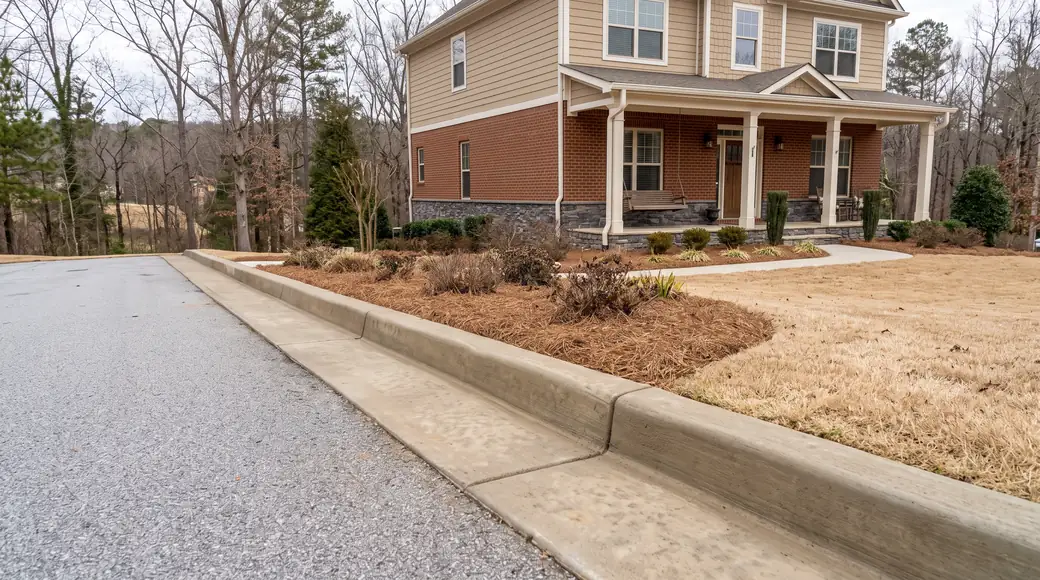
Poured concrete curbing with a rolled profile along a driveway edge at a brick-and-siding two-story home in Lawrenceville, GA, under bright midday cloud.

Curbing & Edging in Lawrenceville, GA

We pour curbing and edging for homes and businesses in Lawrenceville. Landscape curbing around beds and trees, edging that runs the length of a driveway, the strip that separates lawn from a concrete sidewalk: it is all flatwork, and it holds or fails on the same handful of things. Subgrade. Thickness. What the concrete is doing while it cures. As a concrete contractor we set enough of this every season that the details are habit rather than a list we work through.

Most of the yards we edge sit around houses of a certain age. The median home here went up in 1987, in a town of 30,954, and a yard that old has usually had two or three rounds of landscaping laid over the original grade. Old borders sink. Mulch works its way into the turf. Bed lines drawn decades ago no longer match how anyone actually uses the space. New curbing resets that line and keeps it, because concrete does not drift the way plastic and loose stone do.

Curbing takes color and texture the same way a patio does. Stamped concrete borders, integral color, or a plain broom finish that matches the walk already at the front of the house: the finish is yours to pick, and none of it changes what we do below the surface. We cover Lawrenceville and the towns around it, out past Snellville, on the same terms in every one of them. Median home value in the city sits at $335,100, and work that reads as part of the house is worth the same care as the pour itself. Call for a free estimate, and tell us where the line should run.

Call +1 470-229-2076

Licensed, Bonded, and Insured ยท A combined 15 years of experience

Get a FREE Quote

We warranty all of our work because we believe in what we do.

What Curbing & Edging Involves

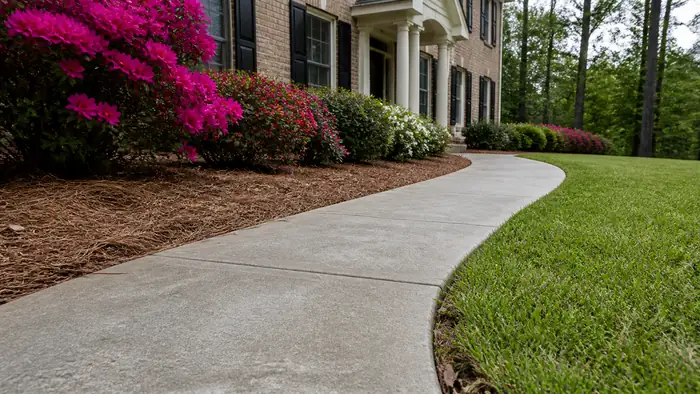
Low concrete edging strip along a mulched garden bed at a tan-brick colonial in Lawrenceville, GA, under an overcast sky.

Concrete edging

Concrete edging is a continuous poured border, usually four to six inches wide and set deep enough to hold its line against mower wheels and root pressure. We form it in place, so it follows the curve of a bed instead of fighting it. Mix and finish matter here. Thin, under-consolidated edging cracks in short sections and lifts at the joints, which is what most failed borders look like a few seasons on.

We can match the finish to nearby flatwork, including a stamped concrete or broom texture that reads with an existing patio or concrete sidewalk.
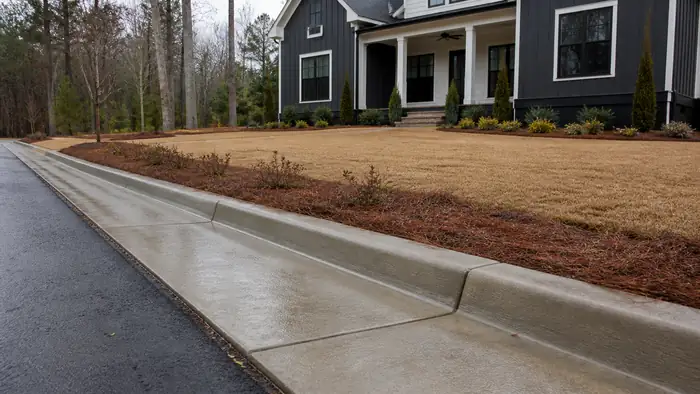
Concrete curb and gutter along a residential street at a charcoal farmhouse-modern home in Lawrenceville, GA, after a rain shower.

Curb and gutter

Curb and gutter carries water, so it gets built heavier than a landscape border. We set the pan and face together in one pour, tie in rebar where a section meets a driveway apron or concrete sidewalk, and hold a consistent slope so nothing ponds against the back of the curb.

Any concrete contractor doing commercial concrete work runs into the same failure: a low spot or a broken grade that puts water where it does not belong. Subgrade compaction is what prevents it.

Curbing & Edging in metro Atlanta

We pour curbing and edging across Lawrenceville and the towns around it: Snellville, Suwanee, Duluth, and Sugar Hill, all inside the same corner of metro Atlanta. Every one of them gets the same crew and the same method. A driveway edge in Sugar Hill is poured the way a bed border in Duluth is poured. Distance changes our drive time, nothing else. If you are inside that ring, the answer is yes, and the trip is short either way.

Scheduling works by pour day. Concrete sets on its own clock, so we group jobs that sit near each other and pour them in the same stretch of dry weather. A curb in Suwanee and one in Snellville can share a morning. On site we stake the line first and let you look at it, because a curb reads differently on the ground than it does on paper. Rain moves a pour, and we would rather move it than fight it.

Older yards cause most of the trouble. The median home in Lawrenceville was built in 1987, which means irrigation lines, downspout drains and low-voltage wire have all been buried at some point, often by different hands. We probe before we cut. Roots are the other one: a curb poured tight against a mature root will lift, so we either route around it or cut back and rebuild the base underneath. Neither problem shows up on a drawing.

Doing it right costs time at the front end. We dig to firm ground, compact the base, and set forms to a line that sends water where it should go. Thicker runs and anything crossing a driveway get rebar or wire mesh. Colored and stamped curbing needs the same base as plain flatwork, nothing less. Skipping that step is what makes a curb crack early. Call for a free estimate.

How the Work Runs

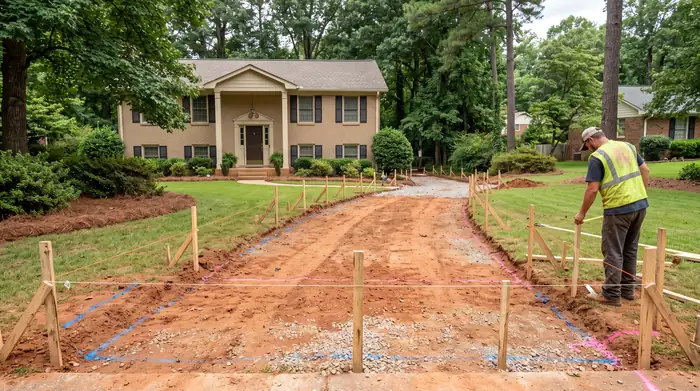
String lines and grade stakes laid out across a yard before a pour at a tan-brick colonial in Lawrenceville, GA, under bright midday cloud.

Step 1: Site Evaluation

We walk the line you want curbed and look at what it borders: a lawn edge, a bed, a concrete driveway, a walkway. Grade matters most. Water has to keep moving, so we check where it drains now and where a raised edge would trap it. We probe for soft fill, buried irrigation lines and tree roots that will heave a curb later. Then we measure the run, including every radius.

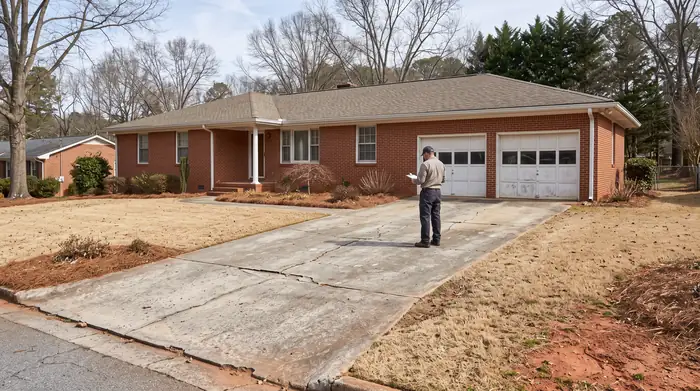
Concrete driveway and walk at a home, the kind of job an estimate covers at a red-brick ranch home in Lawrenceville, GA, under bright midday cloud.

Step 2: Written Estimate and Permits

You get the scope in writing: linear feet, profile height and width, mix, color and finish if you want one, and how we handle transitions where the curb meets existing driveways or steps. Anything we find in the ground that changes the work gets priced before we do it, not after. If a permit applies to your project, we tell you that up front and handle the paperwork.

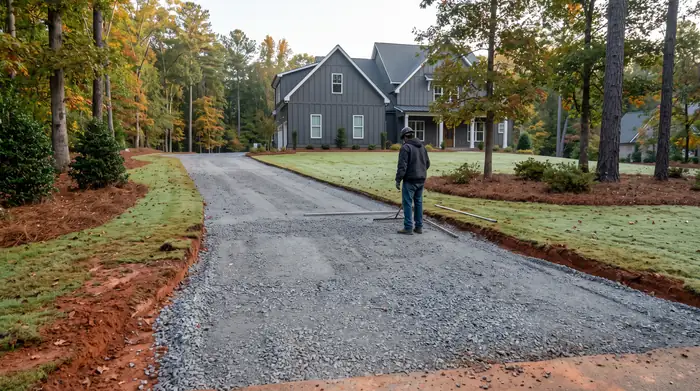
Broken-out concrete removed and the base rebuilt before a new pour at a charcoal farmhouse-modern home in Lawrenceville, GA, in early morning light.

Step 3: Demolition and Base Prep

Old curb, broken edging and root mass come out first, hauled off the same day when we can. We cut a trench wider than the finished curb so the forms have room, then compact the subgrade with a plate compactor. Soft spots get dug out and replaced with crushed stone. Skipping this is why curbs crack in a wave pattern about a year in, no matter how good the mix was.

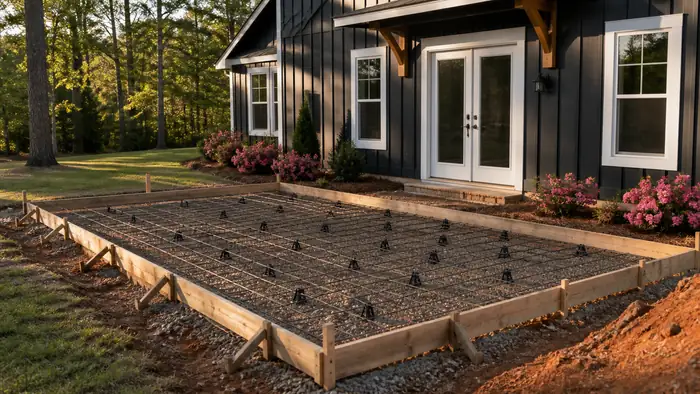
Wooden forms and rebar grid set and tied, ready for concrete at a grey split-level home in Lawrenceville, GA, in late afternoon light.

Step 4: Forming, Steel and the Pour

Flexible forms take the curves; straight runs get staked lumber, string-lined and checked for grade before any concrete arrives. Continuous curb carries rebar through its length, sized to the profile. Where the curb ties into slabs or sidewalks, we dowel it or leave an isolation joint so the two move independently. We place the mix stiff, consolidate it and pull the profile in one pass.

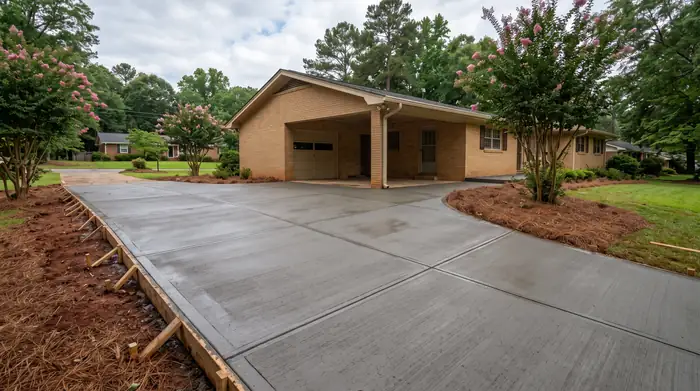
Freshly finished concrete slab curing under a clean broom texture at a buff-brick ranch home in Lawrenceville, GA, after a rain shower.

Step 5: Finishing, Curing and Final Walkthrough

Finish depends on what you picked: a broom texture, a smooth trowel, stamped or colored to match nearby concrete installation. We tool control joints at regular intervals so shrinkage cracks land where we put them. Curing gets a sealer or wet cover, and we ask you to keep vehicles off for several days. Then we walk it with you, backfill the edges and clean up sidewalks and driveways.

What Decides the Price

Curbing and edging prices move on what we find at the bed line, not on the length of the run alone. Around here the median home dates to 1987, so most beds already have something in them, and what that something is matters.

What changes the priceWhich wayWhy
Old edging still in the ground (timber, plastic, brick, buried block)Costs moreIt has to come out and get hauled off before we can trench and pour.
Mature tree roots along the bed lineCosts moreRoots get cut and worked around by hand, and the trench takes longer than open ground.
Irrigation heads and shallow drip linesCosts moreLines get located, protected or moved, and that is careful digging rather than machine work.
Gate width and a clear path to the back yardCosts less when openA truck or buggy that reaches the pour beats wheeling concrete through a thirty inch gate.
Thickness and reinforcement where curbing meets a driveway or is driven overCosts moreA section that carries wheels needs a thicker slab and rebar or wire mesh, not plain flatwork.
A bed that holds water after rainCosts moreSoft ground needs base stone and compaction, and the curb gets set to move water rather than dam it.
Tight curves and short returns instead of long straight runsCosts moreForming radius work is slow, and every corner is a separate setup.
Stamped or colored finish instead of a broom or plain gray edgeCosts moreRelease, color and stamping add material and a second crew day.

Compare bids on the same footage and the same profile. Ask what thickness each one includes, whether reinforcement is priced in where the curb gets driven over, who hauls the old edging and spoil away, and how joints are cut. Bids that differ widely usually differ on base prep.

Questions About Curbing & Edging

What shapes and colors of curbing can I have in Lawrenceville?

Most shapes come off an extruder: mower edge, slant, square top, or a rounded bead. Color goes in the mix or on the surface as a release, and stamped patterns can be run along the top face while the concrete is still green. Earth tones hold up best over years of sun. Bring us a photo of your beds and we will tell you what the curve radius will allow.

Will curbing crack when the ground moves in Georgia?

Yes, eventually, in places. Continuous curbing is a long thin ribbon of concrete, and every long thin ribbon of concrete moves. That is why we cut control joints every few feet, so the concrete cracks where we told it to instead of where it wants to. A joint that opens slightly is doing its job. A section that heaves or separates is a different problem, and we will come look at it.

Can you edge existing Lawrenceville beds without lifting the planting?

Yes, in almost every case. The machine needs a clean strip of soil roughly eight inches wide along the bed line, so we cut sod and pull back mulch rather than pull plants. Shrubs planted tight to the edge sometimes need a branch tied back for an afternoon. Where roots run heavy under the line we shift the curb a few inches out instead of cutting through them.

How long does curbing take to install on a typical Lawrenceville lot?

A house on a standard subdivision lot, the kind built around here in 1987, usually runs one day for the pour. Prep is the variable. Grinding out old plastic or metal edging, cutting sod, and moving a hose line all add hours before the machine ever starts. Curing runs longer than the install: stay off it, keep mowers away from the edge, and give it a few days.

Does curbing stop mulch washing out in Lawrenceville storms?

Mostly, and better than the alternatives. A poured curb sits low on the outside and higher on the bed side, so water sheets across the top instead of pushing mulch under a plastic lip. Heavy rain on a steep bed will still carry pine straw over the edge. Where a bed sits at the bottom of a downspout run, we shape a low spot on purpose and let the water leave.

What is the difference between curbing and edging on a Lawrenceville property?

Edging is the line, curbing is one way to build it. Steel, aluminum, brick and trenched edges all draw the same boundary between turf and bed. Concrete curbing is poured in place as one continuous piece, so it holds a curve without seams and gives a mower wheel something to ride. Anything poured in the right of way goes through the City of Lawrenceville for permitting.

Get a Free Estimate

Get a FREE Quote

We warranty all of our work because we believe in what we do.

Tap to call +1 470-229-2076