+1 470-229-2076
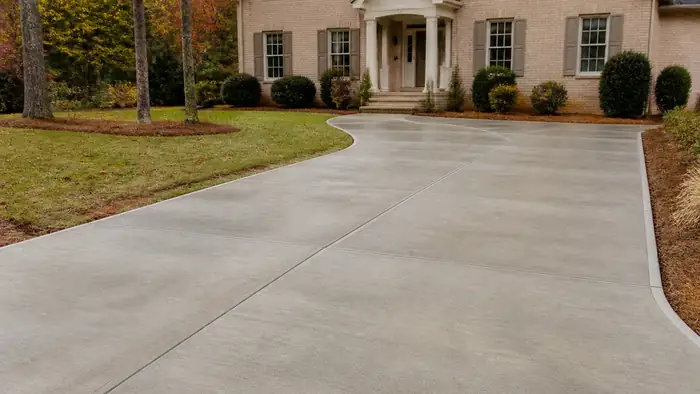
concrete expansion joint installation completed by a local contractor at a brick-and-siding two-story home in Lawrenceville, GA, under an overcast sky.

Concrete Expansion Joint Installation in Lawrenceville, GA

Concrete moves. It swells as it warms, shrinks as it cools, and a slab with nowhere to put that movement will find its own way out, usually as a crack running across a driveway or a patio edge lifting where it meets the house. Expansion joints give it that room. We cut or form them into new pours, replace failed filler in older slabs, and set isolation joints where concrete meets foundations, steps and walls. The median home in Lawrenceville was built in 1987, so plenty of the slabs around town are carrying joint filler that has been out in the weather for a long time.

Gwinnett County gets about 55 inches of rain a year, and water is the other half of the problem. An open or crumbling joint lets it run straight under the slab, where it can wash out the base and leave the concrete unsupported. We clean each joint back to sound edges, set backer rod at the right depth, and seal it so water runs off instead of down. The ground here is hilly and the soil changes from one lot to the next, so we check grade and drainage on every property before deciding where joints go and how wide they need to be. Sealant alone will not fix a slab that has already settled, and we say so when that is the case. Call for a free estimate.

Call +1 470-229-2076

Get a FREE Quote

What Concrete Expansion Joint Installation Involves

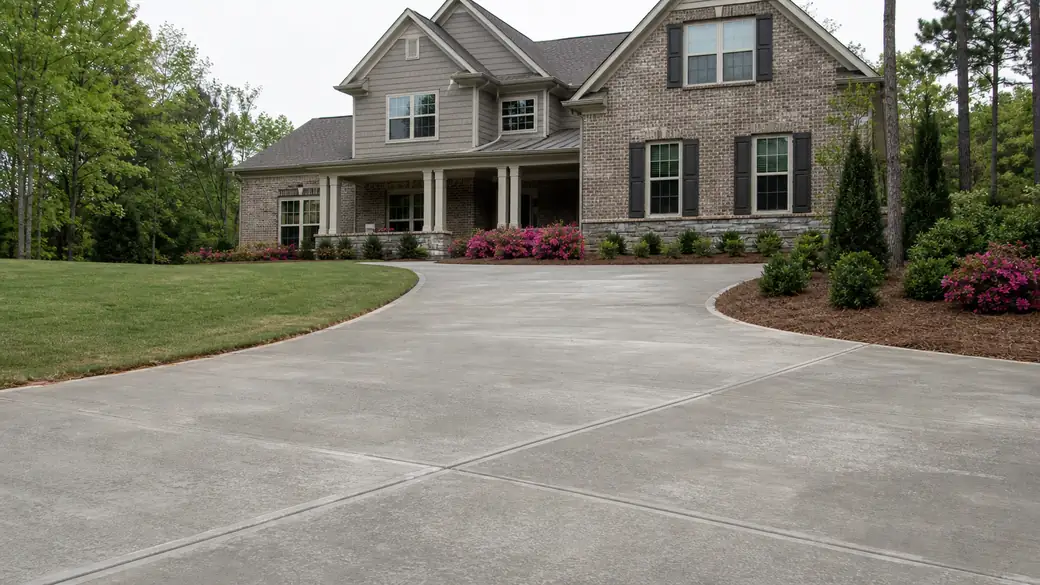
concrete slab installation completed by a local contractor at a tan-brick colonial in Lawrenceville, GA, under bright midday cloud.

Concrete Slab Installation Cost

The price of a slab comes down to what sits under it and what goes into it. Grading a sloped lot, hauling off an old slab and compacting a stone base all add labor before any concrete arrives. Thickness, rebar versus wire mesh, and the finish (broom, stamped or smooth) change the number too. So does the joint layout. We walk the site, measure, and write the estimate from what we find there.


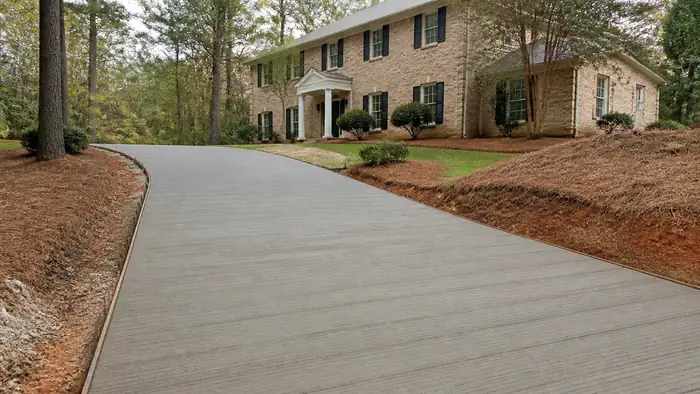
concrete driveway installation completed by a local contractor at a brick-and-siding two-story home in Lawrenceville, GA, in early morning light.

Concrete Driveway Installation

A driveway carries cars, delivery trucks and the odd loaded trailer, so we pour it thicker than a patio and hold the rebar up on chairs where it does its job, not flat in the base. Gwinnett County is hilly, and a sloped driveway needs forms set so water sheds off the surface and away from the house. We saw-cut control joints before the slab can crack on its own, and set expansion joints where it meets the garage and the street.

concrete flooring installation completed by a local contractor at a charcoal farmhouse-modern home in Lawrenceville, GA, after a rain shower.

Concrete Flooring Installation

Floors inside a basement, garage or shop start with a compacted base and a vapor barrier, so ground moisture stays out of whatever goes on top. We wrap columns and walls with isolation joint material, which lets the slab shrink and settle without cracking against the structure. The surface gets a steel-trowel finish for a smooth, dense floor. Control joints are saw-cut early. Curing is slow on purpose: a floor dried too fast curls at the edges.

concrete slab repair completed by a local contractor at a grey split-level home in Lawrenceville, GA, under low winter sun.

Concrete Slab Repair

Most cracked slabs we look at failed at a joint, or failed because there was no joint where one belonged. With about 55 inches of rain a year, water gets into open cracks and washes out the base underneath, and a hairline crack turns into a sunken corner. We rout and seal cracks that have stopped moving, replace failed joint filler, and cut out sections that have settled. Where the base is gone, we rebuild it before pouring, because patching over a void only buys time.

Our Warranty and Guarantee

What stands behind an expansion joint is how it was put in, so that is where we put our attention. Before any cut or strip goes down, the site is graded and tested on its own, because Gwinnett County soil and slope change from block to block. We set joints where the slab needs room to move: against the house, at steps and walkways, and where a driveway meets the garage floor. Filler runs the full depth of the slab. Sealant goes on clean, dry concrete. Shortcuts at any of those points show up later as cracks.

With about 55 inches of rain a year, water is what tests a joint first. A seal that has pulled away lets water under the slab, and water under a slab is where most settling starts, even on well-drained Pacolet soil. The median home here was built in 1987, so we often find original joints that have dried out, split, or disappeared under old patchwork. We show you what we found, what we replaced, and why. If something about the work looks wrong to you, say so while we are on site. Call for a free estimate and ask how we would handle your slab.

Our Concrete Process, Step by Step

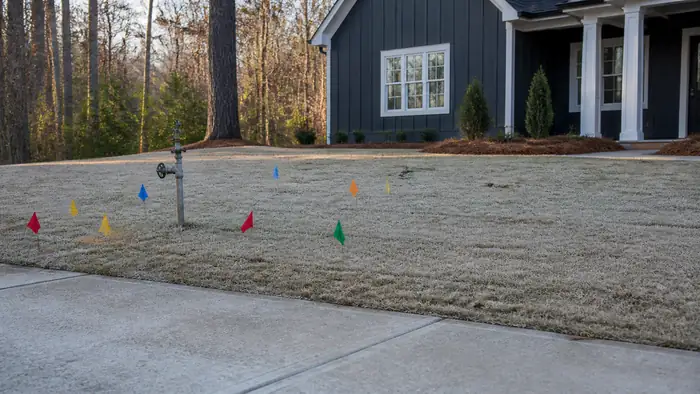
Utility flags mark buried lines before digging starts. at a charcoal farmhouse-modern home in Lawrenceville, GA, in early morning light.

Step 1: Site Assessment

We walk the property first and look at how it sits. Gwinnett County is hilly, and the fall across one yard can differ from the next, so we shoot grades to see where water wants to run and where the new slab will meet the house, a garage apron or an old walk. Plenty of homes here were built around 1987, and their concrete has settled in its own way. Every spot where new concrete butts against old gets marked for an expansion joint.

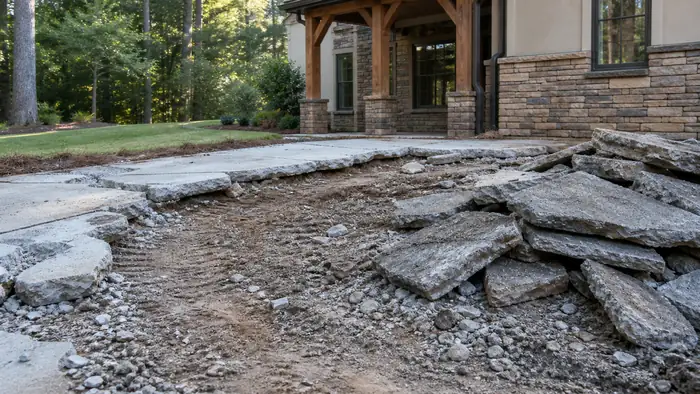
An old patio slab is broken up and hauled away. at a stacked-stone and stucco home in Lawrenceville, GA, under low winter sun.

Step 2: Site Preparation

Digging comes next. We strip topsoil and roots down to firm ground, then bring in crushed stone base and compact it in lifts with a plate compactor. Pacolet soil, the county's dominant type, drains well, but it is not the same on every lot, so we test this site on its own rather than assume. With about 55 inches of rain a year, the grade has to carry water off the slab and away from the foundation. Soft spots get dug out and replaced, not covered over.

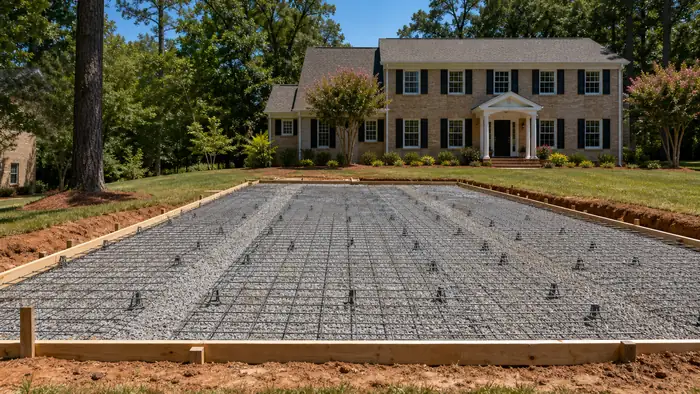
Wire mesh is unrolled across a driveway base before pouring. at a tan-brick colonial in Lawrenceville, GA, in clear late-morning sun.

Step 3: Forming & Reinforcement

Forms go up in straight lumber, staked and braced, set to string lines so the slab pitches the way the grade work planned. Inside them we lay rebar or welded wire mesh, tied at the laps and held up on chairs so it sits in the middle of the slab instead of on the dirt. Wherever new concrete meets a foundation wall, a stoop or an existing driveway, we fasten fiber expansion board the full depth of the pour. That strip lets each piece move without cracking the other.

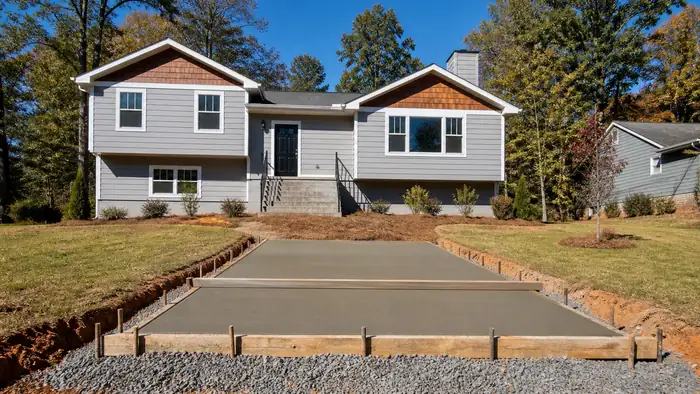
A screed board levels fresh concrete on a small patio. at a grey split-level home in Lawrenceville, GA, in clear late-morning sun.

Step 4: Pouring

Pour day is about timing. The ready-mix truck backs in, and we place concrete from the far end toward the exit, working it into corners and around the steel. A screed pulls the surface flat to the form tops, and a bull float closes it up. On sloped lots we order a stiffer mix so it holds its shape instead of sagging downhill. Adding water at the chute makes concrete easier to push, and weaker. We don't do it.

A broom drags across a driveway creating a slip-resistant texture. at a tan-brick colonial in Lawrenceville, GA, under bright midday cloud.

Step 5: Finishing

Once the bleed water leaves the surface, finishing starts. We run an edger along the perimeter and the expansion board, then cut control joints with a groover so the slab cracks in a straight line where we choose, not across the middle of the driveway. Driveways and walks get a broom finish for grip in the rain. Patios can be stamped or colored for a decorative surface. Troweling too early traps water under the top layer, and that surface flakes off later, so we wait.

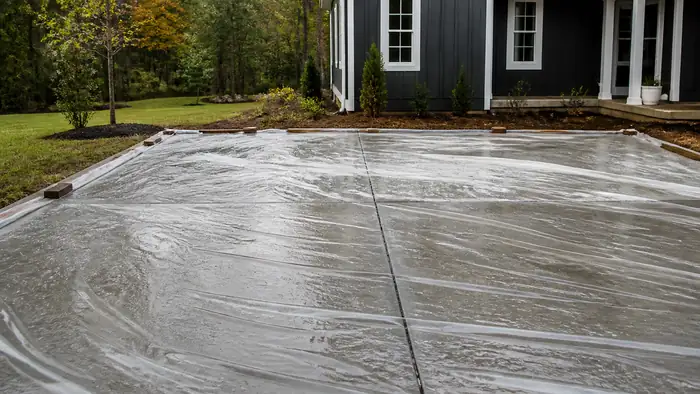
Plastic sheeting covers a curing driveway slab. at a charcoal farmhouse-modern home in Lawrenceville, GA, after a rain shower.

Step 6: Curing

Concrete keeps gaining strength for weeks, and how it cures decides much of how it wears. We spray on a curing compound or cover the slab with plastic or wet blankets so moisture stays in rather than escaping through the top. Let it dry out too fast and you get shrinkage cracks and a dusty, weak surface. Foot traffic can come on after a few days. Cars stay off longer, since a loaded tire puts far more weight on a young slab than a person does.

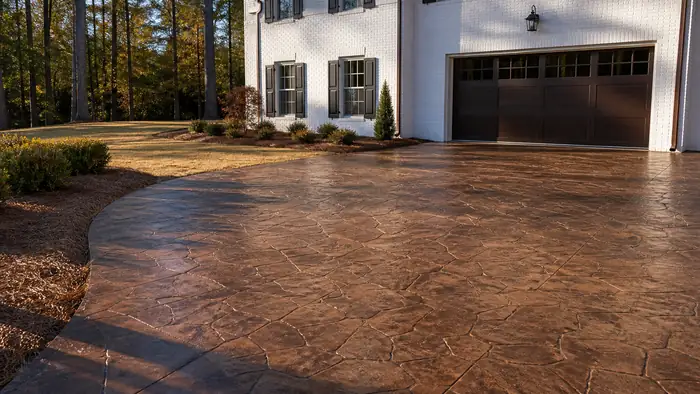
A finished stamped surface shows a glossy sealed sheen. at a painted-white-brick two-story home in Lawrenceville, GA, in late afternoon light.

Step 7: Sealing

After the slab has cured, a penetrating or acrylic sealer goes on to slow down water, oil stains and tire marks. Stamped and colored patios benefit most, since sealer deepens the color and protects the pattern. We also finish the expansion joints: the top of the fiber board gets cut back and filled with a flexible polyurethane sealant so water and grit stay out of the gap. That joint sealant wears faster than the concrete around it, and redoing it is simple maintenance.

Frequently Asked Questions About Concrete Expansion Joint Installation in Lawrenceville

What concrete expansion joint types work best for driveways, patios, and sidewalks in Lawrenceville?

Two kinds do most of the work on residential flatwork. Isolation joints go wherever a slab meets something that moves differently: the house, the garage floor, steps, a column. We set a preformed filler there, full depth, and seal the top. Control joints are cut or tooled across the open field of a driveway, patio or sidewalk so the slab cracks where we choose. On stamped and decorative surfaces we run them along the pattern so they disappear into it.

Will concrete expansion joint installations reduce cracking and shifting from temperature changes and soil movement in Lawrenceville?

Yes, though a joint manages movement rather than stopping it. Concrete expands in warm weather and shrinks in cool weather, and average daily highs and lows here sit around 72°F and 53°F. About 55 inches of rain a year also works on the ground under a slab. Joints give that movement a place to go, so it doesn't tear across the surface. Pacolet soil dominates locally and drains well, but it varies, so we test each site.

How do I know when a concrete expansion joint needs to be installed or replaced in Lawrenceville?

Look at the gaps first. Filler that is dried out, crumbling, sunk below the surface or missing entirely has stopped doing its job, and grass growing through the seam says the same thing. Chipped slab edges along a joint, cracks running beside an old one, or a driveway pressing hard against the garage floor all point to a joint that needs replacing. New concrete poured against old always needs one. The median home here was built in 1987, so some joints are still original.

How much does it cost to install a 4-footconcrete retaining wall in Lawrenceville?

Price depends on what the site asks of the wall, so we give a number only after we have walked it. Length, how steep the ground is behind it, how water drains off the slope, the footing, how much steel reinforcement it needs, the finish on the face, and access for equipment all move the figure. Some walls need an engineer's design as well, and we handle the permit. Call for a free estimate and we will look at your property.

How deep do commercial foundations need to be in Lawrenceville?

Depth comes from the structural design, not a rule of thumb. The design engineer sets it from the building's loads, the code, and what the soil test shows on that lot. The dominant soil around here is well-drained Pacolet, but it varies block to block, and the ground can rise and fall 181 feet within a few miles. That is why every commercial site is graded and tested on its own before we dig. We handle the permit.

What areas beyond Lawrenceville do you serve?

We work across metro Atlanta on the same terms everywhere: the same crew, the same materials, the same site testing before any concrete goes down. A homeowner in Snellville gets exactly the driveway, patio or slab we would pour anywhere else on our list. The full set of towns is on this page. If you are not sure whether your property falls inside it, call and ask, and we can talk through your project and a free estimate.

Get a Free Estimate

Get a FREE Quote

Tap to call +1 470-229-2076