+1 470-229-2076
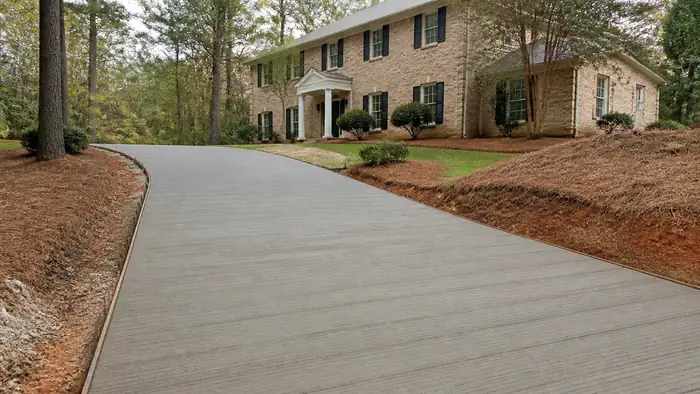
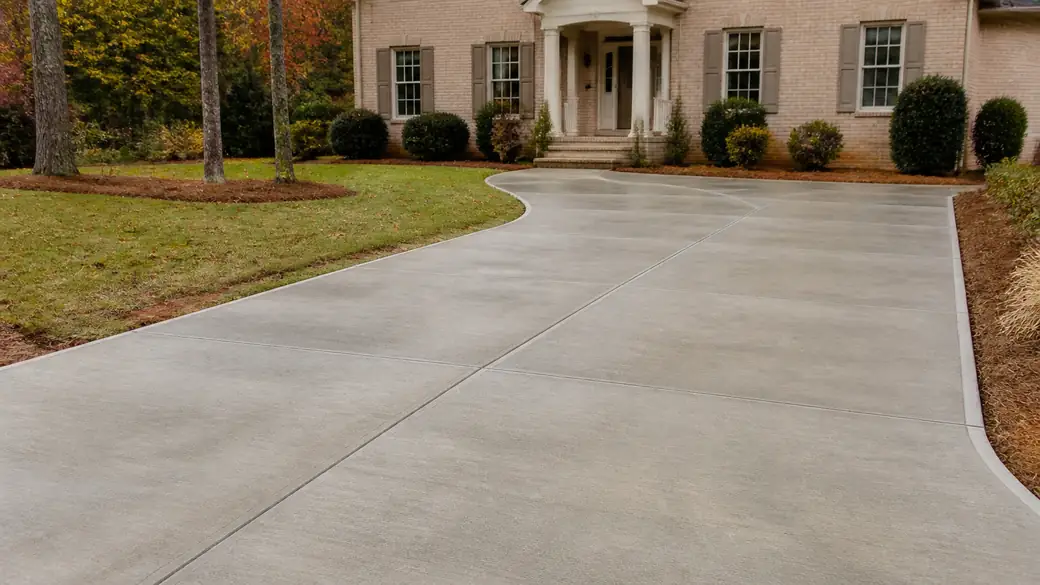
concrete slab installation completed by a local contractor at a tan-brick colonial in Lawrenceville, GA, under bright midday cloud.

Concrete Slab Installation in Mountain Park, Georgia

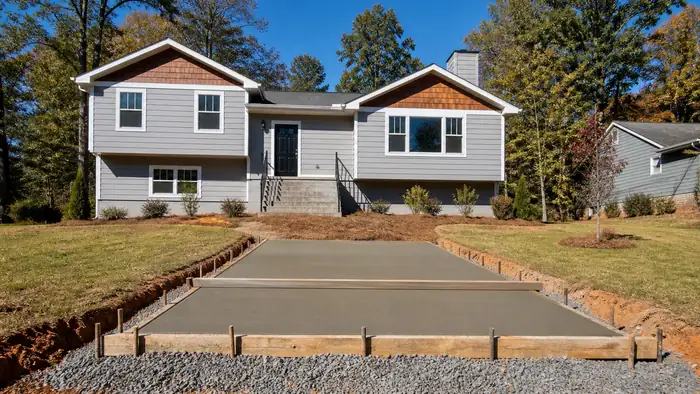
A slab is the flat, reinforced concrete surface that everything else sits on: a garage floor, a shed pad, a patio, the base under a workshop or an addition. We pour residential slabs across Mountain Park, and from the street the job looks simple. It isn't. What decides whether a slab stays flat for decades happens mostly before any concrete arrives, in the ground underneath and the steel inside. That is where we spend our time.

Every site gets tested before work starts. Pacolet soil, which drains well, is the dominant type in Gwinnett County, but it varies from one property to the next, so we check yours instead of assuming. Then we grade, compact the base, set the forms and hold the reinforcement at the right height in the pour. The area sees about 55 inches of rain a year, so we decide where water leaves the slab before we place it.

Most slab failures trace back to a short list: a soft spot nobody found, rebar lying on the dirt instead of sitting in the concrete, control joints cut too late or not at all, water pooling against a foundation wall. None of these show on the day of the pour. They show a year or two later as cracks, settling and edges that drop. Getting it right takes attention up front, not luck. Call for a free estimate.

Call +1 470-229-2076

Get a FREE Quote

What We Do in Mountain Park

Concrete Slab Installation Cost

What a slab costs depends on things we can only judge on site: the square footage, how much grading and base the ground needs, what the slab will carry, and how close a concrete truck can get. A shed pad and a garage floor under a vehicle get different reinforcement and a different base, and that changes both materials and labor. Tight access that calls for a pump adds to it. The estimate is free, and it comes from your property, not a chart.


concrete driveway installation completed by a local contractor at a brick-and-siding two-story home in Lawrenceville, GA, in early morning light.

Concrete Driveway Installation

Driveways fail from the bottom up. Most cracked drives we see were poured on a thin base over soft fill, with no reinforcement and control joints spaced too far apart. We compact a crushed stone base, set rebar on chairs so it sits in the middle of the slab instead of in the dirt, and thicken the apron where tires turn in off the street. The finish is your call: broom for grip on a slope, exposed aggregate, or stamped and colored for a decorative look.

concrete flooring installation completed by a local contractor at a charcoal farmhouse-modern home in Lawrenceville, GA, after a rain shower.

Concrete Flooring Installation

Interior floors ask for a different kind of care than outdoor slabs. Basements, garages, workshops and additions need a vapor barrier under the concrete, a flat and compacted base, and a trowel finish tight enough to seal or stain later. We plan saw cuts so shrinkage cracks land where we want them, not across the middle of the room. For finished spaces we can grind, polish and seal, or leave a smooth surface ready for tile or other flooring to go over it.

concrete slab repair completed by a local contractor at a grey split-level home in Lawrenceville, GA, under low winter sun.

Concrete Slab Repair

Not every cracked slab needs to come out. Hairline shrinkage cracks can be routed and sealed. A slab that has settled or heaved is a different problem, and patching the surface won't hold if the ground underneath keeps moving. Pacolet soil is Gwinnett County's dominant type and it drains well, but it varies across the county, so we test the site before deciding anything. If the base is sound, we repair. If it isn't, we say plainly that replacement is the honest fix.

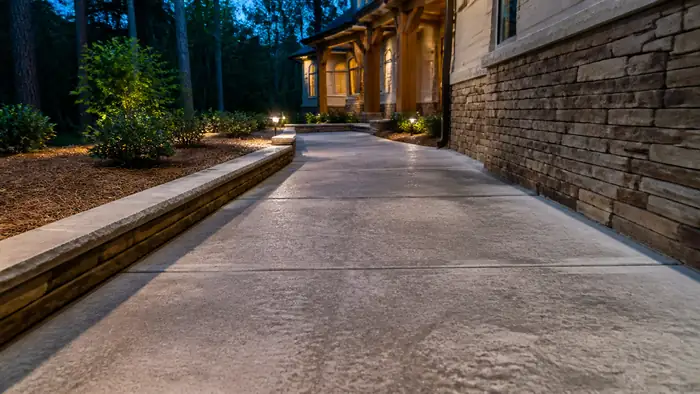
concrete sidewalk installation completed by a local contractor at a stacked-stone and stucco home in Lawrenceville, GA, at blue hour.

Concrete Sidewalk Installation

A sidewalk looks simple, and that's why so many are done badly. Walks need a slight cross slope so water sheds off instead of pooling, and with about 55 inches of rain a year here, standing water is what stains, slicks and slowly undermines a walk. We form clean edges, tool control joints at even spacing, and give the surface a broom finish so it holds grip when wet. Curved garden paths and straight runs to the street get the same base work.

Why Mountain Park Chooses Lawrenceville Best Concrete

A slab is only as good as the ground under it, so that is where we start. Pacolet soil is the dominant type in Gwinnett County, and it drains well, but it changes from one part of the county to the next. So every site gets tested on its own before any forms go up. We would rather learn something inconvenient about your property on the first day than find it later as a crack running across the garage floor.

Rain drives the schedule more than anything else. This part of Georgia gets about 55 inches a year, so we watch the forecast closely and move a pour rather than rush one. Fresh concrete needs dry hours while the surface is being finished, and a hard shower at the wrong moment undoes that work. We plan the base, the reinforcement and the pour as one piece. Nothing gets decided in a hurry on the day.

Most slab failures come down to plain causes: a thin or loosely compacted base, steel left lying in the dirt instead of held up inside the concrete, control joints cut too late or spaced too far apart. None of them are hard to prevent. They just need attention at the right moment, on a residential garage slab or a commercial pad alike. That attention is most of the job. Call for a free estimate.

Our Concrete Process, Step by Step

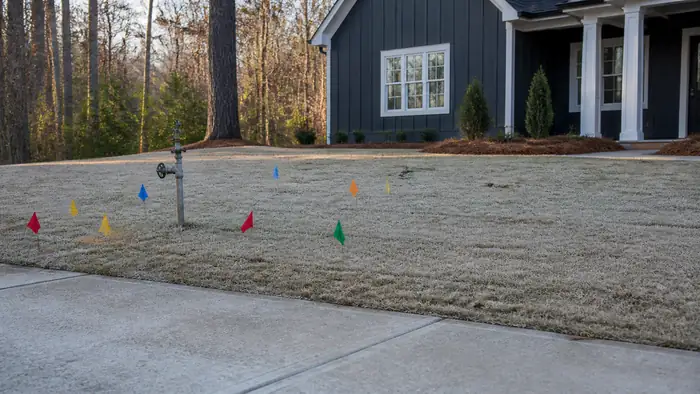
Utility flags mark buried lines before digging starts. at a charcoal farmhouse-modern home in Lawrenceville, GA, in early morning light.

Step 1: Site Assessment

We start on your Mountain Park property with a tape, a probe and a look at where water goes when it rains. Pacolet soil, which drains well, is the dominant type around here, but it changes from lot to lot, so we test every site individually before work starts. We check grade, drainage paths, tree roots, buried lines and what the slab will carry: a patio table, a parked truck, a shop floor. That decides thickness, reinforcement and base.

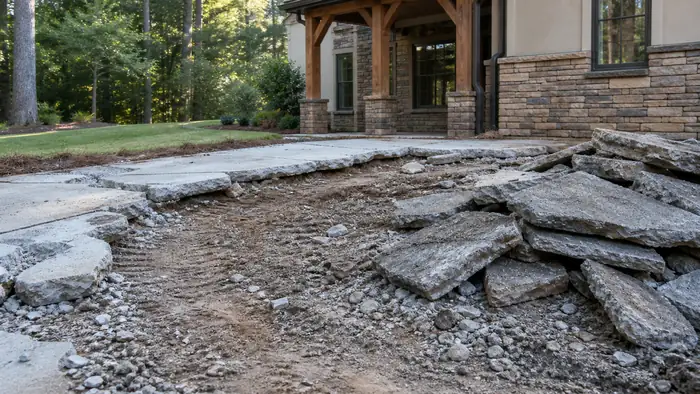
An old patio slab is broken up and hauled away. at a stacked-stone and stucco home in Lawrenceville, GA, under low winter sun.

Step 2: Site Preparation

Most slab failures begin below the concrete, not in it. We strip topsoil and organic material down to firm subgrade, dig out soft spots and replace them with compacted fill. Crushed stone goes on next, spread and compacted in lifts with a plate compactor, not dumped and raked flat. We set the grade to shed water away from the house. With about 55 inches of rain a year, a slab that holds a puddle against a foundation causes trouble.

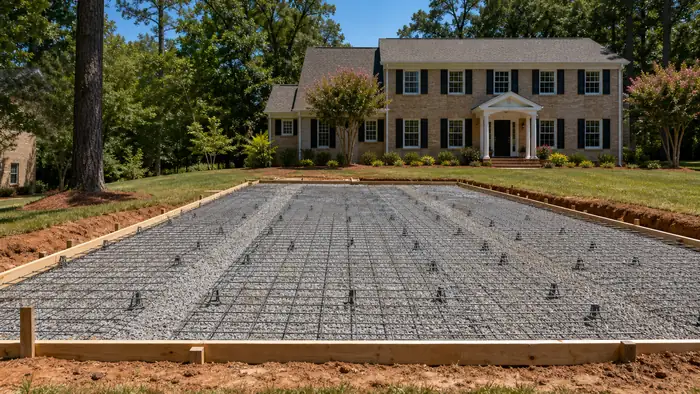
Wire mesh is unrolled across a driveway base before pouring. at a tan-brick colonial in Lawrenceville, GA, in clear late-morning sun.

Step 3: Forming & Reinforcement

Forms go in straight and staked tight, because any bow in a board shows in the finished edge. We set them to final grade and slope off a string line. Reinforcement depends on the job: welded wire mesh or rebar on chairs for most residential slabs, heavier rebar where a driveway takes vehicle loads. The chairs matter. Steel lying on the stone does almost nothing; it has to sit inside the slab to hold cracks closed. Expansion material goes against existing structures.

A screed board levels fresh concrete on a small patio. at a grey split-level home in Lawrenceville, GA, in clear late-morning sun.

Step 4: Pouring

Ready-mix arrives batched for the job, and we check the slump before it leaves the chute. Adding water at the truck makes concrete easier to place and weaker once it sets, so we don't do it. The pour runs continuously wherever we can manage it, with concrete placed close to its final spot rather than dragged across the forms. We screed to grade, then bull float to bring cream to the surface and knock down high and low spots.

A broom drags across a driveway creating a slip-resistant texture. at a tan-brick colonial in Lawrenceville, GA, under bright midday cloud.

Step 5: Finishing

Timing is the whole trade here. We wait for bleed water to leave the surface before touching it again, since finishing too early traps water and leads to scaling and dusting later. Edges get rounded with an edger. Control joints are tooled or saw-cut deep enough to decide where the slab cracks, instead of letting it choose. Then the finish: broom texture where grip matters, a smooth trowel for garage floors, stamped or decorative work on patios.

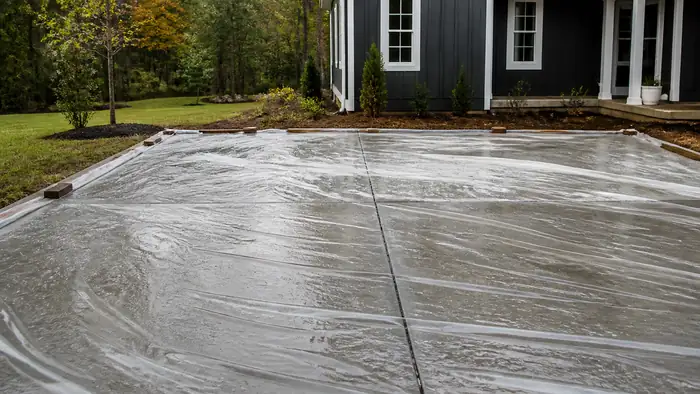
Plastic sheeting covers a curing driveway slab. at a charcoal farmhouse-modern home in Lawrenceville, GA, after a rain shower.

Step 6: Curing

Concrete gains strength as long as it holds moisture, and it keeps gaining for weeks. We keep the surface damp with curing compound or covers so the top doesn't dry out ahead of the slab beneath it. That's how you get surface cracking and a weak, chalky finish. Average highs around 72°F and lows around 53°F are kind to concrete, but a hot, windy afternoon pulls water out of any slab fast. Foot traffic comes first; vehicles wait for real strength.

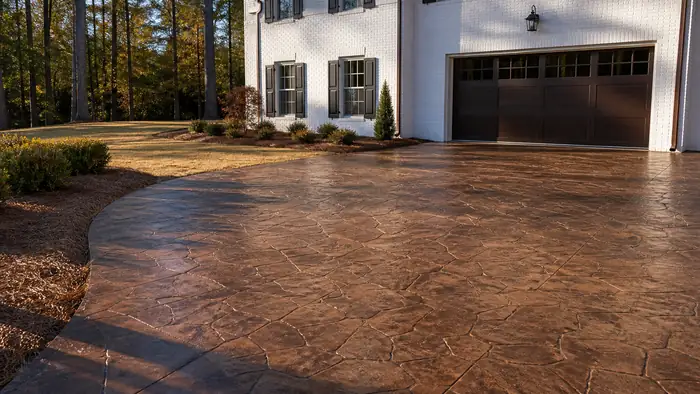
A finished stamped surface shows a glossy sealed sheen. at a painted-white-brick two-story home in Lawrenceville, GA, in late afternoon light.

Step 7: Sealing

Once the slab has cured, we clean it and apply a sealer matched to the surface. Stamped and decorative concrete usually takes a film-forming acrylic that deepens the color and protects the pattern. Plain broom-finished driveways do well with a penetrating silane or siloxane sealer, which keeps water and oil out of the pores without making the surface slick. Sealer wears with traffic and weather, so plan on resealing every few years to keep the slab shedding water.

Common Questions From Mountain Park Owners

What areas beyond Mountain Park do you serve?

Mountain Park is one part of a wider service area across metro Atlanta, and the full list of towns appears elsewhere on this page. Every town on it is served on the same terms: the same crews, the same materials, the same care with base prep and reinforcement. If you are unsure whether your property falls inside it, call and ask. A driveway in Lawrenceville and a patio here get built exactly the same way.

Do I need permits for foundation work in Mountain Park?

Yes, in most cases. Foundation work is structural, and structural concrete generally needs a building permit before any forms go up. The exact requirements come from the local building department, not from us, and they can depend on the size and use of the structure. It pays to sort this out early. Starting without the right permit can mean tearing out work that was otherwise done properly, and nobody wants to pour a foundation twice.

What types of commercial projects does Lawrenceville Best Concrete handle?

We handle the commercial work that takes daily wear: parking areas, loading pads, dumpster pads, sidewalks, curbs, storefront entries and building slabs for retail and office space. We also pour walkways and entrances for schools and clinics, where foot traffic never really stops. Every project starts with the load it has to carry. A sidewalk and a truck apron need different thickness, reinforcement and joint spacing, and we settle those before any concrete is ordered.

What's the difference between acid stain and water-based stain?

Acid stain reacts chemically with the lime in cured concrete. The color it leaves is mottled and translucent, in earthy browns, tans and muted greens, and no two slabs come out alike because the result depends on the concrete itself. Water-based stain does not react. It soaks into the surface and leaves pigment behind, which gives a wider range of colors and a more even, predictable finish. Acid stain also needs neutralizing and rinsing. Both get sealed afterward.

Can commercial driveways in Mountain Park be repaired while staying open to traffic?

Yes, usually. We split the driveway into sections and work one at a time, with cones and clear markings so customers and deliveries still have a way in. The repaired section stays closed until it has cured enough to carry vehicles. Then traffic shifts over and we move to the next. A Mountain Park business with a single narrow entrance takes more planning, and we work out that sequence with you before any demolition starts.

Will Lawrenceville Best Concrete take care of our city permits and inspections?

Yes. On work that needs a permit, we pull it, schedule the inspections and have the site ready when the inspector arrives, whether that is a check of the forms and reinforcement before a pour or a final look afterward. Because you own the property, you may be asked to sign an application or confirm a few details. The rest of the paperwork we handle as part of the project, so you are not left chasing it.

Get a Free Estimate

Get a FREE Quote

Tap to call +1 470-229-2076