+1 470-229-2076
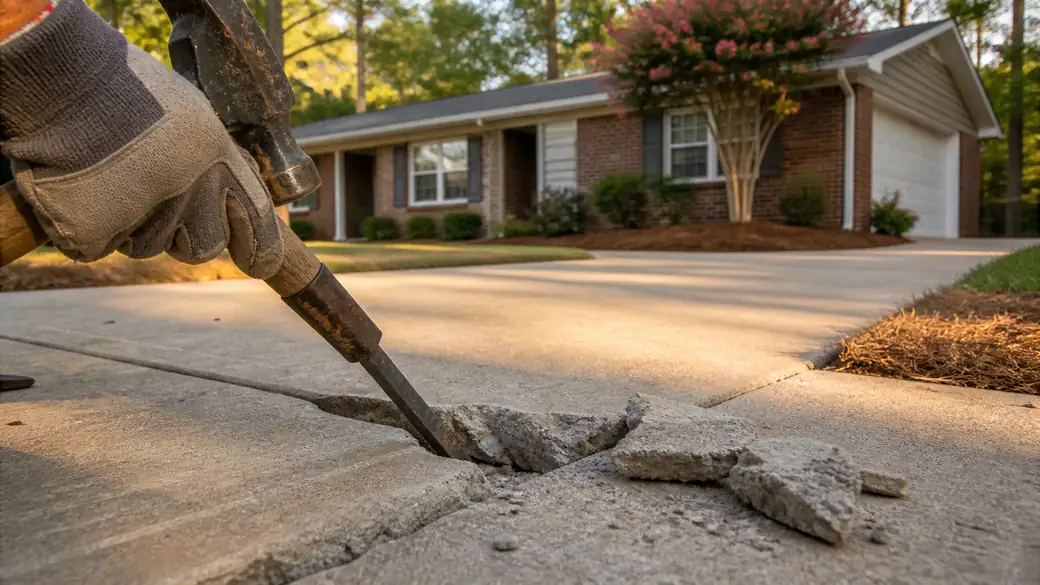
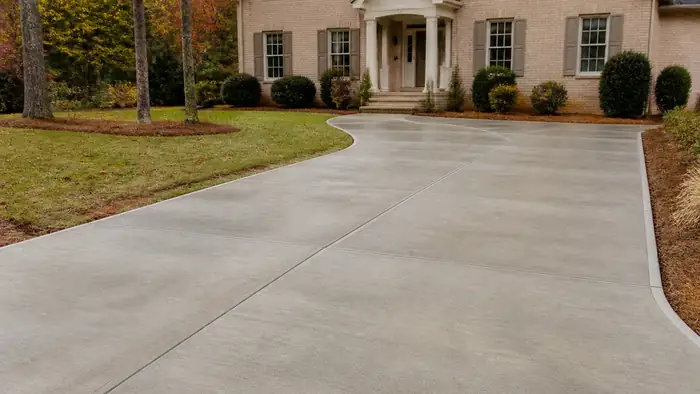
concrete driveway crack repair completed by a local contractor at a red-brick ranch home in Lawrenceville, GA, in late afternoon light.

Concrete Driveway Crack Repair in Lawrenceville, GA

A crack in a concrete driveway is rarely just a line on the surface. It tells you something about the slab underneath: how it was placed, what it rests on, and where the water goes when it rains. In Lawrenceville, the median home was built in 1987, so plenty of driveways here have been carrying cars for decades. We treat every crack as a question first. Then we repair the ones that can be repaired properly.

Our work starts with the ground, not the crack. Gwinnett County is hilly, with about 181 feet of local relief within a few miles, and the grade changes from one block to the next. Pacolet soil is the dominant type here and it drains well, but it varies across the county, so we test each site on its own. With roughly 55 inches of rain a year, any opening in a slab will find water.

Most failed repairs come from treating a moving crack like a still one. A bead of filler over a slab that is still shifting looks fine for a season, then opens again beside the patch. Some cracks only need to be cleaned out and sealed. Others point to a base problem, and a section has to come out and be poured again with proper reinforcement. We tell you which one you have. Call us for a free estimate.

Call +1 470-229-2076

Get a FREE Quote

What Concrete Driveway Crack Repair Involves

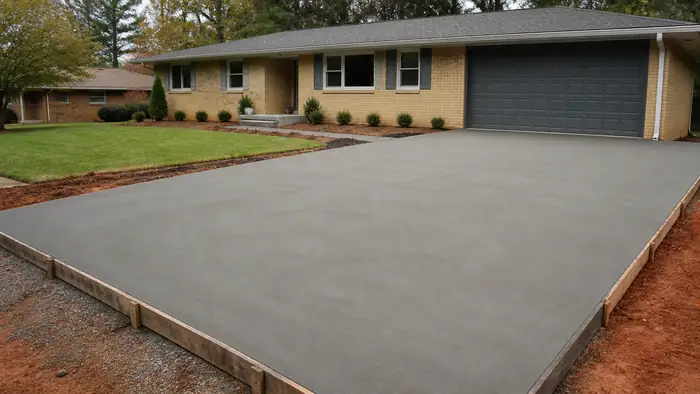
concrete slab installation completed by a local contractor at a tan-brick colonial in Lawrenceville, GA, under bright midday cloud.

Concrete Slab Installation Cost

Four things set the figure: how much ground has to move, how thick the slab runs, what goes inside it, and how easy the site is to reach. Gwinnett County is hilly, so a sloped lot can need cut, fill and a formed edge before any concrete arrives. A slab that carries a vehicle gets a thicker section and rebar. A shed pad may only need wire mesh. We grade and test every site before we put a number on it.


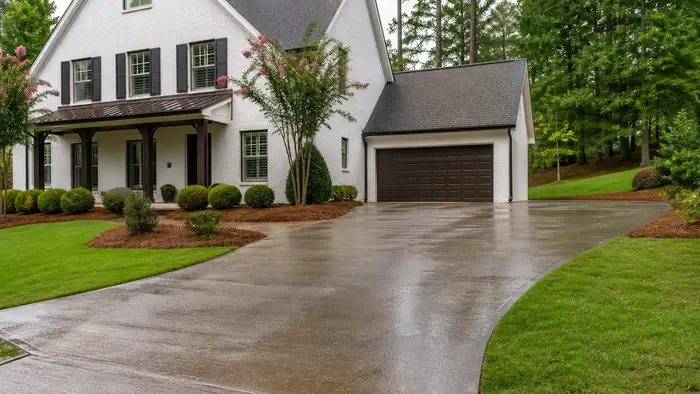
concrete driveway installation completed by a local contractor at a brick-and-siding two-story home in Lawrenceville, GA, in early morning light.

Concrete Driveway Installation

A driveway fails from underneath first. We strip the topsoil, compact a gravel base, and set forms so the surface sheds water toward the street instead of the garage. With about 55 inches of rain a year, that slope earns its keep. Reinforcement sits on chairs in the middle of the slab, not on the dirt. Control joints go in early, so the cracks concrete always makes run in straight lines. Broom finish is standard; stamped and decorative finishes are available.

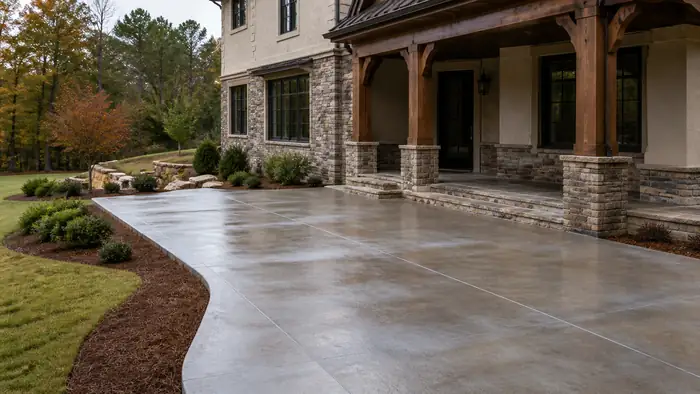
concrete flooring installation completed by a local contractor at a charcoal farmhouse-modern home in Lawrenceville, GA, after a rain shower.

Concrete Flooring Installation

Garage, basement and shop floors start with a vapor barrier over compacted stone, so ground moisture stays out of whatever sits on top. We set the reinforcement, pour, and float the surface flat, then trowel it smooth or leave a light broom texture for grip. Joints get planned around posts and doorways, where shrinkage cracks like to start. Once cured, the floor can take a sealer or a coating. Commercial floors follow the same steps with heavier reinforcement.

concrete slab repair completed by a local contractor at a grey split-level home in Lawrenceville, GA, under low winter sun.

Concrete Slab Repair

The median home here was built in 1987, so plenty of slabs around Lawrenceville have had decades to settle. Hairline shrinkage cracks get routed out and filled with a flexible sealant to keep water from getting under the slab. Cracks that have opened wide or shifted edge to edge point to a base problem: washed-out fill, a tree root, or a downspout emptying against the concrete. We fix the cause first. Broken sections are cut out, doweled into the sound slab, and repoured.

Our Concrete Process, Step by Step

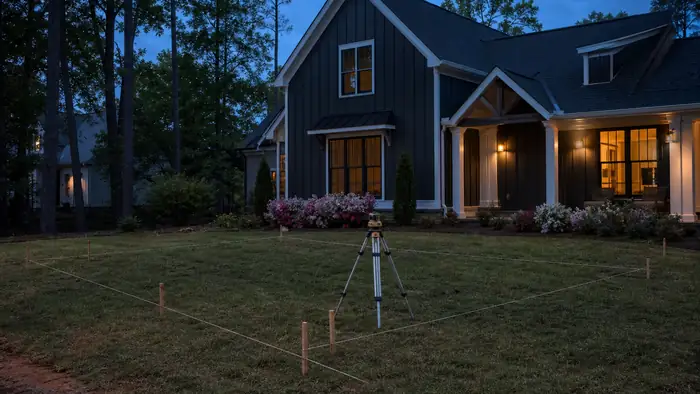
A contractor checks slope and drainage before work begins. at a charcoal farmhouse-modern home in Lawrenceville, GA, at blue hour.

Step 1: Site Assessment

Every driveway shows why it cracked, and we read it before we write an estimate. We look at the crack pattern, whether slabs have settled or lifted, where water runs in a storm, and how tree roots reach under the edges. The median home here was built in 1987, so plenty of driveways have carried cars for decades. We also probe the base. Pacolet soil drains well across much of Gwinnett County, but it varies from lot to lot.

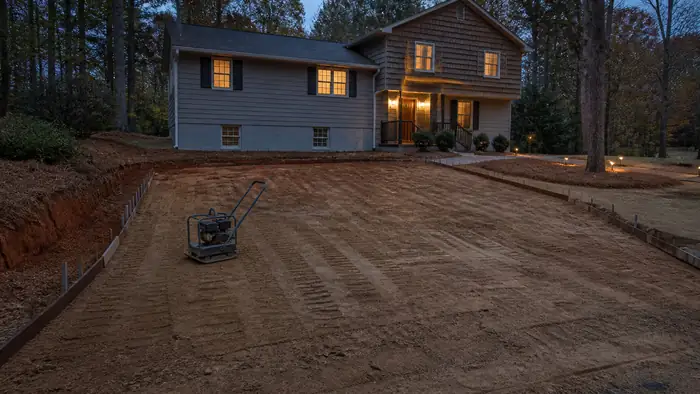
A plate compactor tamps down soil in a small excavated area. at a grey split-level home in Lawrenceville, GA, at blue hour.

Step 2: Site Preparation

Old concrete comes out in sections, broken up and hauled off, and the ground underneath gets the attention it probably never had. We dig out soft spots, cut roots, and bring in crushed stone for the base, compacted in lifts with a plate compactor. Gwinnett County is hilly, with 181 ft of local relief within a few miles, so we set grades with string lines. Water has to leave the slab and the garage door. It never pools against either.

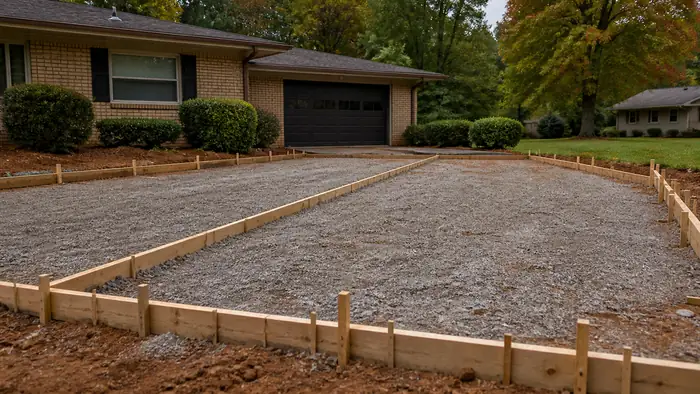
Wooden forms outline a patio slab before the pour. at a buff-brick ranch home in Lawrenceville, GA, under an overcast sky.

Step 3: Forming & Reinforcement

Forms go up in straight lumber, staked tight and checked for pitch along their full run. Curves get bendable form board. Inside, we tie rebar in a grid and set it on plastic chairs so the steel sits in the middle of the slab, not on the dirt, where it does nothing. Steel lying at the bottom is one of the most common reasons we see a driveway crack wide open. Where new concrete meets old, we drill in dowels so both move together.

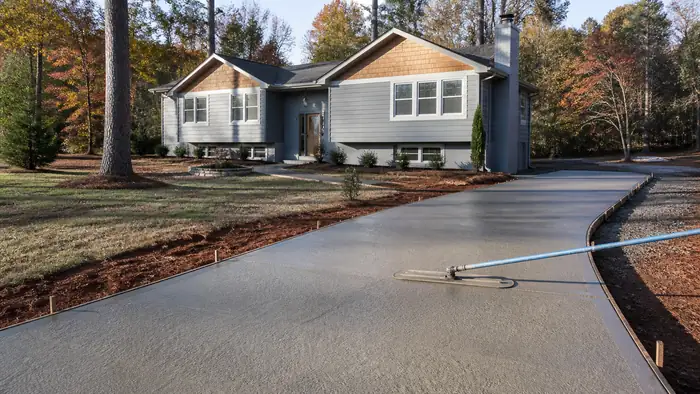
A bull float smooths a residential walkway surface after screeding. at a grey split-level home in Lawrenceville, GA, under low winter sun.

Step 4: Pouring

The truck backs up with a mix ordered for driveway traffic, and we check the ticket before anything goes in the forms. Adding water at the chute makes concrete easier to place and weaker for its whole life, so we don't. The crew places, spreads and screeds in one continuous run to avoid cold joints. On steep lots, we place from the low end up. With about 55" of rain a year here, a pour gets rescheduled rather than rained on.

A hand trowel smooths a small patio surface to a hard finish. at a buff-brick ranch home in Lawrenceville, GA, under bright midday cloud.

Step 5: Finishing

Timing matters more than technique here. We bull float right behind the screed, then wait for bleed water to leave the surface before touching it again. Finish too early and water gets trapped under the top, which later flakes off. Edges get rounded, and control joints go in at spacing that tells the slab where to crack. A broom finish gives tires grip on a sloped drive. Stamped and decorative finishes follow the same timing, with color and release applied first.

A hand sprayer applies curing compound to a finished patio. at a stacked-stone and stucco home in Lawrenceville, GA, after a rain shower.

Step 6: Curing

Concrete gains strength slowly, and the first days decide a lot. We keep the new slab damp or coated with curing compound so the surface doesn't dry faster than the core, which is how shrinkage cracks start. Average daily highs run around 72°F with lows near 53°F, good conditions for curing, though a hot, windy afternoon can still pull moisture out too fast. Foot traffic comes first. Cars wait longer, and we mark the day the driveway is ready for them.

A sprayer applies sealer across a driveway. at a painted-white-brick two-story home in Lawrenceville, GA, after a rain shower.

Step 7: Sealing

Once the slab has cured and dried out, we apply a penetrating sealer that soaks into the surface instead of sitting on top as a film. It slows water and oil from getting in and keeps the concrete an even color. Stamped and colored surfaces usually get an acrylic sealer that deepens the color and needs recoating over time. A sealed driveway sheds water it would otherwise soak up, and in a place that sees about 55" of rain a year, that adds up.

Choosing the Right Concrete System

A crack in a driveway can be closed a few different ways, and the right one depends on what the crack is doing. Hairline shrinkage cracks that have stopped moving take a flexible sealant, routed first so it sits deep enough to hold. Wider structural cracks get an epoxy or polyurethane injection that bonds the slab back together. Where the surface has scaled around the damage, a thin decorative overlay can finish the repair.

We pick the system after looking at the slab, not before. The median home here was built in 1987, so many driveways have had decades to settle, and the real question is whether the concrete is still moving. Slope and runoff matter as well. Gwinnett County is hilly, and about 55 inches of rain a year will find every gap in a surface. Pacolet soil drains well, but it varies, so we test each site on its own.

Most failed repairs come from a mismatch. Rigid epoxy in a crack that still opens and closes will crack again right beside the patch. Sealant pressed into a crack caused by a sunken section only hides the settlement for a while. When the reinforcement underneath has failed, or a section has dropped more than any patch can bridge, we say so plainly and replace that section instead. Call for a free estimate.

How Much Does Concrete Driveway Crack Repair Cost in Lawrenceville?

We price crack repair after we walk the driveway, because two cracks that look alike from the street can need very different work. A hairline crack that has not moved gets cleaned out and sealed. A crack with one side sitting lower than the other means the slab has shifted, and that is a bigger job. These are the things that move the number.

What changes the priceWhich wayWhy
Whether both sides of the crack sit levelLevel costs lessA level crack can be routed and sealed. An offset edge means the base underneath has moved and has to be dealt with first.
Gaps or washed-out gravel along the slab edgesCosts moreWater has carried base material away. That void gets filled before any repair will hold.
Where downspouts and yard runoff landCosts more if they hit the driveWe get about 55 inches of rain a year. Water that runs under the slab reopens the crack, so we reroute it.
Tree roots near the crackCosts moreA root lifting the slab has to be cut back or the section replaced. Sealant over a root does nothing.
Whether a panel has to come outCosts moreA broken-through section gets sawn out, hauled off, and poured new with reinforcement. Removal is real labor.
How a truck reaches the workOpen access costs lessIf a mixer can back up to the section, we pour from the chute. Tight access means wheelbarrows or a pump.
The slope of the drivewaySteeper costs moreMuch of Gwinnett County is hilly. Forming and finishing on a grade takes more setup.
Stamped or colored surfaceCosts moreMatching an existing pattern and color takes more time than a plain broom finish.

When you compare bids, make sure each one describes the same repair. One contractor may quote sealing the crack while another quotes replacing the panel, and those numbers will never line up. Ask what the crack gets filled with, whether the base is addressed, and whether hauling off old concrete is included. A bid that never says what caused the crack is guessing at the fix.

Get a Free Estimate

Get a FREE Quote

Tap to call +1 470-229-2076