+1 470-229-2076
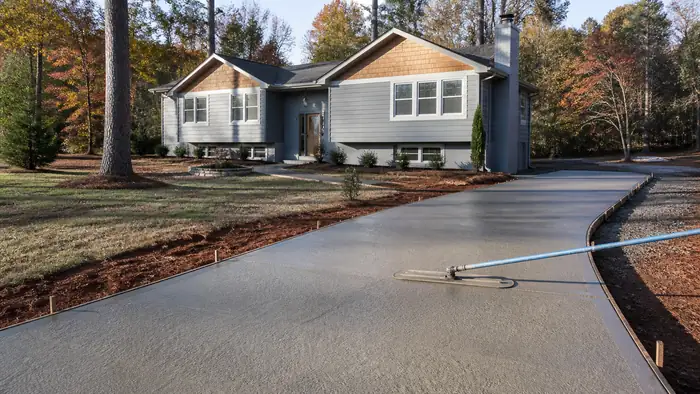
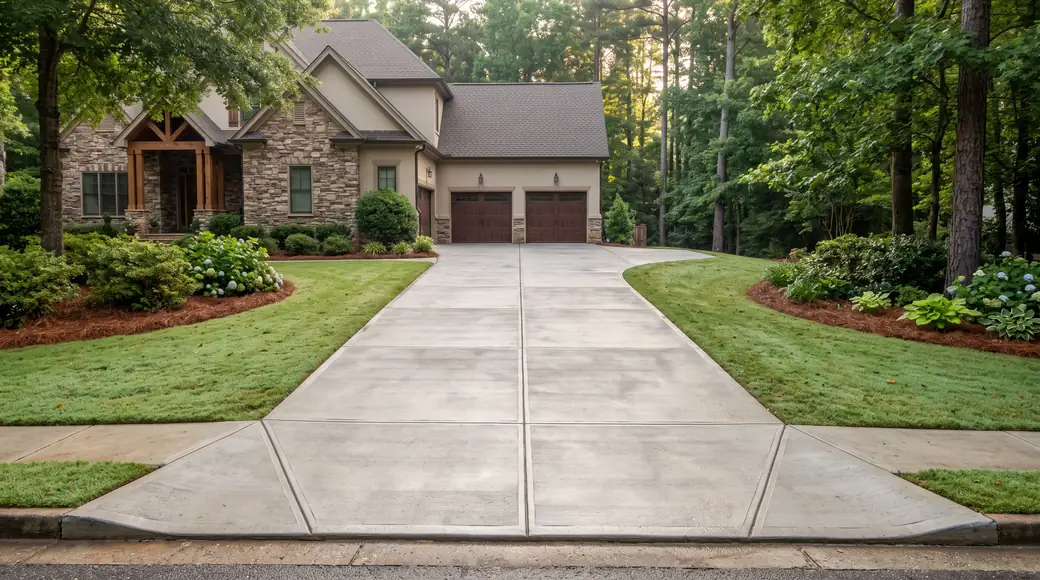
concrete driveway installation completed by a local contractor at a brick-and-siding two-story home in Lawrenceville, GA, in early morning light.

Concrete Driveway Installation in Stonecrest, Georgia

A concrete driveway takes the weight of every car on the property, day after day, and it only holds up if the ground under it was ready before the first truck arrived. That is the part of the job we care about most in Stonecrest. The slab you see is the finish; the base, the grade and the reinforcement underneath decide whether it stays flat. We pour new residential driveways, replace cracked and sunken ones, and add decorative touches like stamped borders where a property suits them. Most people still ask for a plain broom finish, and there is nothing wrong with that. We do both.

Driveways rarely fail at the surface. Water sits where the grade was wrong, the base settles unevenly, and the slab cracks along lines nobody planned. So we test every site individually before work starts, because ground conditions change from one lot to the next and a guess is how problems begin. We set the slope so water runs off, compact the base, and cut control joints so the concrete cracks where we choose instead of where it likes. None of that shows once the surface cures. You notice it years later, when the driveway still sits the way it did the week it went in. Call us for a free estimate.

Call +1 470-229-2076

Get a FREE Quote

What We Do in Stonecrest

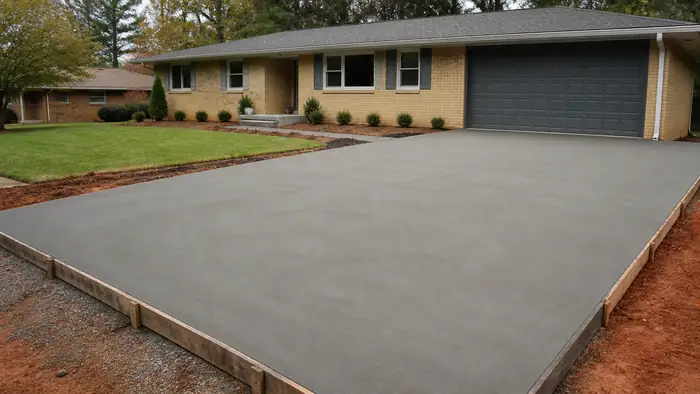
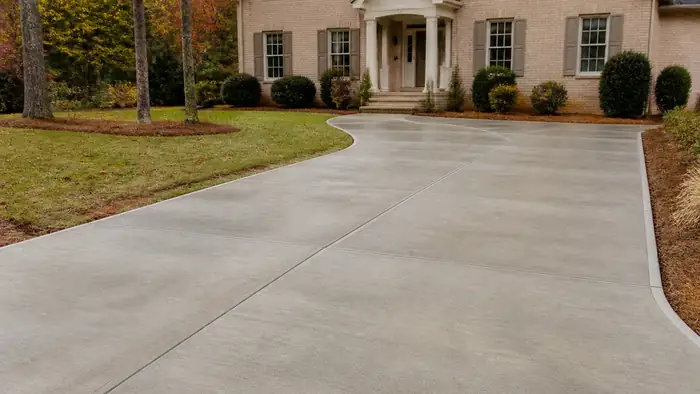
concrete slab installation completed by a local contractor at a tan-brick colonial in Lawrenceville, GA, under bright midday cloud.

Concrete Slab Installation Cost

What a slab costs comes down to what it has to carry and what sits under it. A 4-inch slab for a shed or patio takes less concrete and lighter reinforcement than a 6-inch slab for a workshop or RV pad with rebar set on chairs. Excavation, gravel base depth, forming and how close the truck can get to the pour all move the figure. We measure every site before we price it. Call for a free estimate.


Concrete Driveway Installation

Most residential driveways we pour are 4 inches thick, going to 5 or 6 where heavy trucks park or turn. We compact a gravel base, set rebar or wire mesh, and pitch the surface so water runs off instead of sitting against the garage. Control joints are cut at regular spacing, because concrete shrinks as it cures and the joints tell it where to crack. Broom finish is standard. Stamped and exposed aggregate are there if you want them.

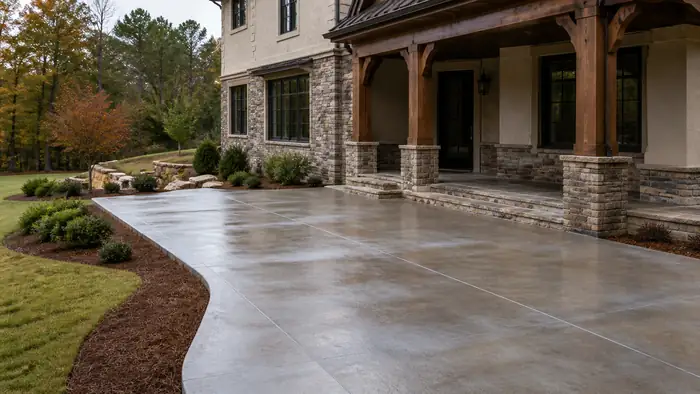
concrete flooring installation completed by a local contractor at a charcoal farmhouse-modern home in Lawrenceville, GA, after a rain shower.

Concrete Flooring Installation

Inside a building, moisture does more damage than weight. Garage, basement and shop floors go down over a vapor barrier so ground moisture stays out of whatever sits on top, whether that is tile, glue-down flooring or stored equipment. We finish with a steel trowel for a hard, tight surface. From there it can be sealed, polished or coated in epoxy. Skip the barrier and the floor can look fine for a year before the covering starts lifting.

concrete slab repair completed by a local contractor at a grey split-level home in Lawrenceville, GA, under low winter sun.

Concrete Slab Repair

Not every cracked slab needs tearing out. Hairline shrinkage cracks can be routed and sealed. A section that has sunk can often be lifted back to level, and a flaking surface can take a bonded overlay if the concrete beneath is sound. We look for the cause first: a downspout dumping water at the edge, a poorly compacted base, roots pushing up. When the base has washed out or the slab has broken into pieces, patching will not hold, and we say so.

concrete sidewalk installation completed by a local contractor at a stacked-stone and stucco home in Lawrenceville, GA, at blue hour.

Concrete Sidewalk Installation

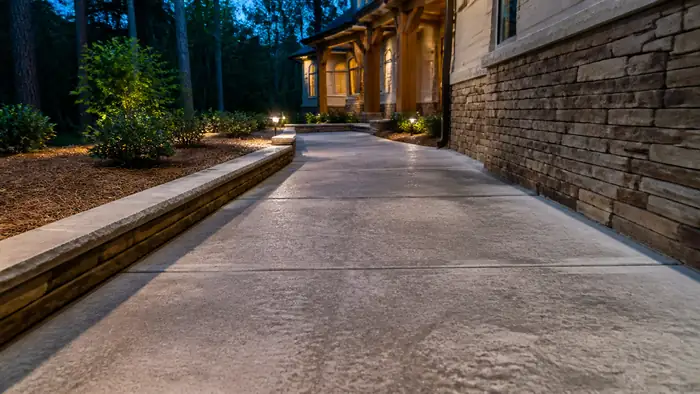
Sidewalks and front walks carry foot traffic, not cars, so 4 inches of concrete over a compacted base does the job. We give each walk a slight cross slope so rain sheds to the side instead of pooling, and we tool the edges so they do not chip. Joints go in at about the width of the walk, keeping the squares even. Where a new walk meets steps or a driveway, an expansion joint lets each piece move on its own.

Our Concrete Process, Step by Step

A contractor checks slope and drainage before work begins. at a charcoal farmhouse-modern home in Lawrenceville, GA, at blue hour.

Step 1: Site Assessment

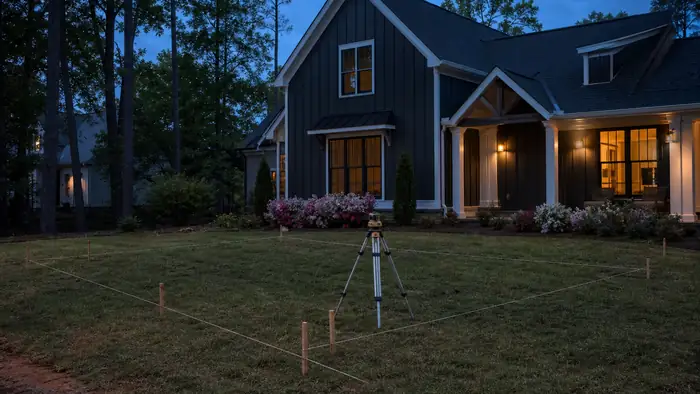
We start by walking the property with you and looking at where the water goes. Low spots, downspouts that empty onto the old driveway, tree roots under the edge, and the grade from the garage down to the street all shape the new slab. We test the soil on every site before work starts, because ground that looks firm can hide soft fill. Then we mark the layout, talk through thickness and finish, and write down what we found.

A plate compactor tamps down soil in a small excavated area. at a grey split-level home in Lawrenceville, GA, at blue hour.

Step 2: Site Preparation

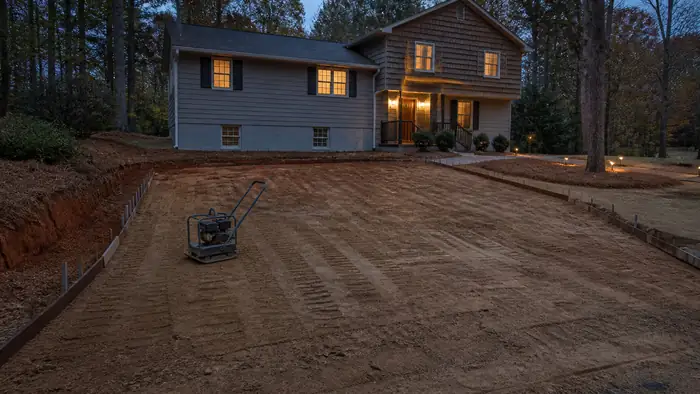
Most driveway failures begin under the concrete, not in it. We tear out the old surface, dig past the topsoil and anything organic, and haul it off. Soft pockets get dug out and replaced with good material. Then we lay a crushed stone base, bring it to grade, and compact it in lifts with a plate compactor until it stops moving underfoot. The base gets a slight fall away from the house so rain runs off instead of sitting against the foundation.

Wooden forms outline a patio slab before the pour. at a buff-brick ranch home in Lawrenceville, GA, under an overcast sky.

Step 3: Forming & Reinforcement

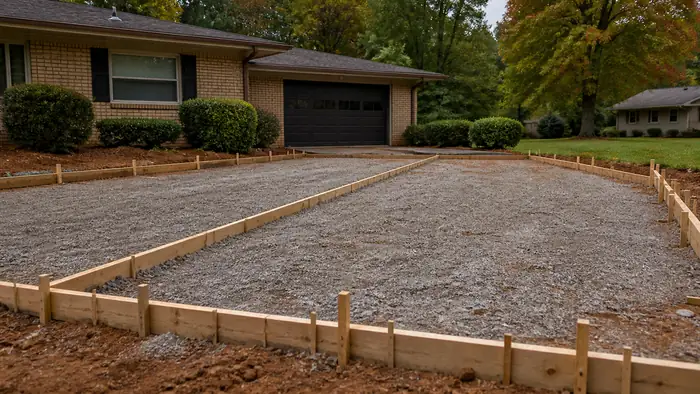
Forms go in next: straight lumber for the long runs, bendable stock for curves, staked tight and checked against a string line so the finished edge stays true. Inside the forms we set rebar or welded wire on chairs, and the whole point is to hold the steel in the middle of the slab. Reinforcement lying in the dirt does nothing. Where the driveway meets the garage floor or the street apron, expansion joint material lets each slab move without cracking its neighbor.

A bull float smooths a residential walkway surface after screeding. at a grey split-level home in Lawrenceville, GA, under low winter sun.

Step 4: Pouring

Ready-mix arrives from the plant with the mix we ordered, and we check it before it leaves the chute. Water added on site makes concrete easier to place and weaker once it sets, so we do not thin it down for convenience. We place it in sections, working it into the corners and around the steel, then screed it level with the tops of the forms. On a hot afternoon the crew moves quickly, because the truck and the sun set the pace.

A hand trowel smooths a small patio surface to a hard finish. at a buff-brick ranch home in Lawrenceville, GA, under bright midday cloud.

Step 5: Finishing

Timing matters more than technique here. We bull float the surface to push the stone down and bring the cream up, then wait for the bleed water to leave before touching it again. Finishing too early traps that water, and the top scales off a season or two later. Control joints get cut or tooled at regular spacing so cracks form in a straight line where we chose. Driveways get a broom finish for grip, while stamped and decorative surfaces get their pattern and color now.

A hand sprayer applies curing compound to a finished patio. at a stacked-stone and stucco home in Lawrenceville, GA, after a rain shower.

Step 6: Curing

Concrete does not dry out to harden. It cures, and it needs moisture to do it. For the first several days we keep the slab damp or covered with a curing compound so the surface does not lose water faster than the inside. A slab that dries too quickly shows it later in fine surface cracks and a dusty, weak top. Foot traffic can come back within days. Cars wait longer, and heavy trucks longer still, because full strength builds over weeks.

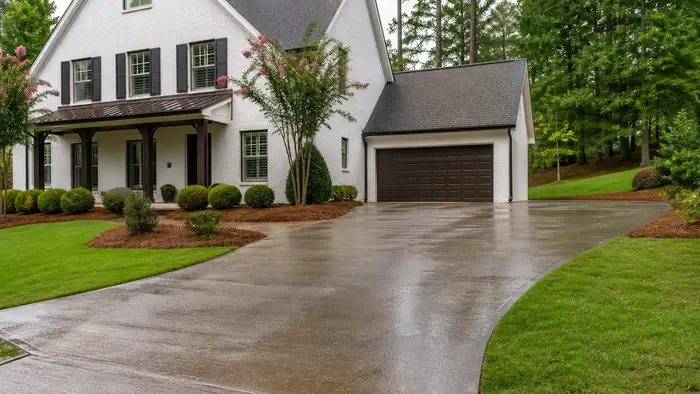
A sprayer applies sealer across a driveway. at a painted-white-brick two-story home in Lawrenceville, GA, after a rain shower.

Step 7: Sealing

Once the slab has cured, a penetrating or acrylic sealer goes on to slow down water, oil and staining. With about 55 inches of rain a year, keeping water out of the surface is worth the effort. Stamped and colored concrete benefits the most, because sealer deepens the color and protects the texture of the pattern. We apply it in thin coats with a sprayer or roller on a dry day. Sealer wears with traffic and weather, so plan on resealing every few years.

Concrete Systems and Materials for Stonecrest

A driveway is a system, not just a slab. Under the concrete sits a compacted gravel base, and under that sits the soil, which we test on every site before work starts. What sits below a slab decides how long the surface stays flat. We set the base depth and the reinforcement (steel rebar or wire mesh) to match what the test shows and what the driveway has to carry, whether that is two cars or a loaded work truck.

Water is the other half of the job. The area sees about 55 inches of rain a year and around 2 inches of snow, so we plan drainage before the first truck arrives. Every driveway gets pitched to shed water away from the house and garage. We cut control joints at set spacing so the slab cracks where we choose, along a straight line, instead of wandering across the middle. The mix gets matched to pour-day weather, because heat and rain both change how concrete sets.

Finish comes last, and it is where most owners spend their time deciding. A broom finish gives grip on a sloped driveway and is the easiest to keep up. Stamped and decorative concrete can take the look of stone, brick or slate, with color worked into the surface. Stamped work needs sealing, and resealing every few years, to hold its color. Fair warning: most driveway failures trace back to a thin base, light reinforcement or missing joints, not to the finish.

What Decides the Price of Concrete in Stonecrest

Two driveways of the same size can land far apart on price, and most of the difference sits in plain sight on the property. It comes down to what has to be removed, how concrete reaches the forms, and what the slab needs to carry. Walk your own driveway with this list and you will have a fair idea of where your project falls.

What changes the priceWhich wayWhy
An old slab or asphalt that has to come outcosts moreBreaking it up, loading it and hauling it off takes labor and truck time before any new work starts.
A mixer truck can back right up to the formscosts lessChuting concrete straight off the truck is faster than pumping it or wheeling it in by the load.
Narrow gates, fences, landscaping or overhead lines between the street and the workcosts moreWe may need a pump truck or extra hands to move concrete across the site.
A work truck, trailer or RV parks on itcosts moreThe slab goes thicker and the reinforcement gets heavier to carry the load.
Water pools on the old surface or runs toward the garagecosts moreRegrading, a drain or extra base stone has to go in so the new surface sheds water, and this area sees about 55 inches of rain a year.
Soft spots, roots or loose fill under the old surfacecosts moreWe test every site before work starts, and poor subgrade has to be dug out and replaced with compacted base.
Curves, flares or tie-ins to a garage floor, walkway or street aproncosts moreEach one means more forming, more cutting and more careful finishing at the joint.

When bids come in, lay them side by side on the same points: slab thickness, the reinforcement (rebar, wire mesh or fiber), how deep the base stone goes and how it gets compacted, whether removal and haul-off are included, and where the control joints will be cut. A lower number that leaves one of those out is pricing a different driveway.

Common Questions From Stonecrest Owners

Is Lawrenceville Best Concrete licensed, insured, and bonded?

That is something to confirm on paper before any contractor starts work, us included. Ask for the license and insurance certificates at the estimate, and read the names and dates on them rather than taking anyone's word for it. Call the insurer listed to check that the policy is active. For bonding, ask who issued the bond and what it covers. A contractor who is set up properly will not mind the questions.

Does Lawrenceville Best Concrete build retaining walls for hillside properties?

Yes. A retaining wall holds back soil and water, so we treat it as structural work, not decoration. Every site is tested individually before work starts, and that result shapes the footing, the steel reinforcement and the drainage behind the wall. Walls tend to fail when water builds up behind them with nowhere to go. That is why we lay drain rock and a perforated pipe along the back. Taller walls may need an engineer's design first.

What areas beyond Stonecrest do you serve?

Stonecrest is one part of a wider map. We take residential and commercial concrete work across metro Atlanta, in towns such as Conyers and the others listed on this page, and every one of them gets the same crew, the same materials and the same process. Short on time? Check the list. If your property sits near one of those towns and you are not sure whether it counts, call and ask.

What's the difference between acid stain and water-based stain?

Acid stain reacts with the lime in cured concrete. The color it leaves becomes part of the surface: mottled, translucent, in a short range of browns, tans and muted greens, and no two slabs come out alike. Water-based stain does not react. It carries pigment into the pores instead, which gives a wider palette, a more even result and fewer fumes on site. Both need a sealer over them. Both also show every flaw in the slab underneath.

How much does it cost to install a 4-footconcrete retaining wall in Stonecrest?

We price every wall after seeing the site, because two walls of the same height can be very different jobs. Length drives most of it. After that come the footing, how much reinforcement the wall needs, the drainage behind it, how easily a truck and crew can reach the spot, and whether the face is plain or decorative. A wall in a tight Stonecrest backyard and one along an open driveway are not the same project. Call for a free estimate.

How does the crew minimize downtime and maintain commercial site safety during active business operations in Stonecrest?

Planning comes first. Before we pour on a working commercial property, we map which entrances, parking rows and walkways have to stay open, then phase the project so the business keeps running while one section is closed. Work zones get barricades, cones and clear signage. Fresh slabs stay taped off until they can carry traffic. Where noisy work would bother customers, we schedule it for quieter hours if the owner asks.

Get a Free Estimate

Get a FREE Quote

Tap to call +1 470-229-2076