+1 470-229-2076
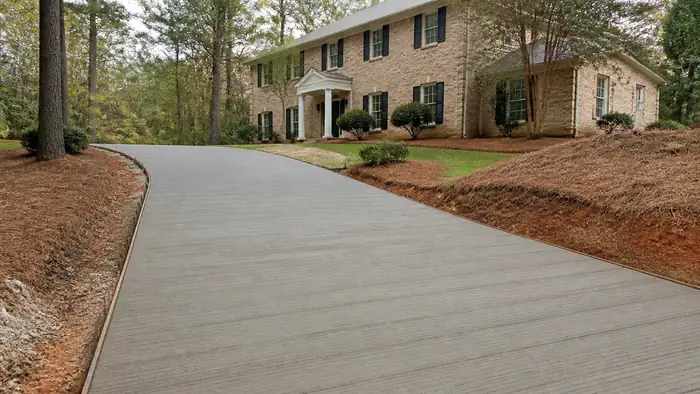
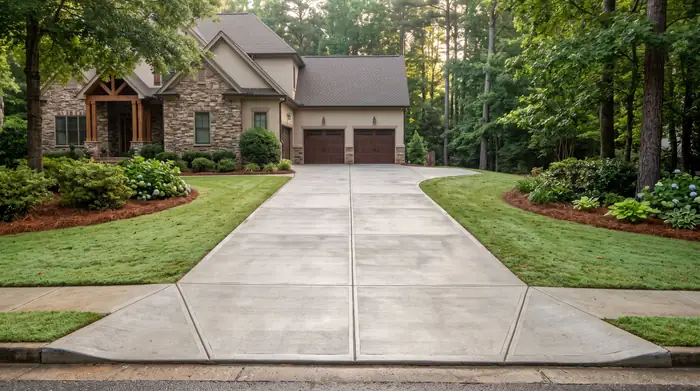
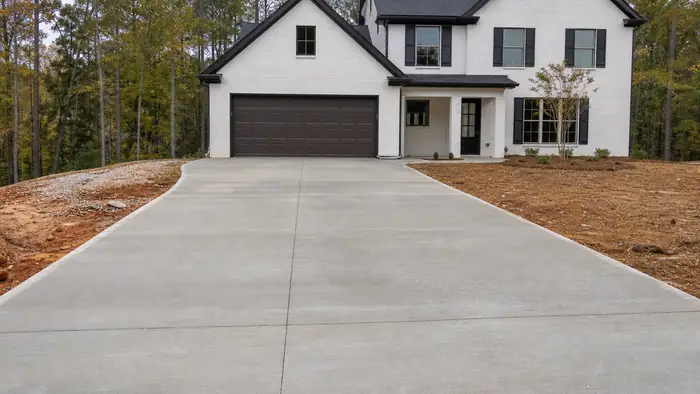
Wide view of finished concrete flatwork across the front of a home at a buff-brick ranch home in Lawrenceville, GA, in clear late-morning sun.

Lawrenceville Best Concrete: Residential & Commercial Repair & Resurfacing, Driveways, Patios & Retaining Walls

We are a concrete contractor in Lawrenceville, Georgia, and most of what we do is flatwork: driveways, patios, walkways, and slabs for sheds, shops and additions. We pour new work, and we tear out and replace concrete that has cracked, settled or spalled past the point where patching is honest. A broom finish is still the most common thing we set forms for, though stamped concrete comes up often on patios and entries. If a sidewalk has heaved at one joint, we will tell you whether that is a two panel fix or the whole run.

Permits for this work go through the City of Lawrenceville, and we pull them ourselves rather than leaving the paperwork with the homeowner. The median home here was built in 1987, so plenty of original driveways have had decades to move, and a good share of our calls are about concrete poured long before the current owner bought the house. We walk the job with you, measure it, and say plainly what has to come out and what can stay. Call for a free estimate.
Call +1 470-229-2076

Licensed, Bonded, and Insured ยท A combined 15 years of experience

Get a FREE Quote

We warranty all of our work because we believe in what we do.

Concrete Services Across metro Atlanta

We pour flatwork across metro Atlanta: driveways, patios, and the concrete sidewalk that ties a front walk to the street. Commercial concrete too, lots and loading areas. Stamped concrete when a plain slab is not the look.

Distance does not change the build. Whether a concrete installation sits in Lawrenceville or out toward Duluth, the forms get set square, the base gets compacted, and the pour runs the same way.

Commercial and Industrial Concrete in Lawrenceville

Concrete walkway and entry paving at a suburban office building in Lawrenceville, GA, under bright midday cloud.

Offices & Corporate Properties

Entry walks take the most abuse on an office property, because every visitor and every employee crosses them twice a day. We pour sidewalks at four inches over compacted base, with wire mesh or fiber, and cut joints early so cracking lands where we put it. The concrete driveway coming in off the street carries delivery weight and gets a thicker section. Panels lifted by tree roots get cut out and replaced rather than patched.

Concrete sidewalk and parking-lot island paving at a retail center in Lawrenceville, GA, under bright midday cloud.

Retail & Shopping Centers

Drive aisles and dumpster pads fail first at a shopping center, and usually for the same reason: they were poured at the depth of a residential driveway. Truck traffic wants eight inches with #4 rebar on chairs, over base that has been proof rolled. We stage the work in sections so storefronts stay reachable. Cart wheels polish a walk slick over time, so we finish with a broom for grip.

Concrete patio slab and service apron behind a restaurant in Lawrenceville, GA, in early morning light.

Restaurants & Hospitality

Kitchen doors, grease and constant foot traffic are hard on flatwork. We broom finish the paths staff actually walk and save stamped or colored concrete for the patio where guests sit. Sealer matters more here than almost anywhere, because oil soaks into bare concrete and never fully comes out. Dumpster pads get eight inches and rebar. Patio slabs get pitched away from the building so water leaves instead of standing.

Concrete loading dock apron and truck pad at a distribution building in Lawrenceville, GA, in late afternoon light.

Warehouses & Distribution

Forklift wheels destroy joint edges long before they destroy a slab. On distribution buildings around Lawrenceville and Duluth, we dowel construction joints, saw control joints the day the slab goes down, and fill the joints that take wheel traffic with a semi-rigid filler. Dock aprons get a thicker section and heavier steel than the interior floor. Where joints have already ravelled, we saw out the damaged strip and repour it.

Concrete entry walk and ADA ramp at a medical office building in Lawrenceville, GA, after a rain shower.

Medical & Dental Offices

Patients arrive on walkers, canes and wheels, so a quarter inch lip in a sidewalk is a real problem, not a cosmetic one. We replace heaved panels, keep cross slope gentle at landings, and hold the finish smooth without letting it get slick. Concrete installation gets sequenced around appointment hours with a walkable route kept open. Ramps and entry landings take rebar instead of mesh, since the load concentrates.

Concrete sidewalk network between buildings at an apartment community in Lawrenceville, GA, under an overcast sky.

Multi-Family & HOA Properties

Much of the housing here dates to the late 1980s (the median home was built in 1987), and flatwork from that era is at the end of its service life. We replace driveways, sidewalks and mailbox pads panel by panel, matching the existing finish so new work does not read as a patch. Exposed aggregate pool decks can often be resurfaced where the slab underneath is still sound. Scope gets written by panel count, so a board can phase it.

Residential Concrete Work in Lawrenceville, GA

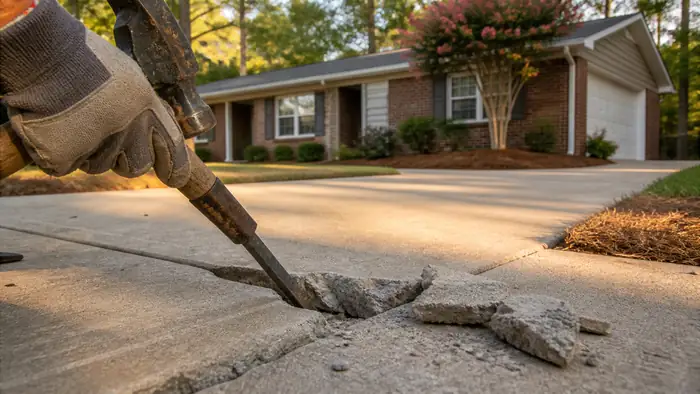
Replaced concrete driveway panel with clean saw-cut edges at a brick-and-siding two-story home in Lawrenceville, GA, under an overcast sky.

Repair, Leveling & Resurfacing

Most of what we repair is original flatwork on houses built around 1987, now sitting on ground that has shifted under it. We slab-jack sunken sections back to grade, saw out panels that have cracked past repair, and resurface spalled or flaking concrete with a bonded overlay. Surface scaling and hairline cracking usually resurface well. Wide cracks with a vertical lip mean the base failed, and an overlay over a failed base fails again.

Broom-finished concrete driveway running up to a two-car garage at a stacked-stone and stucco home in Lawrenceville, GA, in early morning light.

Driveway Installation & Replacement

We pour concrete driveways at four inches over a compacted base, thickened to five or six inches where a truck or trailer parks. Rebar on chairs or wire mesh pulled up into the pour, never left lying on the dirt. Control joints go in early, cut at roughly the slab width, because concrete cracks and joints decide where. Old driveways from the late eighties usually come out because their base is gone, not their surface.

Rectangular concrete patio with a low step up to the rear door at a painted-white-brick two-story home in Lawrenceville, GA, under bright midday cloud.

Patio Construction & Outdoor Living

A patio slab is four inches thick with wire mesh or fiber, sloped away from the house so water leaves instead of pooling at the door. Broom finish, exposed aggregate, stamped and colored concrete all work here. Stamped needs a release agent and a sealer that gets renewed. We isolate the slab from the foundation with an expansion joint so the two move independently, which is what keeps a patio from cracking at the wall.

Board-formed concrete retaining wall holding a raised lawn at a tan-brick colonial in Lawrenceville, GA, in late afternoon light.

Retaining Wall Construction

Walls fail from water, not weight. We build with drainage behind the wall: washed stone, filter fabric, and a perforated drain line daylighted to somewhere it can actually run. Footings sit on compacted, undisturbed ground, cut wide enough for the load the wall carries. Poured walls get vertical and horizontal rebar tied into the footing. Anything tall or holding back a driveway gets engineered, and we tell you that before we quote instead of after.

Square-edged concrete slab pad with a storage shed on it at a red-brick ranch home in Lawrenceville, GA, in late afternoon light.

Concrete Slabs & Pads

Shed slabs, garage floors, HVAC pads, hot tub pads and dumpster pads. Thickness follows the load: four inches for a shed, five or six with heavier rebar for equipment or vehicles. Every slab gets a compacted stone base and a vapor barrier where anything sits on it that minds moisture. We form the edges square, screed flat, and check for drainage before the truck shows up rather than after the pour.

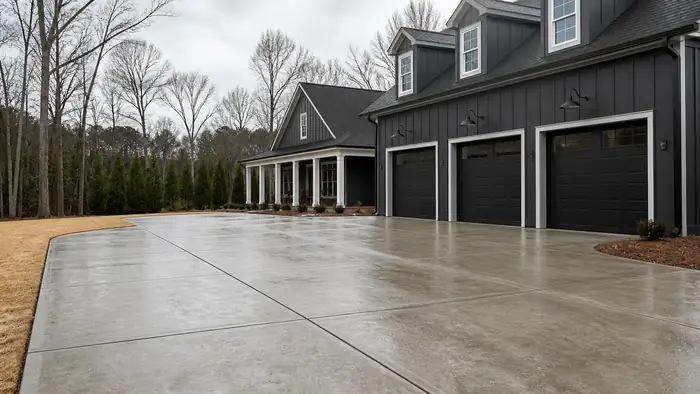
Poured concrete foundation wall and footing for a room addition at a charcoal farmhouse-modern home in Lawrenceville, GA, after a rain shower.

Foundation Pouring & Repair

We pour footings and stem walls for additions, garages and new detached structures, sized to the load and the soil we find when we dig. On existing houses the calls are usually settlement cracks, spalling at grade, or a wall bowing inward. We open it up, look at what water is doing around the house, and fix the drainage along with the concrete. Patching a foundation crack without solving the water just moves the crack.

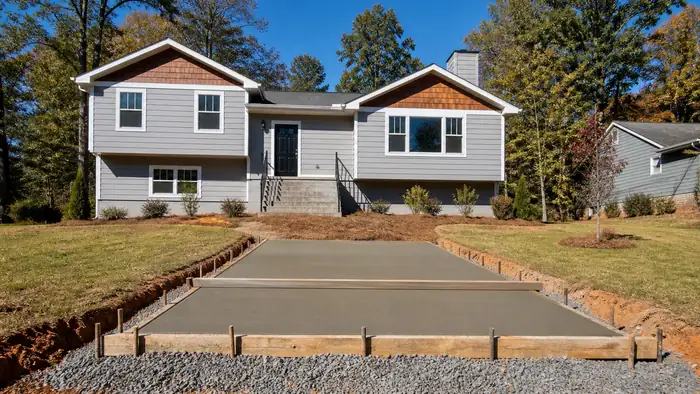
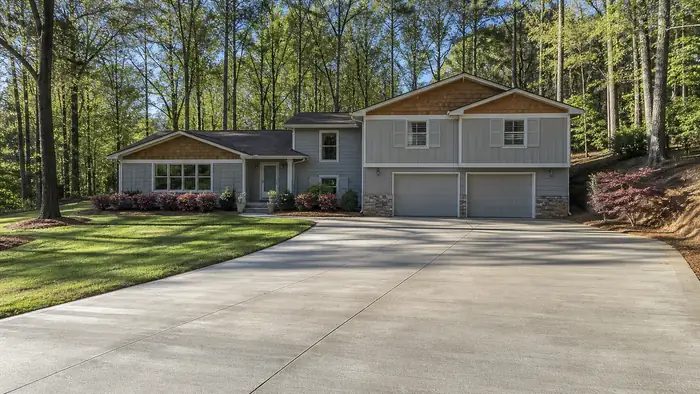
Poured concrete front steps rising to a landing at the front door at a grey split-level home in Lawrenceville, GA, under an overcast sky.

Steps, Stoops & Landings

Steps take more abuse than anything else on a house, and they are what people notice first. We pour on a compacted base with rebar tied through the footing so the steps and the stoop move as one piece. Consistent riser height matters. Old stoops from this era commonly pull away from the house because they were poured on backfill that kept settling; those get rebuilt, not patched.

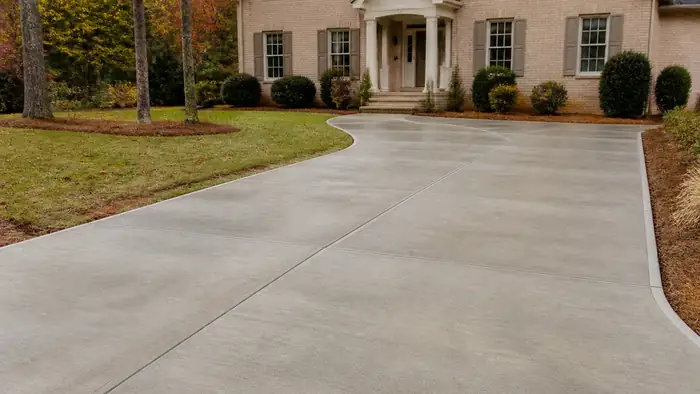
Concrete walkway meeting the driveway apron and front steps at a buff-brick ranch home in Lawrenceville, GA, under bright midday cloud.

Walkway & Sidewalk Installation

Sidewalk installation runs four inches thick over compacted stone, with wire mesh or fiber and joints tooled or saw cut at regular spacing. We set the grade so water sheets off instead of standing, and we hold the walk away from tree roots when we can. Concrete sidewalk installation around older landscaping often means rerouting a path a few feet. Broom finish for traction, or exposed aggregate if you want the texture.

Poured concrete curbing with a rolled profile along a driveway edge at a brick-and-siding two-story home in Lawrenceville, GA, under bright midday cloud.

Curbing & Edging

Poured concrete curbing gives beds and driveway edges a clean line that holds mulch in and mowers out. We extrude or hand-form it, cut control joints every few feet so it cracks where we decide, and match color or a light stamped texture to whatever concrete work is already there. Edging poured too thin or set on loose soil breaks apart under a mower wheel within a season or two.

What You Get When You Hire Lawrenceville Best Concrete

You get the same crew from layout to final finish, not a salesman on Monday and strangers with a mixer on Wednesday. We will tell you plainly whether a slab can be repaired or whether it has moved too far and needs to come out. That answer sometimes costs us the bigger job. We give it anyway, because a patch laid over a failed base cracks along the same line again, and then you have paid twice for one problem. Every square foot of concrete work gets measured, formed and poured by people who have to look at it afterward. Ask us anything about the build and you will get it in plain language.

Underneath the finish sits the part you never see, and it decides how long the rest holds. We dig out soft spots in the subgrade and compact what remains before a single form goes up. Flatwork gets rebar tied and set on chairs, lifted off the grade where steel actually does its job, instead of laid flat on dirt and covered over. Control joints go in early, at spacings that suit the pour. Edges come out straight. Around here the median house dates to 1987, so a lot of the concrete we look at is original, and an old driveway usually has good sections and bad ones. We will show you which is which before anyone starts breaking anything.

Our Concrete Process, Step by Step

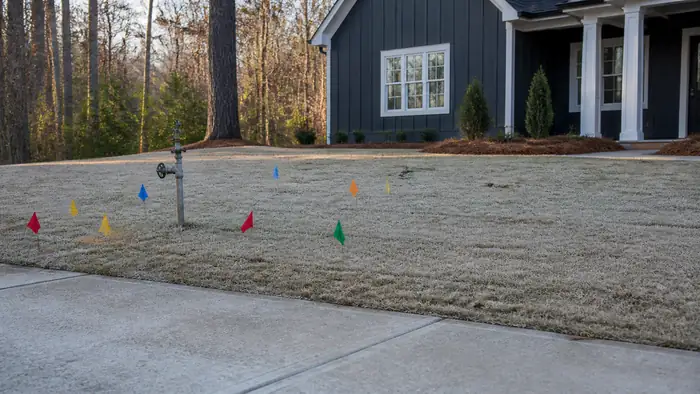
String lines and grade stakes laid out across a yard before a pour at a tan-brick colonial in Lawrenceville, GA, under bright midday cloud.

Step 1: Site Evaluation

We walk the area with you and look at what the concrete has to do. Where water runs, how far the truck can back in, what the existing slab is doing at its edges. On a driveway we check the grade from the street to the garage door and dig at the edge to see what the subgrade is: undisturbed dirt, uncompacted fill, or something soft that has been holding a settled slab up badly for years. We measure, note thickness, and talk through finish options.

Concrete driveway and walk at a home, the kind of job an estimate covers at a red-brick ranch home in Lawrenceville, GA, under bright midday cloud.

Step 2: Written Estimate and Permits

You get the scope in writing: square footage, slab thickness, reinforcement, finish, joint layout, and how we handle haul-off of the broken concrete. If the work needs a permit, we tell you before anything starts. Estimates are free. Bring us a bid you already have and we will tell you plainly what it does and does not include, because thickness and steel are where numbers usually differ.

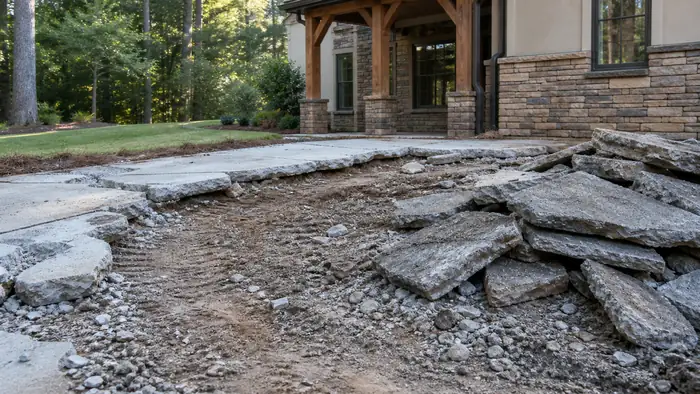
Broken-out concrete removed and the base rebuilt before a new pour at a charcoal farmhouse-modern home in Lawrenceville, GA, in early morning light.

Step 3: Demolition and Base Prep

Old concrete comes out in full. We break it, load it, and haul it off rather than pouring over a failed slab, since a new pour on top of a bad base cracks the same way the old one did. Then the base gets cut to depth, graded to drain away from the house, and compacted in lifts. Soft spots get dug out and replaced with crushed stone. Most failures we are called out for start here.

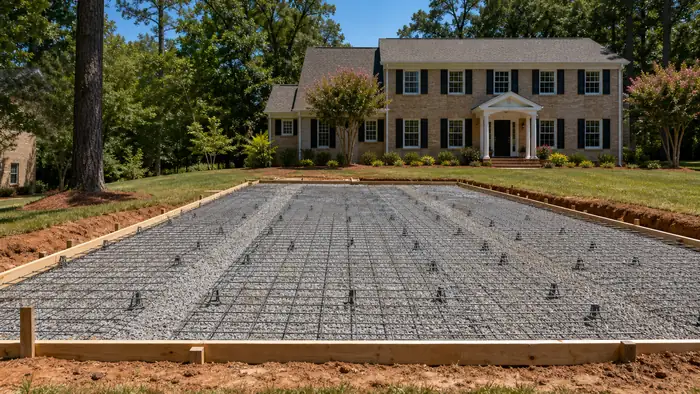
Wooden forms and rebar grid set and tied, ready for concrete at a grey split-level home in Lawrenceville, GA, in late afternoon light.

Step 4: Forming, Steel and the Pour

Forms go in straight and set to the grade we measured, staked tight so nothing bows when the concrete pushes against them. Driveways get rebar on chairs, tied in a grid, sitting up in the middle of the slab where it does work. Lighter flatwork may take wire mesh instead. We pour full depth, screed, and run a bull float. Concrete driveways carry vehicle loads, so thickness and steel are not places to save.

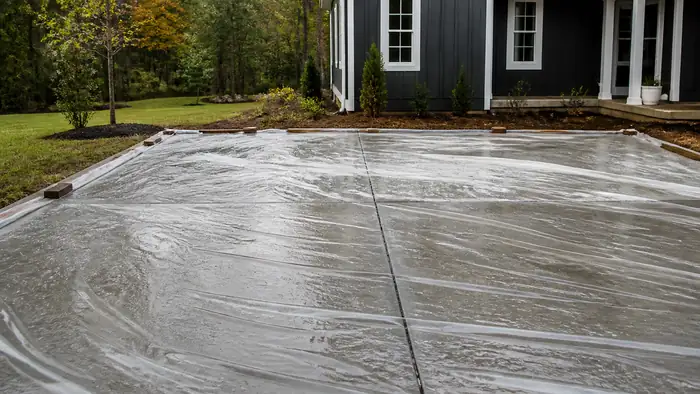
Freshly finished concrete slab curing under a clean broom texture at a buff-brick ranch home in Lawrenceville, GA, after a rain shower.

Step 5: Finishing, Curing and Final Walkthrough

Finishing depends on what you picked: broom for grip, exposed aggregate washed at the right hour, stamped and colored while the surface is still workable. A concrete patio gets its texture and joints laid out so cracks land where we put them. Control joints are cut early, not whenever. Then the slab cures, and we tell you when to walk it, when to park on it, and what to keep off it.

Top Decorative Concrete Styles for Lawrenceville Homes

Polished concrete floor with a satin sheen in a finished interior room at a painted-white-brick two-story home in Lawrenceville, GA.

Polished Concrete Floors

Polished concrete floors start with the slab you already have. We grind with diamond pads, moving from a coarse cut through fine resin steps, then densify and seal so the surface stops dusting. How much stone shows depends on how deep the first cut goes: cream finish, salt and pepper, or full aggregate. Old adhesive, patched trenches and hairline cracks telegraph straight through a polish, so we read the slab before anyone picks a look.

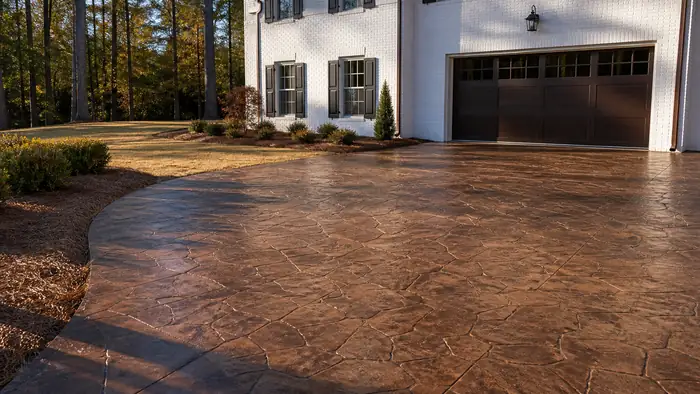
Stamped concrete patio in a running-bond brick pattern at a painted-white-brick two-story home in Lawrenceville, GA, under bright midday cloud.

Stamped Concrete Patterns

We press mats into the concrete while it is still plastic, running slate, ashlar cut or wood plank across a four inch pour with fiber or wire mesh in it. Color goes in the mix and on the surface, and a release powder shades the grooves. Median household income here is $58,606 against $74,664 statewide, so most homeowners stamp one patio or front landing and leave the driveway a plain broom finish.

Acid-stained concrete patio in mottled earth tones at a tan-brick colonial in Lawrenceville, GA, after a rain shower.

Stained Decorative Concrete

Acid stain reacts with the lime in cured concrete and leaves mottled, uneven color that reads closer to stone than paint. Water based dyes produce flatter, more predictable colored concrete across a wider range of tones. Neither hides much. Patched cracks, sealer residue and hard troweled spots all pull color differently, and that shows. On any older slab we stain a test panel in a corner first, then decide.

Exposed aggregate concrete driveway showing washed river-rock stone at a red-brick ranch home in Lawrenceville, GA, under an overcast sky.

Exposed Aggregate Finishes

Exposed aggregate starts with a retarder sprayed on fresh concrete, then a wash the next morning that strips the top paste and leaves the stone standing proud. The texture holds grip in rain, which is why it turns up in concrete sidewalk installation and on sloped drives. Wash too aggressively and stones pop loose along the edges. Plan on resealing every few years, otherwise the surface dulls out and starts feeling gritty.

Where We Work Around Lawrenceville

We work Lawrenceville and the neighborhoods that run out toward Suwanee, all of it on the same terms. Much of the housing here dates to around 1987, so tired flatwork is a steady part of what we pour.

  • Driveways, aprons and turnarounds, torn out and replaced
  • Concrete slab installation for garages, sheds and additions, tied with rebar or wire mesh
  • Exposed aggregate patios, walkways and pool decks
  • Sidewalk repair where a slab has lifted or cracked through

Outside that ring, call anyway. We take the drive when the job fits.

What Concrete Costs in Lawrenceville, GA

Square footage is the smallest part of what a concrete job costs. Thickness moves the number, and so does reinforcement, because wire mesh and rebar are not the same spend and do not produce the same slab. Tear-out of an old driveway adds labor and hauling. Subgrade prep adds more, and it is the part that decides whether the concrete is still flat in ten years. Access counts too. A truck that cannot reach the pour means the concrete gets carried.

Formwork is where two bids quietly separate. A rectangular patio forms fast. Curves, steps, thickened edges and a decorative concrete finish all take hours of setup before a single truck arrives, and the finish work continues after the pour. Two slabs of identical size can carry very different labor, and a total on a page rarely tells you which one you are buying. Ask every contractor to put the following in writing, then read the bids side by side:

  • Slab thickness, and whether reinforcement is wire mesh, rebar, or nothing
  • How the subgrade is prepared and compacted, and what base material goes down
  • Who removes and hauls the old concrete
  • Control joint spacing, and whether joints are cut or tooled
  • What the formwork covers: straight runs, curves, steps, thickened edges
  • The finish: broom, exposed aggregate, stamped, colored
  • What the bid excludes

Median household income here is $58,606, against $74,664 across Georgia, so a driveway is a real decision and we treat it that way. A low bid is usually low for a reason the specifications will show you. Concrete slab installation priced thin and unreinforced sells you the second pour along with the first.

Getting a Quote From Lawrenceville Best Concrete

Call or send a message with the rough dimensions and what you want the concrete to do. We look at the site before we put a number on it. Access matters, and so does what is already in the ground. Residential concrete and commercial jobs get the same visit, here in Lawrenceville or out toward Duluth. Photos help, but we would rather see it.

The quote spells out slab thickness, whether we are using rebar or wire mesh, how the subgrade gets prepared, and the finish. Decorative concrete takes an extra conversation, since stamped and colored work involves choosing a pattern and a color. Concrete patios often change shape once we stand in the yard. Ask anything about the concrete construction itself. We would rather answer it early.

The Failures We Are Called Out For Most

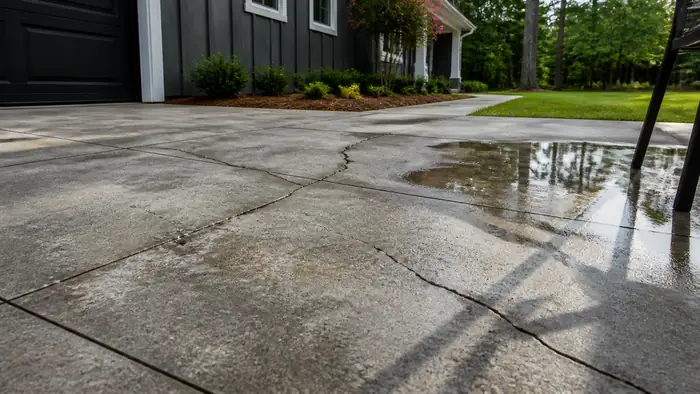
Cracked driveway panels come up most, followed by slabs that have settled at one corner and concrete patios that have pulled away from the house. We also get called out for sidewalk sections lifted at the joints, surfaces flaking off in sheets, and rust stains bleeding up through the top. The median home here was built in 1987, so a good share of the original flatwork is still in the ground, and concrete that old has usually spent decades doing exactly what it was always going to do.

Most of what fails traces back to what happened under the slab rather than anything on top of it. Base that was never compacted leaves voids, and the concrete bridges them until it cannot. Pours run thin at the edges, which is where delivery vans and turning tires put the most load. Rebar and wire mesh get left out, or laid flat on the dirt instead of set up in the pour. Control joints cut too late, or spaced too far apart, let the slab pick its own crack line.

Getting it right is not complicated. It is mostly work nobody sees: digging out and compacting the base, setting reinforcement at the right height, choosing concrete mixes suited to the job instead of whatever pours easiest, cutting joints on schedule, and letting the slab cure instead of rushing traffic onto it. Some concrete projects are a real repair, a few panels pulled and replaced and matched to what stays. Others are past that point, and we will tell you so, because patching over a failed base buys you a season. Call for a free estimate on your concrete project.

Common Questions About Concrete Work

How far in advance should I book concrete work in Lawrenceville?

Sooner is better, because a pour gets scheduled around weather, and a wet week moves everybody's calendar at once. Call while the job is still an idea. We can walk the site, take measurements, and tell you honestly where the work sits. Jobs needing demolition, grading, or forming around existing structures take longer to set up than a straight replacement of what is already there.

How do you keep concrete from cracking or settling in Lawrenceville's ground conditions?

Most of that answer happens before the truck arrives. We dig down to firm ground, pull out soft or organic material, and compact the base in lifts rather than dumping fill and hoping. Rebar or wire mesh ties the slab together. Control joints get cut early, at spacing suited to the shape of the pour, so the concrete cracks along our line instead of somewhere random.

Which towns around Lawrenceville does Lawrenceville Best Concrete serve?

Lawrenceville is home base, and we work the surrounding towns on exactly the same terms, out as far as Sugar Hill and everything in between. No address waits behind another one. If you are unsure whether your street falls inside what we cover, call and read it to us. That is a short conversation, and we would rather have it than let you guess.

What maintenance or sealing will my new concrete need in Georgia?

Very little, and none of it is hard. Keep the surface clean, rinse off fertilizer and anything that stains, and reseal decorative work when water stops beading on it. Broom finished flatwork can go unsealed and still hold up fine. Stamped concrete and colored concrete gain more from sealer, since sealer is what carries the color and the sheen. We tell you which category your job falls into.

What is the difference between repairing and replacing concrete in Lawrenceville?

Repair treats the surface. Replacement treats the cause. When a slab is sound underneath and the damage is cosmetic, patching or resurfacing is honest work that will hold for years. When the base has washed out, or a panel has broken into pieces that move independently under your foot, no topping saves it. We tell you which one you have before you spend anything on the wrong fix.

What decorative finishes can I choose for a project in Lawrenceville?

Stamped concrete, colored concrete, and exposed aggregate cover most of what homeowners ask about. Stamping presses texture into the fresh slab: stone, plank, brick, tile patterns. Color goes into the mix or onto the surface. Exposed aggregate washes the top layer back to reveal the stone underneath, which gives you grip. Bring a photo of what you like, and we will say plainly whether it is achievable.

What concrete services do you offer in Lawrenceville, Georgia?

Flatwork is the bulk of it: concrete driveways, patios, walkways, and concrete sidewalk installation. We pour slabs for additions, sheds, and equipment pads. We build steps and retaining walls. Repair and resurfacing run alongside all of that, often on the same visit. If a job involves forming, reinforcing, placing, and finishing concrete, it is the kind of work a concrete contractor like us does every week.

Does Lawrenceville Best Concrete take on commercial work as well as residential?

Yes. Storefront walkways, parking areas, dumpster pads, loading aprons, and ramps built to ADA dimensions are all regular work. Commercial jobs carry different constraints. You usually cannot shut the whole lot down, so the pour has to be staged in sections and cured while people still reach your door. We phase around your hours and keep access open wherever the site allows it.

Do you fix trip hazards and uneven public sidewalks for Lawrenceville businesses?

Yes. A lifted sidewalk panel is one of the calls we take most often, and it is usually correctable without tearing out the entire run. Depending on the height of the lip and what pushed it up, we either cut out and replace the single panel or grind the raised edge back flush. We will tell you which one the walk in front of your building needs.

What does concrete cost per square foot around Lawrenceville, Georgia?

That depends on things we can only see standing on the site: square footage, thickness, reinforcement, truck access, and whether old concrete has to be broken out and hauled off. A flat number quoted over the phone is a guess wearing a suit. We measure, write everything down, and give you a free estimate itemized clearly enough that you can compare it against anyone else's.

Are you insured to work on commercial property in metro Atlanta?

Ask us for current documentation before you sign anything, and verify it the same way you would with any contractor. Property managers typically want that paperwork on file before work begins, and it is a reasonable thing to require. We would rather you check it yourself, up front, than treat a sentence on a website as proof of something that matters this much.

How do you protect my lawn and landscaping while you work in Lawrenceville?

Plywood and mats go down along whatever route the wheelbarrows and trucks take, which keeps ruts out of your turf. We tarp beds near the pour, wash tools well away from plantings, and contain the washout in one spot. On tight lots, some scuffing is unavoidable. When it happens, we point it out ourselves rather than let you find it after we leave.

Tap to call +1 470-229-2076