+1 470-229-2076
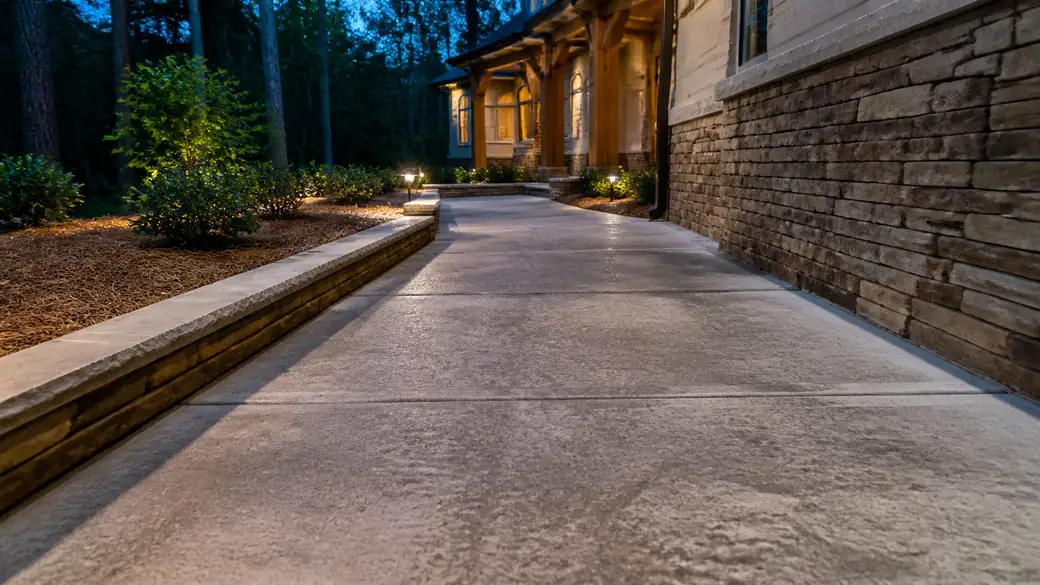
concrete sidewalk installation completed by a local contractor at a stacked-stone and stucco home in Lawrenceville, GA, at blue hour.

Concrete Sidewalk Installation in Lawrenceville, GA

We pour concrete sidewalks for homes and commercial properties across Lawrenceville: the front walk from the driveway to the door, the path out to a back patio, the strip along a storefront that carries foot traffic all day. A good sidewalk is a simple thing. It drains, it stays level, and nobody catches a toe on it. Getting there takes a compacted base, reinforcement matched to how the slab will be used, and control joints cut where the concrete would crack anyway. With the median home here built in 1987, plenty of the walks we replace have been in the ground a long time, and it shows in the cracks and the lifted edges.

Slope is the part people underestimate. Gwinnett County is hilly, with 181 feet of local relief within a few miles, and a walk that runs down a grade needs a different plan than one crossing a flat yard. The area gets about 55 inches of rain a year, so we set the pitch to shed water off the surface instead of letting it sit there or run under the edge. The dominant soil is well-drained Pacolet, though it changes from lot to lot, which is why we grade and test each site before we set a single form. We handle the permit. Call us for a free estimate on your sidewalk.

Call +1 470-229-2076

Get a FREE Quote

What Concrete Sidewalk Installation Involves

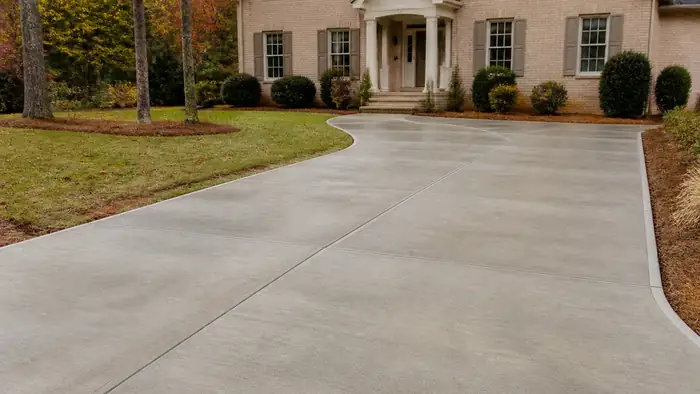
concrete slab installation completed by a local contractor at a tan-brick colonial in Lawrenceville, GA, under bright midday cloud.

Concrete Slab Installation Cost

What a slab costs depends on what sits under it and what goes on top of it. A shed pad on firm, level ground needs less base, forming and steel than a slab on a hillside lot that has to be cut in or built up. We test the soil on every site, because it decides how much base goes down. Thickness, reinforcement, finish and how close the truck can reach the pour all move the number. We measure all of it before we quote.


concrete driveway installation completed by a local contractor at a brick-and-siding two-story home in Lawrenceville, GA, in early morning light.

Concrete Driveway Installation

A driveway carries more weight than any other surface on the property, and it turns tires in the same spots every day. We cut out soft soil, compact a gravel base, and thicken the edges where wheels roll on and off. Rebar or wire mesh sits on chairs in the middle of the slab, not flat on the ground. With about 55 inches of rain a year, every driveway gets a slope that sends water away from the garage. Control joints make cracks follow our lines.

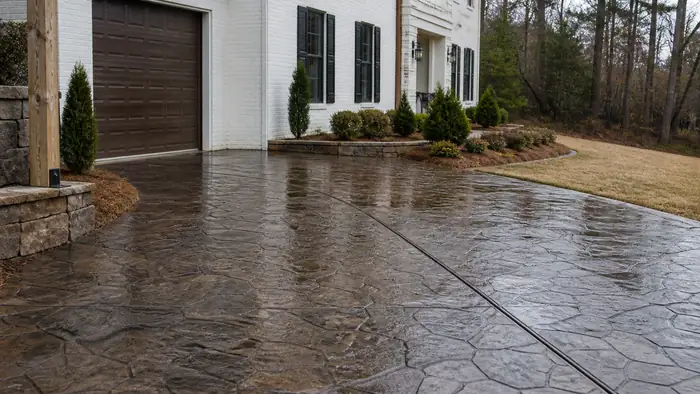
concrete flooring installation completed by a local contractor at a charcoal farmhouse-modern home in Lawrenceville, GA, after a rain shower.

Concrete Flooring Installation

Garage, basement and workshop floors get a vapor barrier under the slab, so ground moisture stays out of whatever sits on top. The base is compacted before the pour, because a floor only stays flat if the ground under it does. Inside, we finish with a steel trowel for a hard, smooth surface that sweeps clean. Floors can also be stained, sealed or polished as a decorative finish. Joints are sawcut soon after the pour, before shrinkage picks its own crack lines.

concrete slab repair completed by a local contractor at a grey split-level home in Lawrenceville, GA, under low winter sun.

Concrete Slab Repair

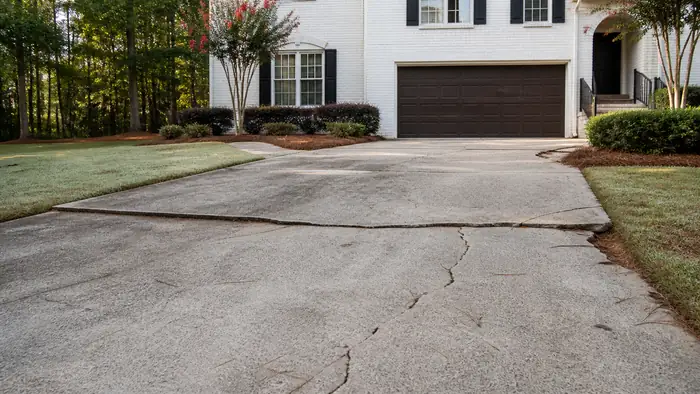
Not every cracked slab needs to come out. Hairline shrinkage cracks are cosmetic and can be sealed. A slab that has sunk, heaved, or split with one side higher than the other has a base problem, usually water washing out fill or soil that was never compacted. We find that cause first. Sometimes the fix is cutting out the bad panel and repouring it, doweled into the old concrete. Surface scaling can be resurfaced, but only if the slab underneath is sound.

Our Warranty and Guarantee

A sidewalk lasts because of what sits under it, so that is where we put our attention. Gwinnett County is hilly, with 181 feet of local relief within a few miles, and the ground changes from one block to the next. Pacolet soil is the dominant type across the county and it drains well, but we test every site on its own before any concrete goes down. We set the grade so water runs off the surface instead of pooling at a joint. Then we place reinforcement where the slab needs it. None of that shows once it's poured.

About 55 inches of rain falls here in a typical year, and that is what tests a sidewalk first. Hairline cracks are normal in concrete, and the control joints we cut are there to decide where they happen. What should not happen is a panel that settles, lifts or holds water against the house. Those problems come from the base, not the surface. When you call for a free estimate, ask how we plan to prepare the ground on your property. The answer tells you more about how long the walk will last than anything on paper.

Our Concrete Process, Step by Step

A worker examines an old driveway before replacement. at a painted-white-brick two-story home in Lawrenceville, GA, in early morning light.

Step 1: Site Assessment

We start by walking the route with a tape and a level. Gwinnett County is hilly, with 181 ft of local relief within a few miles, so we check how much the ground falls along the walk and which way water will run off it. We mark utilities, tree roots, downspouts and every spot where the walk meets a driveway or steps. If the job needs a permit, we handle the permit. Then we test the soil on your property before anything gets dug.

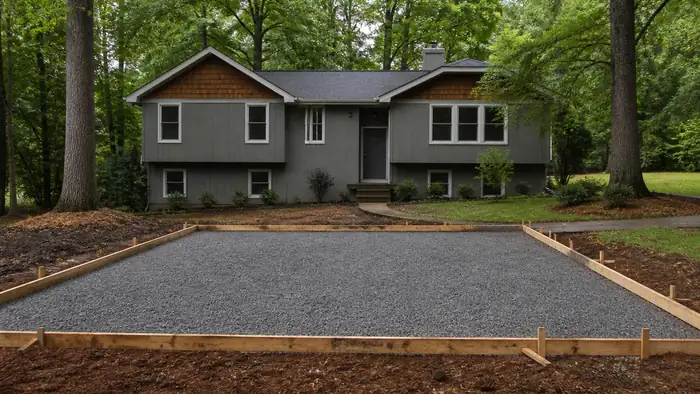
Crushed stone base is raked level inside driveway forms. at a grey split-level home in Lawrenceville, GA, after a rain shower.

Step 2: Site Preparation

Pacolet soil, the county's dominant type, drains well, but it varies from lot to lot. So we dig out sod, roots and soft spots until we reach firm ground. A layer of crushed stone goes down and gets compacted with a plate compactor in lifts, not dumped and raked flat. Most sidewalk cracks start right here: the base settles, a void opens under the slab, and the concrete breaks over it. We set the grade so water runs off the surface and away from the house.

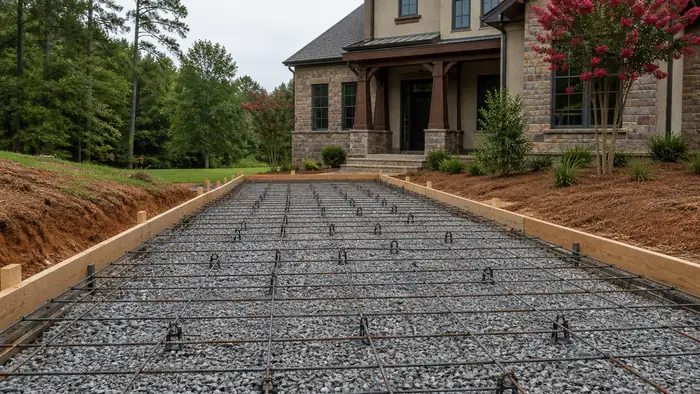
A worker ties rebar into a grid before a residential pour. at a stacked-stone and stucco home in Lawrenceville, GA, under an overcast sky.

Step 3: Forming & Reinforcement

Forms are straight lumber or steel, staked tight and set to a string line with a slight cross slope so rain sheds to one side. Curves get flexible hardboard. Inside the forms we place wire mesh or rebar on chairs so the steel sits in the middle of the slab, not on the ground where it does nothing. Where the walk crosses a driveway apron, we thicken the section and add reinforcement. Isolation joint material goes wherever new concrete meets a foundation, step or existing slab.

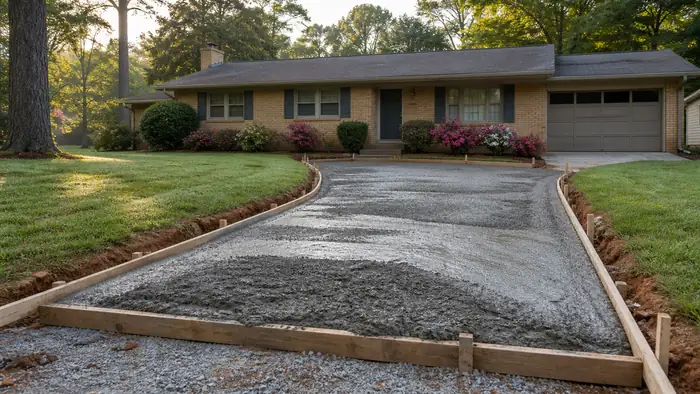
A ready-mix truck discharges concrete into a driveway form. at a buff-brick ranch home in Lawrenceville, GA, in early morning light.

Step 4: Pouring

The ready-mix truck backs in as close as the site allows, and we place concrete near its final spot by chute or wheelbarrow. Adding water on site makes the mix easier to spread and weaker once it sets, so we order the right slump instead. The crew works it into the forms with shovels and a come-along, pulls it level with a screed board, then runs a bull float over it. Average daily highs sit around 72°F here. On hot afternoons, we pour early.

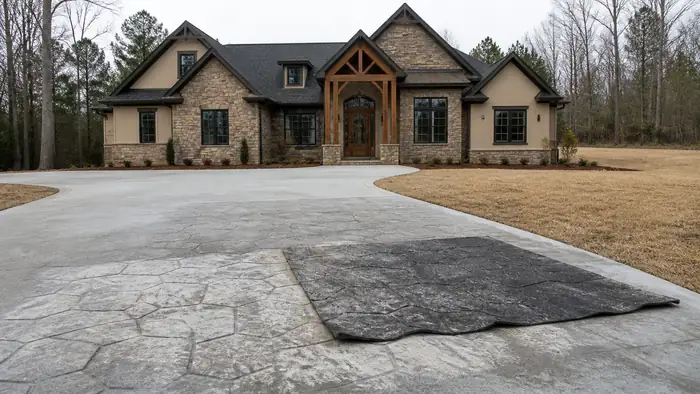
Stamping mats are pressed into a patio surface to imprint a pattern. at a stacked-stone and stucco home in Lawrenceville, GA, under an overcast sky.

Step 5: Finishing

After the bleed water leaves the surface, we run a hand edger down both sides so the corners do not chip later. Control joints get tooled or saw cut at intervals about equal to the walk's width, which gives the concrete a planned place to crack. A broom finish is standard for sidewalks because it holds traction when wet. Troweling a walk smooth looks nice and turns slick after rain. Stamped and decorative finishes are an option where a walk ties into a patio.

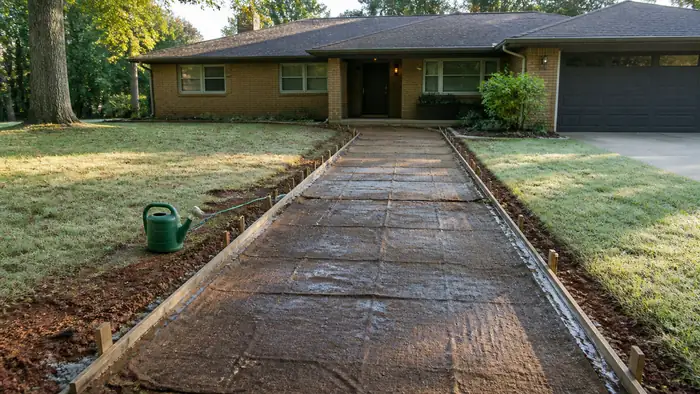
Damp burlap covers a small slab section during curing. at a buff-brick ranch home in Lawrenceville, GA, in early morning light.

Step 6: Curing

Concrete keeps gaining strength for weeks, and it only does that if it stays damp. Right after finishing, we spray on a curing compound or cover the slab with plastic so the surface does not dry out ahead of the core. That is what prevents dusting and fine surface cracks. Walking on it comes first; wheelbarrows, bikes and anything heavy wait longer. With about 55" of rain a year, we watch the forecast and keep poly on hand for storms that show up unannounced.

A roller applies sealer to a stamped patio surface. at a painted-white-brick two-story home in Lawrenceville, GA, after a rain shower.

Step 7: Sealing

Once the slab has cured, we apply a penetrating silane or siloxane sealer, or an acrylic sealer on decorative work where you want some sheen. Sealer keeps water, fertilizer and deicing salt from soaking into the surface. The area gets about 2" of snow a year, so salt is not a constant threat, but a bag of ice melt spread by the front steps still eats at unsealed concrete. Resealing every few years keeps the walk shedding water instead of absorbing it.

How Much Does Concrete Sidewalk Installation Cost in Lawrenceville?

Most of what a sidewalk costs is settled before any concrete shows up. It depends on what is already in the ground, how the material reaches the forms, and what the site asks for underneath. We price a walk after walking it ourselves, and these are the things we look at while we are there.

What changes the priceWhich wayWhy
An old walk or slab still in placecosts moreIt has to be broken out, loaded and hauled off before we can form the new one. With the median home here built in 1987, plenty of original walks are still down.
Wire mesh or tree roots under the old walkcosts moreBoth slow demolition. Steel has to be cut, and roots have to be cleared back so they do not lift the new surface.
A fence, gate or narrow side yard between the street and the workcosts moreIf the truck cannot back up to the forms, concrete moves by pump or by wheelbarrow, which takes more hands and more time.
Slope along the pathcosts moreGwinnett County is hilly. A walk that climbs may need steps, deeper forms or extra grading to stay safe underfoot.
Low spots where water sits after raincosts moreThe area sees about 55 inches of rain a year. A walk that pitches toward the house or holds water needs regrading first.
Carts, mowers or cars crossing itcosts moreA walk that carries more than foot traffic calls for more thickness and reinforcement.
Stamped or decorative finishcosts moreA broom finish is standard. Pattern and color add labor and materials.
Tying into a driveway, steps or porchcosts moreMatching heights and setting the joints between old and new concrete takes careful work.

When you compare bids, check that each one names the same thickness, the same reinforcement and the same base. See whether removal and haul-off are included. A lower number sometimes just leaves out the grading or drainage work your property actually needs.

Frequently Asked Questions About Concrete Sidewalk Installation in Lawrenceville

Do I need a permit for sidewalk installation in Lawrenceville?

Yes, in many cases, though it depends on where the walk runs. A path that stays well inside your own yard is often treated differently from a sidewalk that meets the street or crosses the public right-of-way. We look at the layout before any concrete is ordered and tell you which side of that line your project sits on. When a permit is needed, we handle the permit.

What permits are required for sidewalk installation in Lawrenceville?

That comes down to the property and the route. Work at the curb or in the right-of-way typically calls for a right-of-way or encroachment permit, and a walk tied into a new driveway may be reviewed along with it. Some neighborhoods add their own approval on top. We sort out which of these apply, file what is needed and line up any inspection, so the paperwork stays off your desk.

How long does it take to complete a concrete sidewalk installation in Lawrenceville?

Most of the time belongs to the concrete, not the crew. Digging out, setting forms and placing reinforcement go quickly on a straightforward residential walk. The pour and the finish happen together. After that, the slab needs time to cure before foot traffic, and longer still before anything heavy rolls across it. The length of your walk and how easily we can reach it decide the rest.

How long does a concrete sidewalk installation take in Lawrenceville, GA?

Weather sets the pace as much as the job does. Lawrenceville gets about 55 inches of rain a year, and we do not pour into a forecast that would wash the surface or leave it soft. Ground matters too. Gwinnett County is hilly, so a walk that follows a slope takes more grading and forming than one across a flat lawn. Tearing out an old sidewalk first adds a step.

Do I need permits for foundation work in Lawrenceville?

Yes. Foundation work is structural, and structural concrete is exactly what permits and inspections exist for. We handle the permit, and any required inspection happens while the footings and steel are still open to view. Soil is part of that picture. Pacolet soil, which drains well, is the most common type in Gwinnett County, but it changes from lot to lot, so every site is tested on its own first.

Are you licensed and insured?

No license number or insurance certificate is posted on this site, and we would rather say that plainly than print something you cannot check. Ask for both when you call about your sidewalk. Any contractor you are weighing, us included, should be able to show current paperwork before forms go in on your property, and you should see it with your own eyes.

Get a Free Estimate

Get a FREE Quote

Tap to call +1 470-229-2076