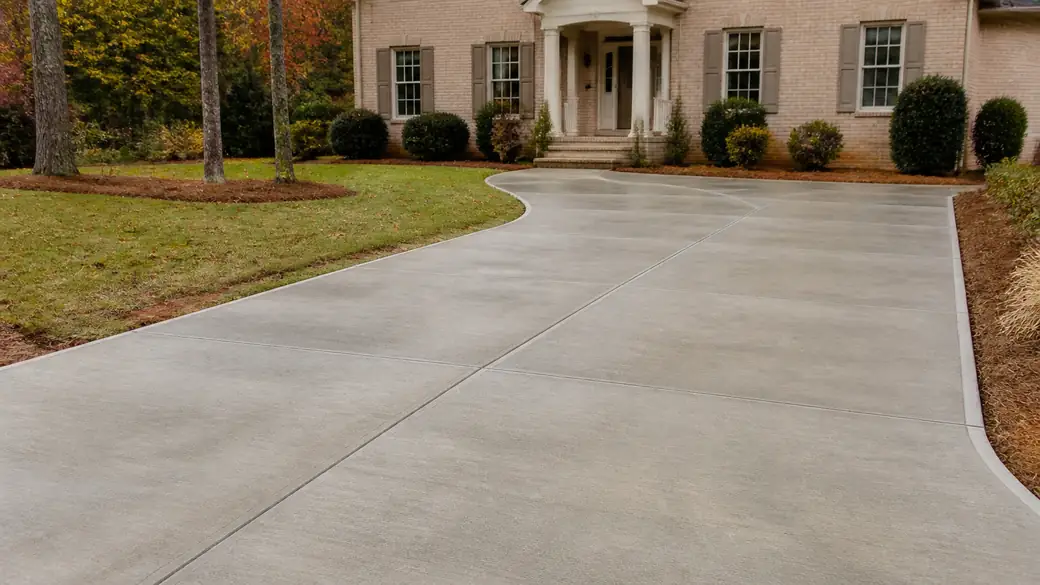
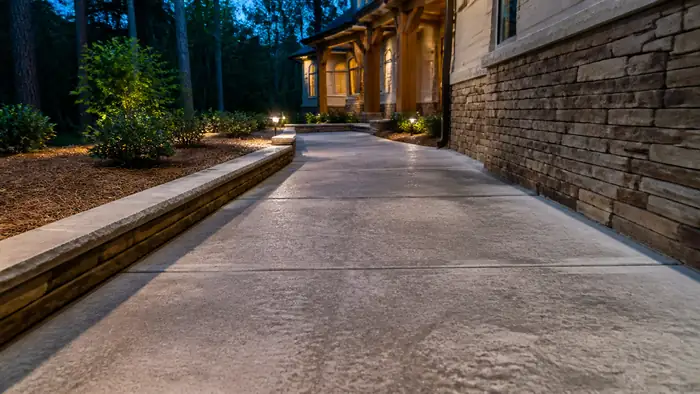
A concrete slab is a system, not just a pour. Under it sits a compacted base of crushed stone that carries the load and lets water move away. Inside it sits reinforcement: steel rebar, welded wire mesh, or fiber mixed into the concrete, chosen for what the slab has to hold. Joints are cut or formed to tell the concrete where to crack. On top, the surface is finished for its job, with a broom finish for driveways and walks, a steel trowel for garage and shop floors, and stamped or colored concrete for decorative patios.
We start with the ground, because everything above depends on it. Pacolet soil, which drains well, is the dominant type in Gwinnett County, but it varies across the county, so every site is tested individually before any work begins. From there the order holds on every project, residential or commercial. We excavate, set forms, and grade the subbase so water has somewhere to go. The base is placed and compacted in lifts. Reinforcement goes in on chairs so it sits inside the slab rather than under it. Then we pour, finish, cut joints, and let the concrete cure.
Most slab problems start with something nobody can see once the concrete is down. A soft spot left in the base settles, and the slab above it cracks. Mesh that gets stepped into the bottom of the pour does almost nothing there. Joints cut too late, or spaced too far apart, let the slab choose its own crack lines, and it rarely chooses well. Water causes the rest. With about 55 inches of rain a year, a driveway or patio pitched the wrong way either holds puddles on the surface or sends runoff back toward the house.
Doing it right costs time and materials up front, and we would rather spend them than skip them. That means hauling out poor soil instead of pouring over it, placing enough base, and using reinforcement that suits the load rather than the lightest option on the truck. It means waiting for the concrete to set before finishing, and keeping traffic off a new driveway until it has cured. None of those steps show in the finished surface. They show years later, in a slab that is still flat and still whole in Doraville. Call for a free estimate.