+1 470-229-2076
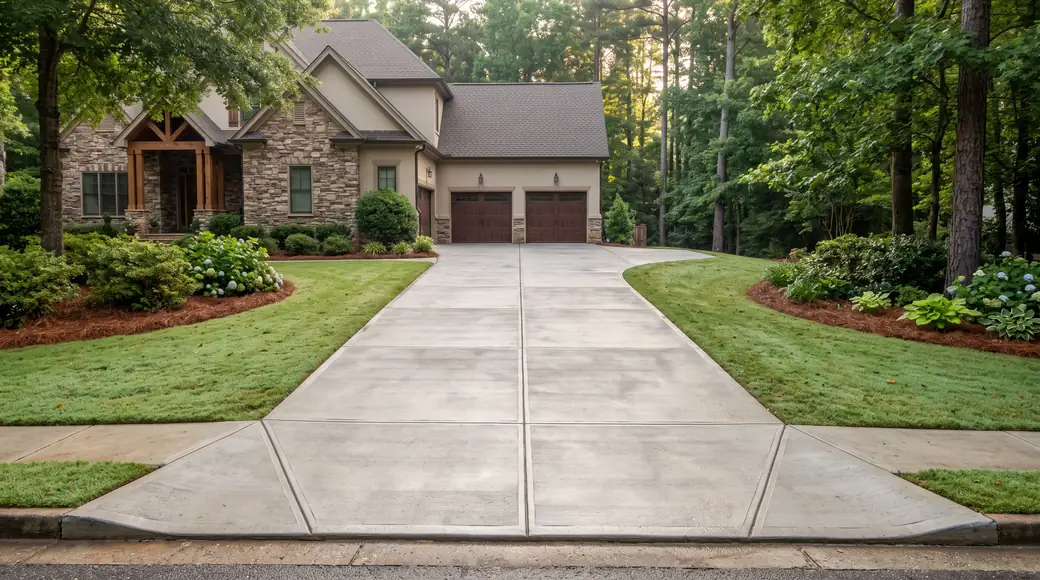
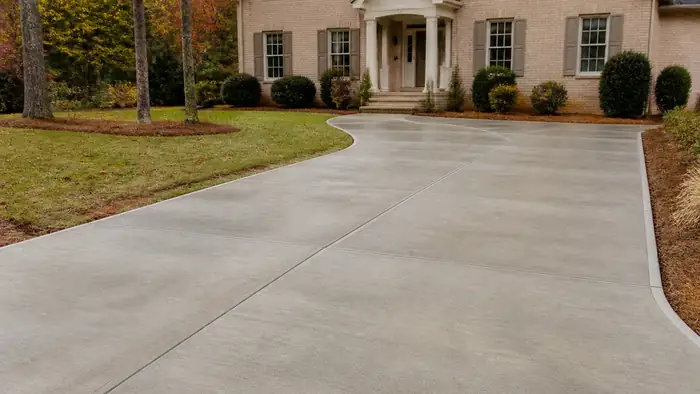
concrete driveway installation completed by a local contractor at a brick-and-siding two-story home in Lawrenceville, GA, in early morning light.

Concrete Driveway Installation in Lawrenceville, GA

We pour concrete driveways in Lawrenceville: new ones for new builds, and replacements for the cracked, sunken or heaved slabs that have finally given up. The median home in town was built in 1987, so a good share of the driveways we look at have been carrying cars, trucks and the odd moving van for a long time. Some of them were done well and simply wore out. Others were never right from the first pour, with a thin base or too little reinforcement under the surface. The difference matters, because it decides what we take out and what goes back in.

Most of what ruins a driveway is water and grade. Lawrenceville gets about 55 inches of rain a year, and Gwinnett County is hilly, with ground that changes from one block to the next. A slab that sheds water off its edges and away from the house lasts. One that lets water run under it, or back toward the garage, does not. Pacolet soil is the county's dominant type and it drains well, but it isn't the same everywhere, so we grade and test every site on its own before any concrete arrives. Get the base and the slope right, and the rest is straightforward. Call for a free estimate.

Call +1 470-229-2076

Get a FREE Quote

What Concrete Driveway Installation Involves

concrete slab installation completed by a local contractor at a tan-brick colonial in Lawrenceville, GA, under bright midday cloud.

Concrete Slab Installation Cost

The price of a slab comes down to what the ground needs before the concrete arrives. A flat lot with open access takes less prep than a sloped one where we cut, fill and compact before any forms go up. After that, thickness, reinforcement and finish do the rest: rebar costs more than wire mesh, and stamped costs more than broom. We walk the site, measure it, and price your slab from what we find there.


Concrete Driveway Installation

A driveway starts below the surface. We tear out the old concrete or sod, grade for drainage, and compact a gravel base so the slab sits on something that stays put. Gwinnett County is hilly and gets about 55 inches of rain a year, so we pitch every driveway to send water away from the garage. Rebar sits on chairs in the middle of the pour. Control joints decide where the cracks go.

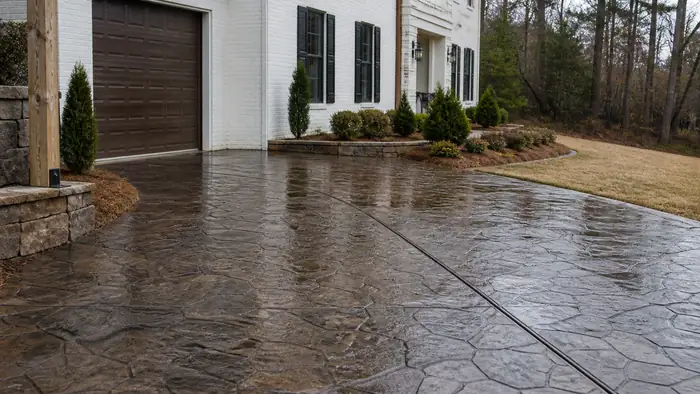
concrete flooring installation completed by a local contractor at a charcoal farmhouse-modern home in Lawrenceville, GA, after a rain shower.

Concrete Flooring Installation

Garage floors, basement slabs and shop floors go down over a vapor barrier. Skip it, and moisture coming up through the concrete will lift coatings and ruin flooring later. We set grade stakes, screed the pour flat, then power trowel it to a hard, smooth finish that sweeps clean. Fiber in the mix helps hold down surface cracking. If you plan to put epoxy or tile over it, the slab has to cure fully first.

concrete slab repair completed by a local contractor at a grey split-level home in Lawrenceville, GA, under low winter sun.

Concrete Slab Repair

With the median home here built in 1987, plenty of concrete around Lawrenceville has had decades to settle, crack and heave. Hairline cracks can be routed out and sealed. A sunken section can sometimes be lifted back to level. When tree roots or a washed-out base caused the damage, we cut the section out, drill dowels into the old slab and pour new. We tell you which repair your slab needs, and when replacing it makes more sense than patching.

Our Concrete Process, Step by Step

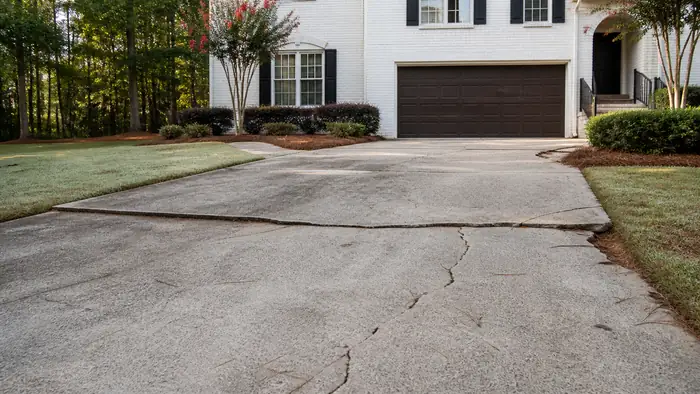
A worker examines an old driveway before replacement. at a painted-white-brick two-story home in Lawrenceville, GA, in early morning light.

Step 1: Site Assessment

Every driveway starts with a walk of the property and a hard look at what the ground is doing. The land around here is hilly and changes from one lot to the next, so we measure the fall from the garage to the street before anything else. Pacolet soil, which drains well, is the dominant type locally, but it varies, so your site gets tested on its own. We check drainage paths, tree roots and any old slab, and we handle the permit.

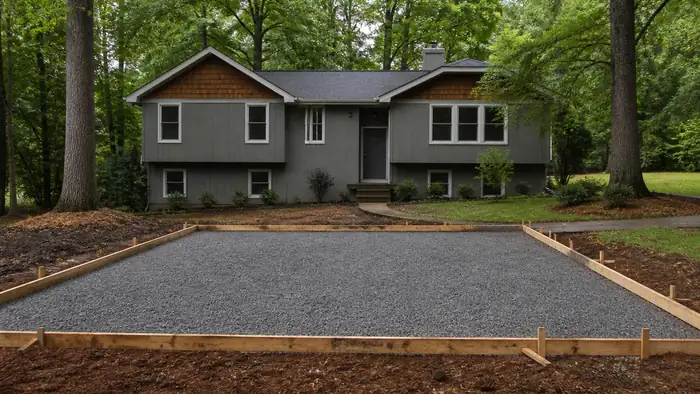
Crushed stone base is raked level inside driveway forms. at a grey split-level home in Lawrenceville, GA, after a rain shower.

Step 2: Site Preparation

Old concrete gets broken out and hauled off. Then we cut to grade, strip topsoil and roots, and compact the subgrade until it stops moving under the plate compactor. A soft spot left here is what cracks a slab later. Crushed stone goes on top, compacted in lifts. With about 55 inches of rain a year, slope matters: we pitch the base so water runs off the surface and away from the house, not under the slab.

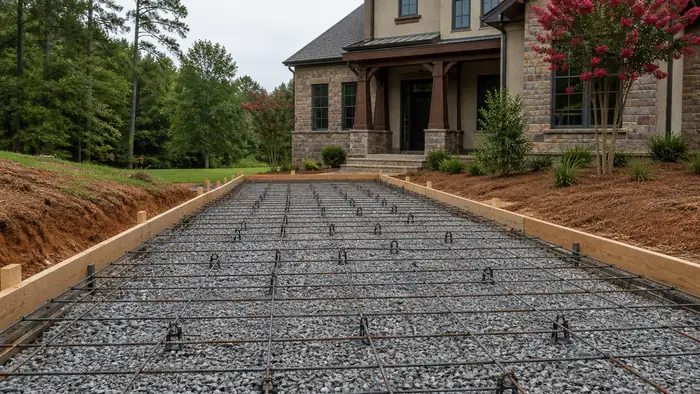
A worker ties rebar into a grid before a residential pour. at a stacked-stone and stucco home in Lawrenceville, GA, under an overcast sky.

Step 3: Forming & Reinforcement

Forms are straight lumber or steel, staked tight and set to the grade lines from the assessment. A standard residential driveway gets a four-inch slab, thicker at the apron and anywhere a truck or trailer will sit. Reinforcement is rebar tied in a grid and held up on chairs so it lands in the middle of the slab, not on the ground where it does nothing. Fiber can be added to the mix. Expansion joint material goes against the garage and walks.

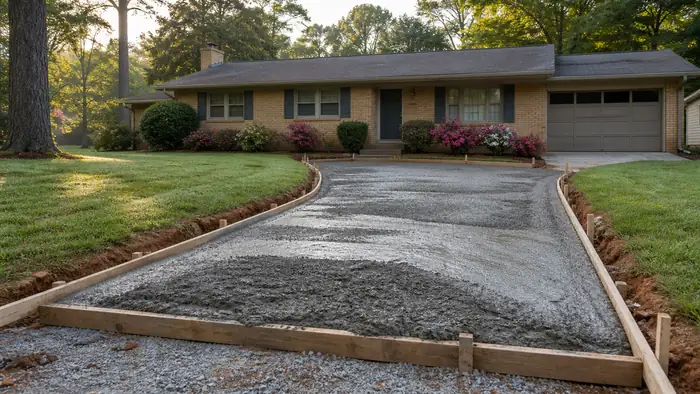
A ready-mix truck discharges concrete into a driveway form. at a buff-brick ranch home in Lawrenceville, GA, in early morning light.

Step 4: Pouring

Pour day is about timing. The ready-mix is ordered for driveway work, with the right strength, air content and slump, and we don't add water at the chute to make it spread easier, because extra water weakens the surface. On a sloped lot the truck can't always reach, so we pump it or wheel it. The concrete is placed, pulled with come-alongs and screeded off the forms. Warm weather shortens working time, so crew size is set before the truck arrives.

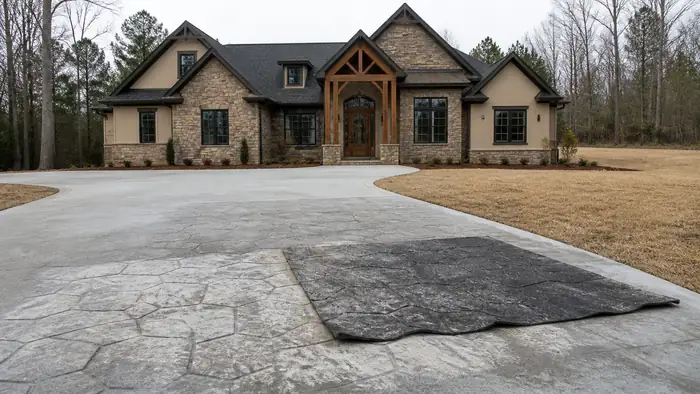
Stamping mats are pressed into a patio surface to imprint a pattern. at a stacked-stone and stucco home in Lawrenceville, GA, under an overcast sky.

Step 5: Finishing

After the bleed water leaves the surface, we bull float, edge the slab and tool in control joints, spaced so cracks form in the joint instead of across the middle. Finishing too early traps water and leaves a top layer that flakes. A broom finish is standard for driveways because it gives tires and shoes grip on a wet, sloped drive. Decorative work, stamped patterns and color, goes in at this stage too, and the window for it is tight.

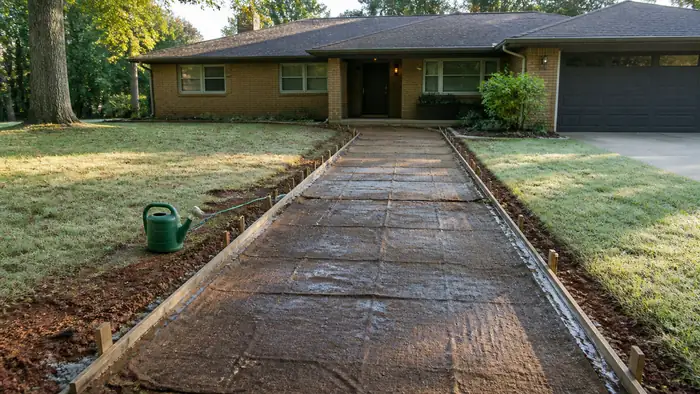
Damp burlap covers a small slab section during curing. at a buff-brick ranch home in Lawrenceville, GA, in early morning light.

Step 6: Curing

Concrete doesn't dry, it cures, and it needs moisture to do that. Right after finishing we apply a curing compound or cover the slab so the top doesn't lose water faster than the inside. A surface that dries too fast comes out weak and dusty. Foot traffic is fine after a day or so. Cars wait about a week. Full strength takes around 28 days, which is why heavy trucks and dumpsters stay off it for the first month.

A roller applies sealer to a stamped patio surface. at a painted-white-brick two-story home in Lawrenceville, GA, after a rain shower.

Step 7: Sealing

Sealing comes after the slab has cured, not before. Broom-finished driveways get a penetrating sealer that soaks in and helps the surface resist water, oil and staining without turning slick. Stamped and colored concrete usually gets an acrylic sealer, which deepens the color and adds a light sheen. Neither lasts forever. Traffic and sun wear sealers down, and they need to be reapplied every few years. Which one fits depends on the finish and how hard the driveway gets used.

Choosing the Right Concrete System

A driveway is more than the slab you see on top. The system underneath decides how long it lasts: the base, the slab thickness, the reinforcement and the finish. Most residential driveways we pour carry cars and the odd delivery truck, so we size the concrete and the steel to the load the driveway will actually see. Where the lot slopes, we plan joints and drainage around the grade so water runs off the surface instead of sitting on it. That comes up often, since Gwinnett County is hilly, with 181 feet of local relief within a few miles.

Finish is usually what homeowners ask about first. A broom finish gives tires and shoes some grip, which counts for a lot on a sloped drive in a place that gets about 55 inches of rain a year. Stamped and decorative concrete looks good on a front walk or a patio. On a steep driveway we will tell you plainly it is the wrong choice. The median home here was built in 1987, and an older driveway can sit on a base that has shifted over the years. Pacolet soil drains well across much of the county, but it varies, so we test your site before recommending anything. The right system is the one that fits your property.

Frequently Asked Questions About Concrete Driveway Installation in Lawrenceville

How long does a concrete driveway installation take in Lawrenceville, GA?

The work on site moves quickly. The waiting is what takes time. Tear-out, grading and forming come first, then the pour and finish, which happen together once the base is ready and the weather cooperates. After that the slab has to cure before it carries weight, and you can walk on it well before you can park on it. Size, access and rain all move the schedule, so we set dates once we have seen the property.

Do I need permits for concrete driveway installation in Lawrenceville?

Yes, in most cases, particularly where a new driveway meets the street or changes how water leaves the lot. We handle the permit as part of the job, so you are not the one filling out forms or chasing inspections. What we need from you is a clear idea of where the property lines sit and anything buried in the yard that you know about. A survey plat helps. An old one is fine.

What type of concrete is best for driveway installation in Lawrenceville?

For most homes here, a broom-finished slab with steel reinforcement is the right call. The mix matters less than what sits under it. Pacolet soil, the dominant type in Gwinnett County, drains well, but it changes from one yard to the next, so every site gets tested before we order materials. Stamped and decorative surfaces are available on top of that. They look good and take a little more care to keep that way.

How much does concrete driveway installation cost in Lawrenceville?

That depends on the driveway, and we would rather price yours than quote a figure that fits nobody. The big drivers are square footage, whether an old slab has to come out, how much grading the lot needs, and the finish you choose. Gwinnett County is hilly, with 181 feet of local relief within a few miles, and a steep approach takes more base work than a flat one. Call for a free estimate.

How do I maintain my concrete driveway in Lawrenceville, GA?

Keep it clean and keep water moving off it. The area sees about 55 inches of rain a year, so clear leaves and grit out of the joints and make sure downspouts do not empty against the slab edge. A penetrating sealer every few years helps with oil and stains. Snow is rare, around 2 inches a year, but when ice does show up, use sand rather than rock salt. Fix cracks while they are small.

What is the average cost per square foot for a new driveway installation in Lawrenceville?

We do not work from an average, because an average hides the things that actually change the bill. A square foot of slab on a flat, open lot is not the same job as a square foot on a grade that needs cutting, a deeper base and more reinforcement. Truck access matters too. We measure the site, look at the conditions, and give you a price for your driveway, not a rate for someone else's. Ask for that estimate when you call.

Get a Free Estimate

Get a FREE Quote

Tap to call +1 470-229-2076