+1 470-229-2076
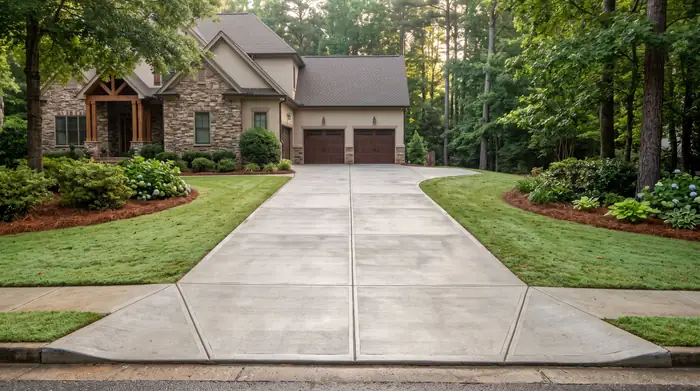
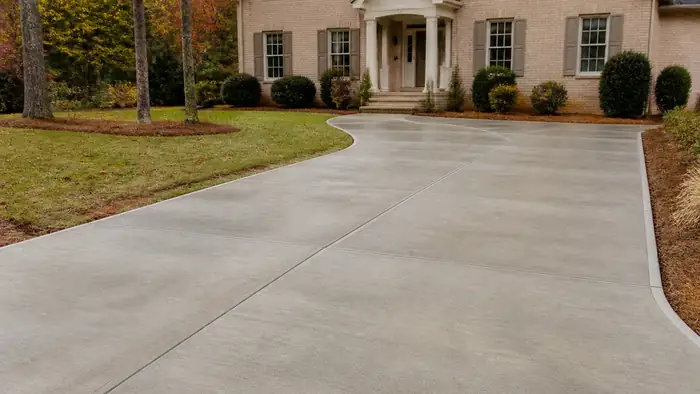
Wide view of finished concrete flatwork across the front of a home at a buff-brick ranch home in Lawrenceville, GA, in clear late-morning sun.

Repair, Leveling & Resurfacing in Suwanee, Georgia

Concrete fails in ways you can see long before anyone explains them to you. A driveway panel sits half an inch below its neighbor. A sidewalk section rocks under your foot. Surfaces go chalky and start shedding sand. We repair, level and resurface existing slabs in Suwanee, and we work as a concrete contractor who would rather save a sound slab than sell you a new one. Some of it is worth saving. Some of it is not, and we tell you which one you have.

What matters most is what sits under the slab, not the crack you happen to be looking at. Settled fill, a washed out void, roots working their way under a corner: those move the concrete, and patching the top leaves the cause exactly where it was. We check whether the slab is still solid enough to lift and bring back to grade, or whether the base has to come out. Old flatwork poured without rebar or wire mesh gives up faster, and that usually shows in how it broke.

Resurfacing has an honest limit. An overlay bonds to sound concrete, so it covers scaling, spalling and a worn broom finish well, and it does nothing at all for a slab that is still moving. Put a fresh surface over active settlement and the crack comes back through it within a season or two. Stamped concrete and colored work can be resurfaced the same way, with pattern and color carried into the overlay, though a stamped repair on one panel rarely matches the original perfectly. We say so up front.

Getting it right takes more than the part you can see. Full depth replacement means breaking out the old panel, hauling it off, compacting the base back to grade, and setting rebar or wire mesh before anything gets poured. Leveling means drilling, lifting in stages, and reading the slab as it comes up. The median home in this market was built in 1987, so we open up a fair amount of concrete that was poured thin, over loose fill, with no steel in it anywhere.

Our repair work covers driveways, patios, steps, garage slabs and sidewalk sections, residential and commercial alike. When a walk is broken past patching, we take out the bad panels and pour new ones matched to the finish beside them, exposed aggregate and stamped patterns included. We work out of Lawrenceville, and Suwanee is regular ground for us, close enough that it never turns into an ordeal. Bring us the slab you have been stepping around for two years. Call for a free estimate.

Call +1 470-229-2076

Licensed, Bonded, and Insured ยท A combined 15 years of experience

Get a FREE Quote

We warranty all of our work because we believe in what we do.

What We Do in Suwanee

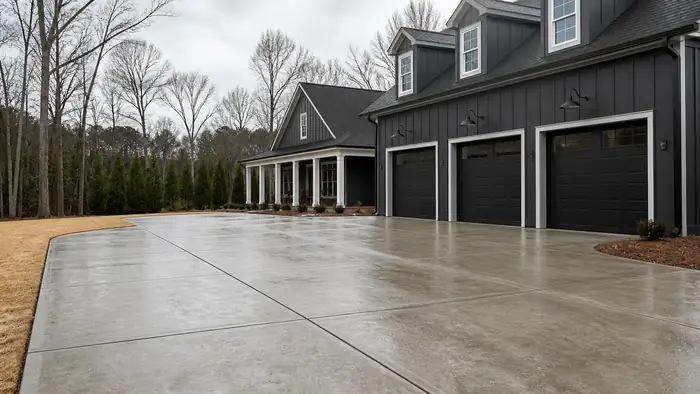
Replaced concrete driveway panel with clean saw-cut edges at a brick-and-siding two-story home in Lawrenceville, GA, under an overcast sky.

Repair, Leveling & Resurfacing

Repair starts with figuring out why the concrete moved. A panel that has dropped at one edge usually has a void under it, and slabjacking fills that void to bring the slab back to grade. Cracks wider than a pencil get chased out, cleaned and filled. Resurfacing lays a polymer-modified overlay over sound concrete, which covers spalling and scaling but will not save a slab broken all the way through. We tell you which one you have.

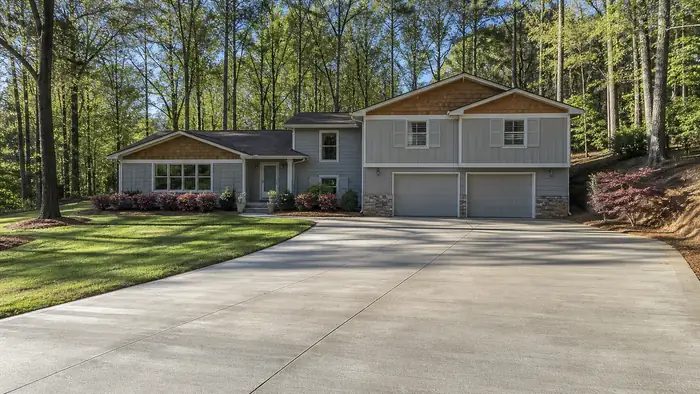
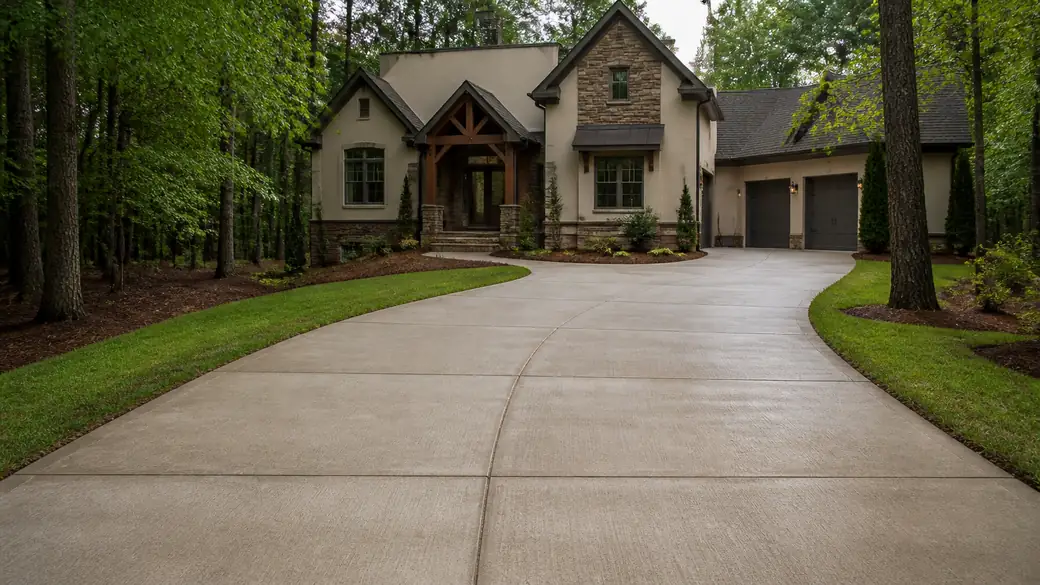
Broom-finished concrete driveway running up to a two-car garage at a stacked-stone and stucco home in Lawrenceville, GA, in early morning light.

Driveway Installation & Replacement

Most driveways we replace are four inches of concrete over compacted graded aggregate base, with wire mesh or rebar sized to the pour. Thickness goes to five or six inches where trucks turn or a slope loads one edge. Permits, where the work calls for one, come through the City of Lawrenceville. Tearout and haul-off are part of the job. Control joints get cut early, before the concrete decides on its own where it wants to crack.

Rectangular concrete patio with a low step up to the rear door at a painted-white-brick two-story home in Lawrenceville, GA, under bright midday cloud.

Patio Construction & Outdoor Living

Patios go in at four inches with a broom, exposed aggregate or stamped finish, and that finish decision moves the schedule more than the shape does. Stamped concrete needs release color, mats and sealer, so it takes a longer day and a dry one. Colored concrete mixed integral holds up better than a surface color that wears thin on the step nosings. Seat walls, curves and a fire pit pad can go in on the same pour.

Board-formed concrete retaining wall holding a raised lawn at a tan-brick colonial in Lawrenceville, GA, in late afternoon light.

Retaining Wall Construction

Walls under four feet we build as segmental block on a compacted stone base, with drainage stone and a drain line behind the face so water leaves rather than pushes. Taller than that, or holding up a driveway, and it wants an engineered design: geogrid tiebacks, or a poured wall on a proper footing. Almost every failed wall we get called to look at had no drainage and no base. Caps get glued down, not stacked loose.

Square-edged concrete slab pad with a storage shed on it at a red-brick ranch home in Lawrenceville, GA, in late afternoon light.

Concrete Slabs & Pads

Slabs and pads cover the rest of it: garage floors, shed and generator pads, dumpster enclosures, and the commercial concrete behind a building where trucks back in. Sidewalk installation runs four inches with wire mesh, and a concrete sidewalk tying into a public walk has to match line and grade. Loading pads get poured thicker with rebar on chairs. As a concrete contractor working Suwanee and out toward Sugar Hill, we take flatwork at any size.

How a Job Runs

A job starts with us standing on the concrete you already have, looking at what it is doing and working out why. We measure the slab, check the fall, and watch where water goes when it comes off the roof and crosses the yard. Cracking tells us something, and so does a driveway that has settled hard at the apron while sitting dead true up near the garage. We take notes and photographs, and we tell you what we are seeing before anybody starts talking about work.

The estimate comes off measurements, not off a glance through the truck window. We write out square footage, thickness, reinforcement, finish, and what happens to the old material once it comes out of the ground. Repair, leveling and resurfacing all live on the same slab, and which one is right depends on whether the concrete underneath still has strength left in it. We will say plainly when a patch is only buying a little time, and just as plainly when a full tear out is more than the problem calls for.

Our crews work Lawrenceville, Suwanee, Snellville, Duluth and Sugar Hill, all of it inside the piece of metro Atlanta we cover. Same crews, same trucks, same order of operations, whichever of those towns the address sits in, and nothing changes at a town line. Scheduling turns on the weather and on what is already in the ground ahead of you, never on how far out you are. We would sooner move a pour a day than put concrete down into a forecast that will ruin the finish.

Demolition day is loud and short. We saw a clean edge where the new concrete will meet the old, break out the failed sections, and haul the rubble off rather than burying it in the yard. Anything we drive equipment across gets matted or planked first, and irrigation heads, shallow conduit and gas lines get located before a machine touches dirt. Ruts are quick to make and slow to fix, and a broken line turns a straightforward job into a different one entirely.

Base work is the part nobody sees and the part that decides everything else. We grade to a consistent depth, dig out the soft spots, bring in stone where the subgrade will not hold compaction, and pack it in lifts. Concrete does not fix a bad base. It bridges one for a season or two, then telegraphs every void up through the surface as a crack that will not sit still. Most of the failed driveways we tear out failed underneath long before anything showed on top.

Forms go in next, set to the grade we want water to follow as it leaves the slab. Rebar or wire mesh gets tied and chaired up off the base so the steel ends up inside the concrete instead of lying beneath it doing nothing. Control joints get laid out before the first truck backs in, then cut or tooled to depth, because concrete cracks and the only real question is where. Pour day starts early and moves quick, since the material keeps its own schedule and will not wait on ours.

Finishing is where a concrete driveway either looks right or looks like something you have to see every day on the way in. Broom finish for traction, stamped and colored concrete where you want a pattern, exposed aggregate where you want texture underfoot. We float it, let it come back to us, and go over it again, because rushing a finish seals water at the surface and leaves a slab that dusts and scales. Sidewalks get the same attention as the big flatwork.

Cure time is the one part of a concrete installation we cannot shorten for anybody, and we are straight with you about that from the start. We tell you when the slab will take foot traffic and when it will take a vehicle, and those are not the same day. Homes around us run to a median build year of 1987, so much of what we remove has carried traffic for decades and has simply reached the end. New concrete, put down right, gets the same long run. Call for a free estimate.

Suwanee Questions

Does Suwanee require its own permit for this work?

Sometimes. Repair, leveling and resurfacing on an existing slab often falls outside what needs a permit, since we are not changing the footprint or the drainage. Replacing a driveway or pouring new flatwork in the right of way is a different matter. We look at what the job actually involves, tell you what it will need, and handle the paperwork if there is any.

Can you match concrete you did not pour in Suwanee?

Usually close, rarely exact. Concrete cures to a color that depends on the mix, the sand, the water and roughly forty years of weather on a 1987 slab. New work poured next to old will read lighter for a while, then darken. We can match broom direction, joint spacing and edge profile, which is what the eye actually picks up from the street. On colored or stamped work we test on a sample before committing.

Is there a minimum job size for Suwanee?

No. We will do a single panel, one settled step, a short stretch of sidewalk. Small jobs get bundled with other work in the area when the schedule allows, which keeps the mobilisation sensible for both of us. Some repairs genuinely are not worth doing, though, and we will say so: a slab broken across multiple panels with no subgrade left under it wants replacement, not patching.

How quickly can you get a crew to Suwanee?

Suwanee sits inside our normal working radius, so getting there is never the constraint. Weather is. Concrete work needs a dry window and a temperature range, and resurfacing overlays are fussier about both than a straight pour. Scheduling also depends on what is already booked. Call and we will tell you honestly where you would land in the queue.

Do you charge more to work in Suwanee than in Lawrenceville?

No. Same rates, same crews, same materials. Suwanee is close enough that travel does not register as a separate line, and we do not price by zip code. What moves a number is the work itself: how much demolition, how deep the failure runs, whether rebar or wire mesh is involved, and how much surface area we are finishing.

Get a Free Estimate

Get a FREE Quote

We warranty all of our work because we believe in what we do.

Tap to call +1 470-229-2076