+1 470-229-2076
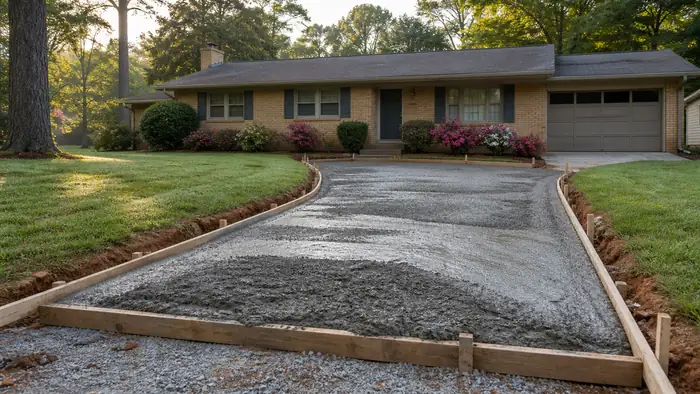
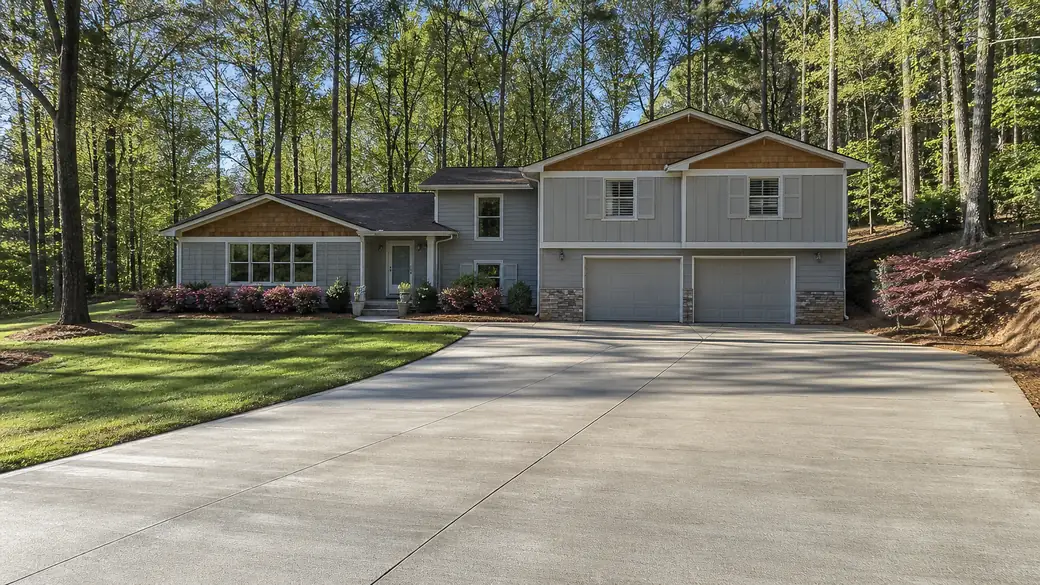
concrete slab repair completed by a local contractor at a grey split-level home in Lawrenceville, GA, under low winter sun.

Concrete Slab Repair in Conyers, Georgia

A cracked or sunken slab in Conyers usually tells you something about what sits underneath it. We repair residential and commercial concrete slabs: garage floors, driveways, patios, walkways and the pads under sheds and equipment. Some of that work is a surface fix, filling and sealing cracks before water finds a way in. Some of it is structural, where a section has settled or heaved and needs to be cut out, the base corrected, and the slab poured back with proper reinforcement.

Every project starts on the ground, not on paper. We look at the slab, the joints, and how the property sheds water, then test the site before any work begins, because conditions change from one lot to the next. From there we tell you plainly whether a repair will hold or whether replacement is the honest answer. Stamped and decorative surfaces get the same attention, and we match the finish as closely as the existing concrete allows.

Water is behind most of the failures we see. The area gets about 55 inches of rain a year, and a slab poured over a poorly compacted base, or with nowhere for that water to go, will settle unevenly over time. Patching the crack on top does nothing for the cause. We correct the base, the joints and the drainage along with the concrete itself, using materials suited to the job. Call for a free estimate.

Call +1 470-229-2076

Get a FREE Quote

What We Do in Conyers

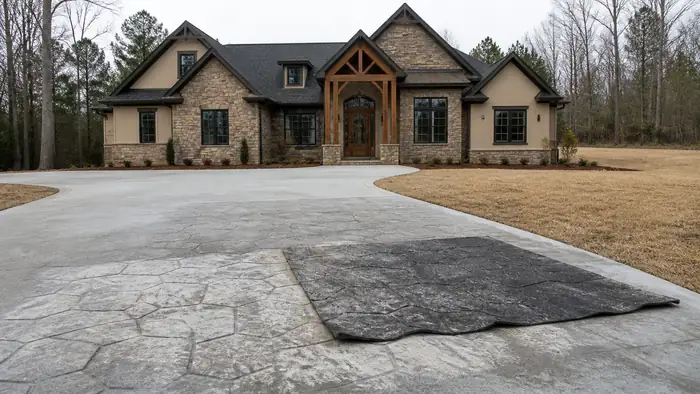
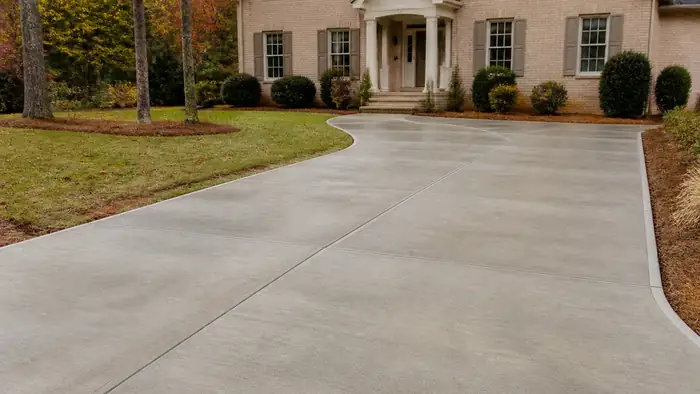
concrete slab installation completed by a local contractor at a tan-brick colonial in Lawrenceville, GA, under bright midday cloud.

Concrete Slab Installation Cost

A slab is priced by what goes under it and into it. That means the depth of compacted gravel base, rebar or welded wire mesh, the strength of the mix, the finish, and how the edges are formed and thickened. Two quotes can show the same square footage and describe very different slabs. When you compare numbers, ask each contractor to put those items in writing. Then you are comparing concrete to concrete, not one guess to another.


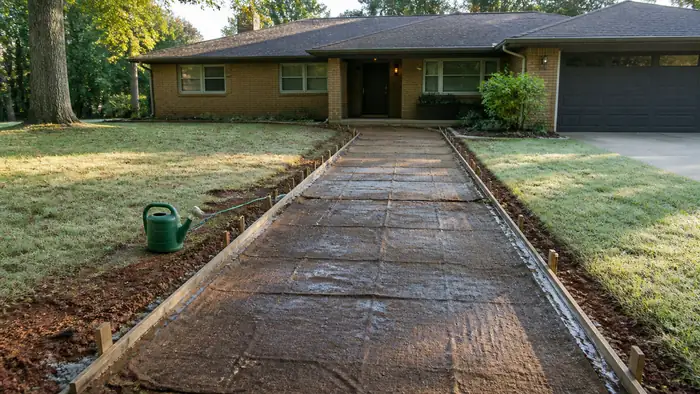
concrete driveway installation completed by a local contractor at a brick-and-siding two-story home in Lawrenceville, GA, in early morning light.

Concrete Driveway Installation

Driveways fail at the edges and the apron first, because that is where tires turn and water collects. We thicken the edges, set rebar on chairs so it sits mid-slab rather than in the dirt, and saw control joints before the concrete picks its own crack lines. This area gets about 55 inches of rain a year, so we slope the surface to shed water away from the garage. Finishes run from broom to exposed aggregate to stamped.

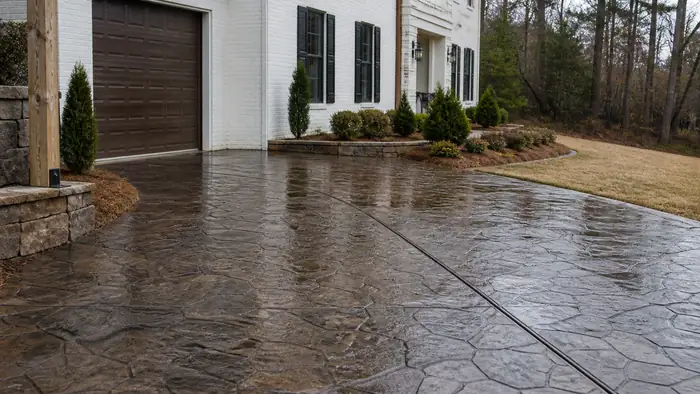
concrete flooring installation completed by a local contractor at a charcoal farmhouse-modern home in Lawrenceville, GA, after a rain shower.

Concrete Flooring Installation

Interior floors for garages, basements, shops and commercial spaces start with a vapor barrier under the slab, because moisture coming up through concrete ruins anything glued on top of it. We screed it flat, power trowel it smooth, and cure it slowly so the surface does not dust and the corners do not curl. If the floor will stay bare, we can seal or polish it. If it will be covered, we leave a surface the next trade can bond to.

Concrete Slab Repair

Repair starts with finding out why the slab moved. Hairline shrinkage cracks can be routed and sealed. A section that has sunk or heaved usually sits on a base that washed out or was never compacted, and patching the top will not hold. Soil varies from one site to the next, so we test the ground before deciding. Sometimes that means lifting and filling underneath. Other times the bad section is cut out and repoured, doweled into the old slab.

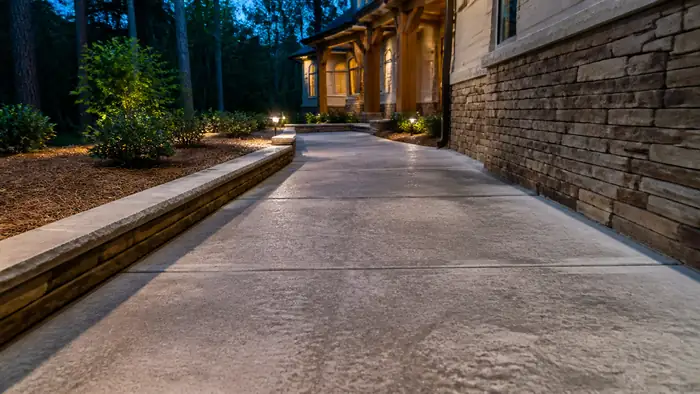
concrete sidewalk installation completed by a local contractor at a stacked-stone and stucco home in Lawrenceville, GA, at blue hour.

Concrete Sidewalk Installation

A sidewalk is a narrow slab, which makes it easy to crack if the joints are spaced wrong. We set control joints at even intervals, roughly as far apart as the walk is wide, so any crack lands in the groove instead of across the panel. Forms are staked straight, the base compacted, and the top broom-finished for grip in the wet. Where a walk meets a driveway or step, we add an expansion joint so the two can move independently.

Why Conyers Chooses Lawrenceville Best Concrete

A cracked or sunken slab is rarely the whole story. Something under it moved first, and a patch that ignores that will crack again along the same line. We look at the base, the drainage and the reinforcement before we talk about a fix, because a repair only holds if the ground beneath it holds. For Conyers owners that covers driveways, patios, garage floors and commercial walkways, each treated as its own property with its own conditions.

Every site is tested individually before work starts. Ground can change from one lot to the next, so we don't carry assumptions from the last project into yours. What you get from us is a straight read on the slab: which sections can be saved, which need to come out, and why. Sometimes the honest answer is a smaller job than you expected. Sometimes it's a bigger one, and we would rather say so now than after the pour.

Failed slab repairs usually share a cause: new concrete poured over a problem nobody fixed. Water keeps running under the edge, the base keeps settling, and the fresh surface cracks again. Getting it right takes more preparation than most people expect. That means compacting the base, correcting the grade so water runs away from the slab, and tying new concrete into sound concrete with proper reinforcement. None of that shows once the job is finished. It's still the part that decides how long the repair lasts.

Our Concrete Process, Step by Step

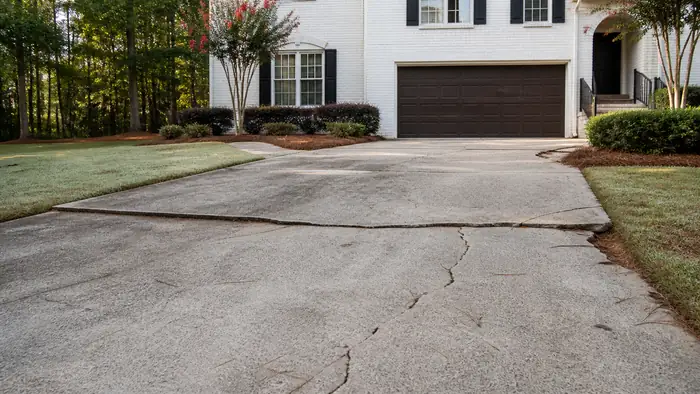
A worker examines an old driveway before replacement. at a painted-white-brick two-story home in Lawrenceville, GA, in early morning light.

Step 1: Site Assessment

We start by finding out why the slab failed, because patching a crack without knowing its cause just moves the crack somewhere else. We measure how far sections have dropped, check whether joints have opened, and look at where water runs off the roof and yard. Gwinnett County's dominant soil is well-drained Pacolet, but it varies across the county, so we test the ground at every site individually. Then we tell you plainly whether the slab can be repaired or needs replacing.

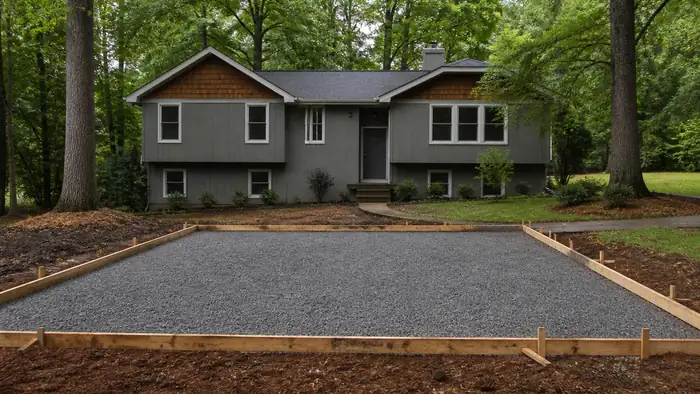
Crushed stone base is raked level inside driveway forms. at a grey split-level home in Lawrenceville, GA, after a rain shower.

Step 2: Site Preparation

Broken concrete comes out with a saw cut, not a sledgehammer, so the edge left behind is clean and square. We dig out any soft or washed-out base, bring in crushed stone, and compact it in lifts until it stops moving under the plate compactor. This is where most failed repairs went wrong the first time. With about 55 inches of rain a year here, we also grade the base so water leaves the slab instead of collecting underneath it.

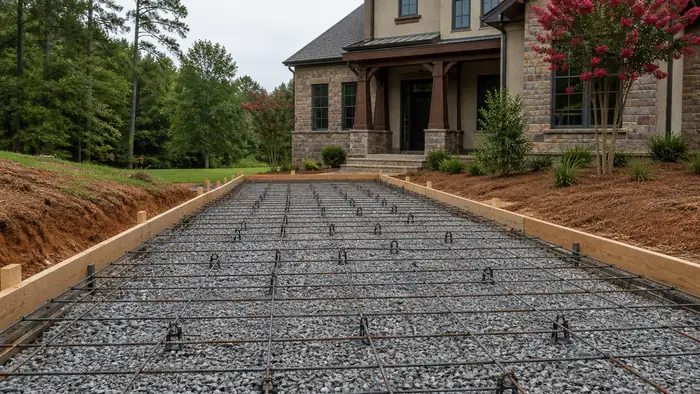
A worker ties rebar into a grid before a residential pour. at a stacked-stone and stucco home in Lawrenceville, GA, under an overcast sky.

Step 3: Forming & Reinforcement

Forms go up from straight lumber, staked and set to the grade of the surrounding surfaces so the repair lands flush. Where new concrete meets old, we drill into the existing slab and epoxy steel dowels in place. That keeps the two sections from settling at different rates. Inside the form, rebar or welded wire mesh sits on chairs at mid-depth. Mesh left lying on the stone does nothing, and it is one of the most common shortcuts we find.

A ready-mix truck discharges concrete into a driveway form. at a buff-brick ranch home in Lawrenceville, GA, in early morning light.

Step 4: Pouring

The mix is ordered for the job, and a driveway section gets a stronger mix than a patio. We check the slump when the truck arrives and turn it away if water has been added to make it easier to place. Extra water weakens the surface and leads to dusting and scaling later. The concrete goes in close to its final position, gets consolidated along the forms and around the dowels, and is struck off level with a screed.

Stamping mats are pressed into a patio surface to imprint a pattern. at a stacked-stone and stucco home in Lawrenceville, GA, under an overcast sky.

Step 5: Finishing

Timing matters more than technique here. We bull float to push the aggregate down, then wait until the bleed water is gone before working the surface again. Finishing too early traps that water, and the top flakes off. Driveways and walks get a broom finish for grip. Garage and interior slabs can be steel troweled smooth. Control joints are tooled or saw cut at spacing matched to the slab, so any cracking follows a straight line we chose.

Damp burlap covers a small slab section during curing. at a buff-brick ranch home in Lawrenceville, GA, in early morning light.

Step 6: Curing

Concrete does not dry. It cures, and it needs water to do it. Right after finishing we apply a curing compound or cover the slab with wet burlap or plastic sheeting, so the surface does not lose moisture faster than the inside. A slab that dries out early ends up with a weak, crumbly top and fine surface cracks. Foot traffic stays off for the first few days and vehicles longer. Average daily highs around 72°F give good curing conditions most of the year.

A roller applies sealer to a stamped patio surface. at a painted-white-brick two-story home in Lawrenceville, GA, after a rain shower.

Step 7: Sealing

Once the slab has cured, we seal it. A penetrating silane or siloxane sealer soaks into the concrete and keeps water out without changing how it looks, which suits plain broom-finished driveways. Stamped and decorative surfaces usually get an acrylic sealer that deepens the color and adds some sheen. We also fill the seam between old and new concrete with a flexible joint sealant, since that is where water tries to get in first. Resealing every few years keeps it working.

What Decides the Price of Concrete in Conyers

Square footage moves a quote less than most people expect. What moves it is what we find around the slab: what sits underneath, how a truck gets to it, and what the new surface has to carry. Everything below is something you can walk out and check on your own property.

What changes the priceWhich wayWhy
Old concrete that has to come outcosts moreBreaking out, loading and hauling the old slab is labor and disposal before any new work starts.
Roots, stumps or buried debris under the slabcosts moreSoft spots get dug out and refilled with compacted base. Skip that and the new slab sinks the same way the old one did.
Repairing one section instead of the whole slabcosts lessIf the surrounding concrete is sound, we cut out the failed section and tie new concrete into it.
Truck access to the workcosts less when openA mixer that backs up to the forms pours straight in. A fenced backyard means pumping or wheelbarrows.
Thickness and reinforcement the job calls forcosts moreA driveway that carries a truck needs more depth and steel than a walkway.
Where water sits after a stormcosts more if it poolsWith about 55" of rain a year, standing water needs somewhere to go: regrading, a drain, or a pitched surface.
Soil conditions under the sitecosts more if weakPacolet soil drains well, but conditions vary, so every site is tested before work starts.
Stamped or decorative finishcosts morePattern, color and sealer add materials and time on pour day.

When you compare bids, line them up item by item. Look for slab thickness, reinforcement, base preparation, how much old concrete comes out, and how drainage is handled. A lower number usually means one of those was left off.

Common Questions From Conyers Owners

Should a damaged Conyers patio be repaired or replaced?

It depends on what sits under the surface. If the base is sound and the damage is shallow (scaling, spalling, hairline cracks, a chipped edge), a repair usually makes sense. If sections have sunk, heaved, or rock underfoot, the problem runs deeper than the slab, and patching the top only hides it for a while. Stamped and decorative patios are harder to patch invisibly, which sometimes tips the call toward replacement.

How does the crew minimize downtime and maintain commercial site safety during active business operations in Conyers?

We plan the work around how the business actually runs. Demolition and pours are broken into phases so entrances, parking and deliveries keep moving while one section is closed. Work zones are fenced and marked. Saw cutting is done wet to keep dust out of doorways and off parked cars. Where a property can't close during the day, we talk through early or off-hours scheduling at the estimate. Nothing gets poured until that plan is agreed.

What areas beyond Conyers does Lawrenceville Best Concrete serve?

Our work covers metro Atlanta, on residential and commercial projects alike. Every town we serve gets the same crew, the same materials and the same standard of work, whether the job is a driveway, a slab or a stamped patio. The full list of towns is set out elsewhere on this page. If your property sits near Stonecrest or anywhere else in the area and you aren't sure it's covered, call and ask.

Do you coordinate ready-mix delivery and placement for Conyers job sites?

Yes. We order the ready-mix, time the delivery against the pour, and handle placement on site. That means matching the mix to the job, checking truck access, and deciding whether the concrete goes in by chute, buggy or pump. On a tight Conyers lot, access often decides the method more than anything else. Forms and reinforcement are checked and the crew is in place before the first truck arrives.

How deep do commercial foundations need to be in Conyers?

There is no single depth that fits every building. Footing size and depth come from the structural drawings, the loads the building carries, and what the ground shows when it's tested. Pacolet soil, which drains well, is the dominant type across Gwinnett County, but conditions vary, so every site is tested individually before work starts. We build to the engineer's specification. If you don't have drawings yet, that is the first step.

Are you licensed and insured?

Ask for current license and insurance documents in writing before any contractor starts work on your property. Check that the name on them matches the name on your estimate, and confirm with the issuing office that they are current. That applies to every concrete job, from a small patio repair to a commercial slab. It is the simplest way to know who is responsible if something goes wrong.

Get a Free Estimate

Get a FREE Quote

Tap to call +1 470-229-2076