+1 470-229-2076
Stamped concrete patio in a running-bond brick pattern at a painted-white-brick two-story home in Lawrenceville, GA, under bright midday cloud.

Stamped Concrete Patterns in Lawrenceville, GA

We are a concrete contractor in Lawrenceville, Georgia, and stamped concrete makes up a good share of the flatwork we pour each season. Patios, walkways, front entries, pool decks. The pattern is pressed into the slab while the concrete is still green, so it belongs to the surface itself instead of sitting on top like a coating that wears thin at the high spots. Color goes in the same day, either mixed through the load or broadcast across the top.

The median house in town went up around 1987, so a fair number of the patio slabs and sidewalk runs we look at are still the original pour. Once concrete has cracked through and one side has settled, stamping over it does nothing worth paying for. We break it out, find what the old base was doing wrong, and start from ground that will hold the new slab flat. That is not the interesting part of the job. It decides everything that comes after it.

Every slab we pour gets a compacted base, rebar or wire mesh, and control joints cut where the concrete is likely to move. Work in Suwanee runs the same way as work here in town: same mix, same crew, same order of operations. Stamped patio, new driveway, a sidewalk poured to match what is already there. Call for a free estimate and tell us what you are picturing. We would rather spend the extra hour on the subgrade than come back to a corner that has dropped.

Call +1 470-229-2076

Licensed, Bonded, and Insured ยท A combined 15 years of experience

Get a FREE Quote

We warranty all of our work because we believe in what we do.

What Stamped Concrete Patterns Involves

Stamped concrete patio in a running-bond brick pattern at a painted-white-brick two-story home in Lawrenceville, GA, under bright midday cloud.

Stamped concrete

Stamped concrete is a poured slab that takes its texture from mats pressed into the surface while the concrete is still plastic. We place it four inches thick over compacted base, run wire mesh or rebar, then float, apply color hardener and release, and stamp before the set catches up with us. Timing is the whole job. Stamp early and the mats sink; stamp late and the impressions come out faint and uneven. A concrete sidewalk follows the same sequence on a smaller scale.

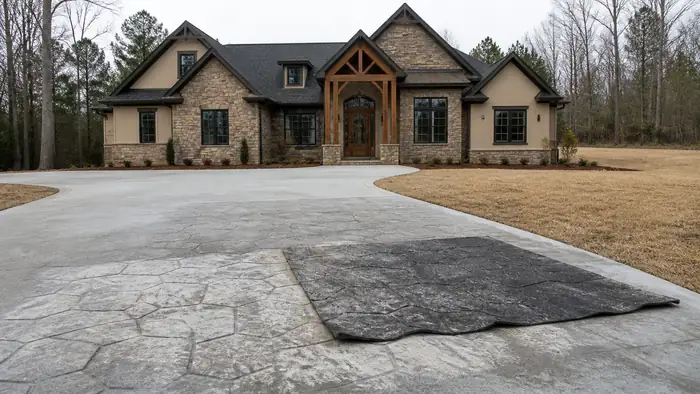
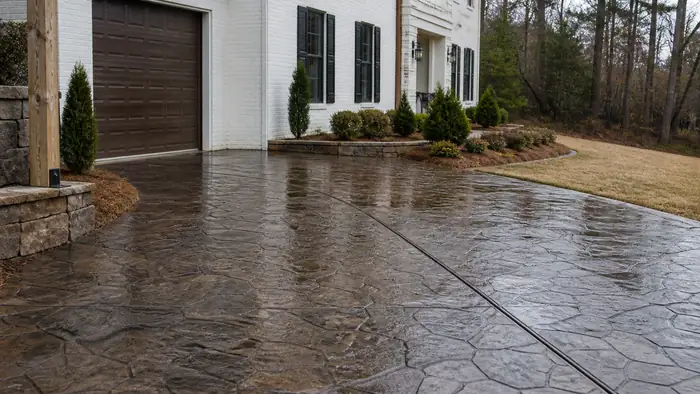
Stamped concrete driveway in a fan-set cobblestone pattern at a brick-and-siding two-story home in Lawrenceville, GA, under bright midday cloud.

Stamped concrete driveway

Driveways carry weight, so a stamped concrete driveway is built heavier than a patio: five inches of concrete over well compacted subgrade, rebar set on chairs, and control joints cut early to steer where it cracks. We hide those joints inside the pattern lines where the layout allows. What fails on a driveway is usually the base or the sealer rather than the stamp. Settled fill telegraphs through, and tire scuffing wears the finish at the turn-in.

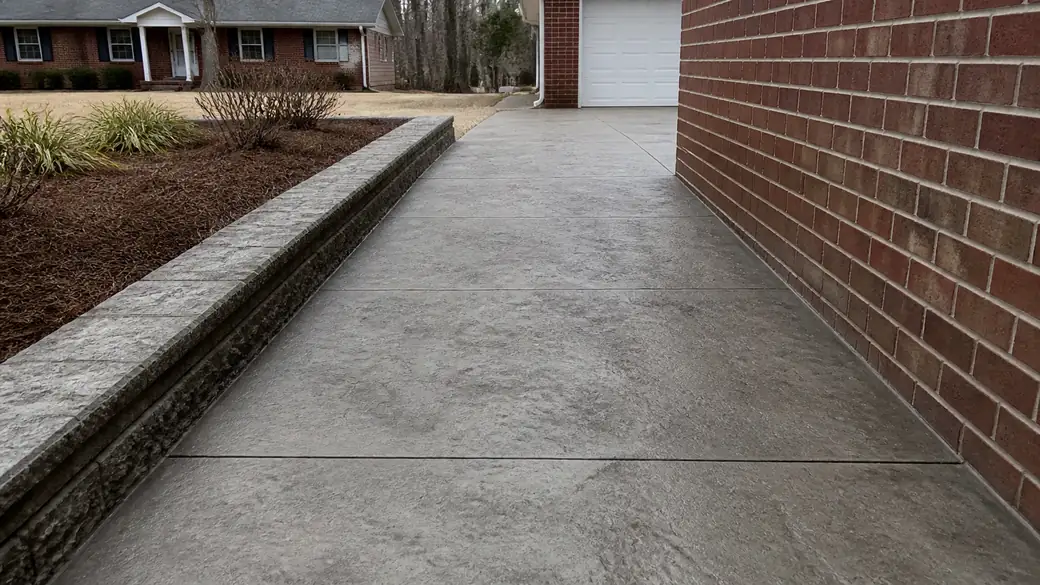
Close-up of stamped concrete texture and hand-tooled joint lines at a brick-and-siding two-story home in Lawrenceville, GA, under bright midday cloud.

Stamped concrete patterns

Pattern choice comes down to scale. Ashlar slate and seamless texture suit wide open areas, running bond brick and cobblestone read better along a sidewalk or a border, and wood plank needs a straight run to look convincing. Color comes from a base hardener with a darker release worked into the grout lines and washed back. Ask any concrete contractor to show you a poured slab instead of a brochure. On commercial concrete we keep the pattern simpler, since traffic dulls fine detail.

Stamped Concrete Patterns in metro Atlanta

Most of the houses we stamp around Lawrenceville went up near the median build year of 1987, and that shapes the work more than any pattern choice does. A patio poured with the house is close to forty years old now. Some of it is sound and just tired looking. Plenty of it has settled at one corner, or spalled where a downspout has been dumping on the same spot for decades. We read the existing slab before anyone talks about ashlar slate or a running bond brick, because what sits under the stamp decides how long the stamp holds its color and its edges.

Permits run through the City of Lawrenceville, and we pull what the job needs instead of leaving that on the homeowner. Access matters about as much as paperwork on a lot of this vintage: mature trees, fenced back yards, and a gate too narrow for a buggy all change how concrete actually reaches the pour. Metro Atlanta traffic decides the morning more than anything else, so a job in Duluth and a job here both start early. We walk the route first. If a truck cannot get close, you hear it from us well before the day of the pour.

Stamped work fails in ways plain flatwork does not, which is worth knowing before you pick a pattern. Color goes flat when release is washed off too hard or the slab gets sealed before it has cured out. Patterns lose their definition when the mats go on late and the mud has stiffened past taking a clean imprint. Control joints cut carelessly will run a crack straight through the middle of a stone. None of that is exotic. It is timing, enough hands on the slab at the right moment, and a willingness to move a pour a day when the weather turns on us.

How the Work Runs

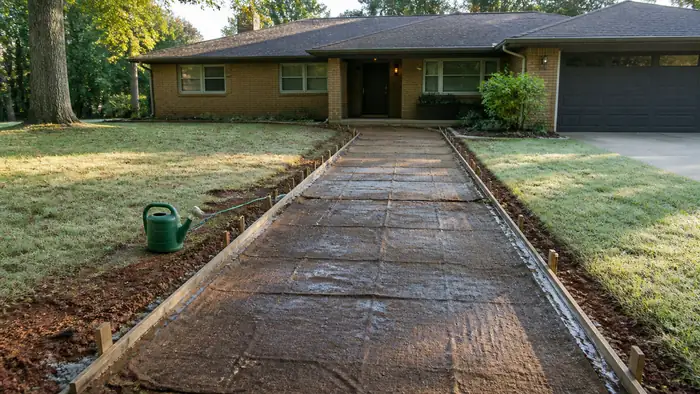
String lines and grade stakes laid out across a yard before a pour at a tan-brick colonial in Lawrenceville, GA, under bright midday cloud.

Step 1: Site Evaluation

We walk the area with you and look at what the concrete has to sit on. Grade, drainage, how water leaves the site, where downspouts empty, whether tree roots run under the path. On a stamped patio we check the slab's relationship to the door threshold, because a pattern looks wrong if the surface pitches back toward the house. We measure square footage, note access for the truck, and talk through pattern and color while standing on the spot.

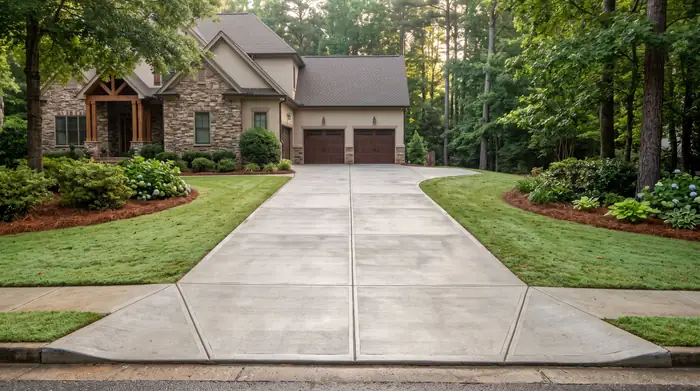
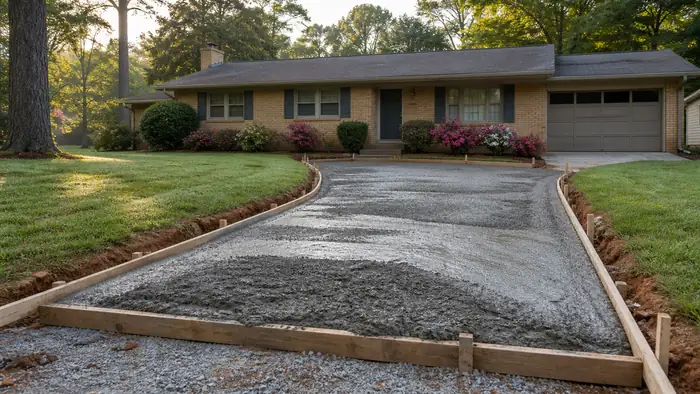
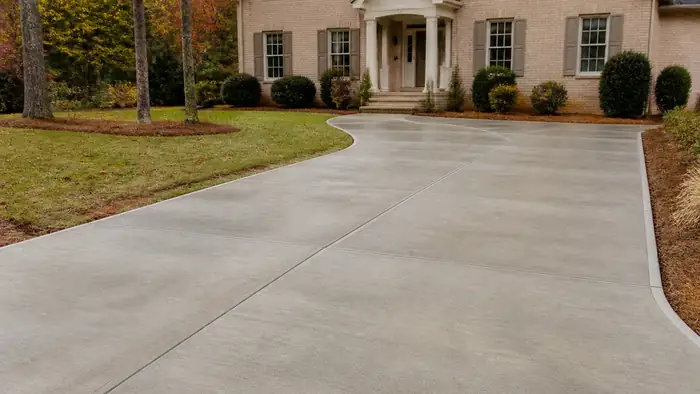
Concrete driveway and walk at a home, the kind of job an estimate covers at a red-brick ranch home in Lawrenceville, GA, under bright midday cloud.

Step 2: Written Estimate and Permits

You get the scope in writing: square footage, slab thickness, reinforcement, the stamp pattern, base and release colors, joint layout, and sealer. Anything we are not doing gets named too, so there is no argument later about who was hauling off the old slab. If the job needs approval before we break ground, we handle that paperwork and schedule the pour around it rather than starting and hoping.

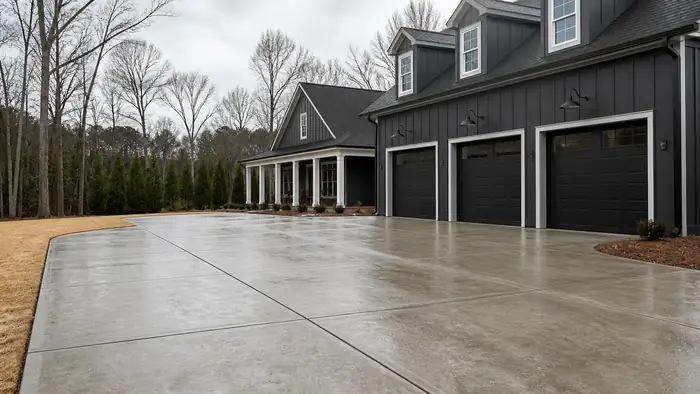
Broken-out concrete removed and the base rebuilt before a new pour at a charcoal farmhouse-modern home in Lawrenceville, GA, in early morning light.

Step 3: Demolition and Base Prep

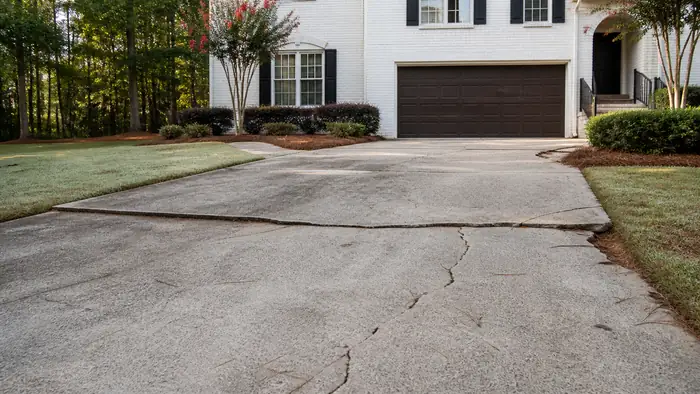
Old concrete comes out in pieces and leaves on a truck. Then the real work starts. We excavate to depth, cut out soft spots and organic material, and bring in crushed stone that gets spread in lifts and compacted with a plate compactor or roller. Base is where most failed concrete driveways actually fail. Skip the compaction and you get a slab that cracks in a year no matter how thick it was poured.

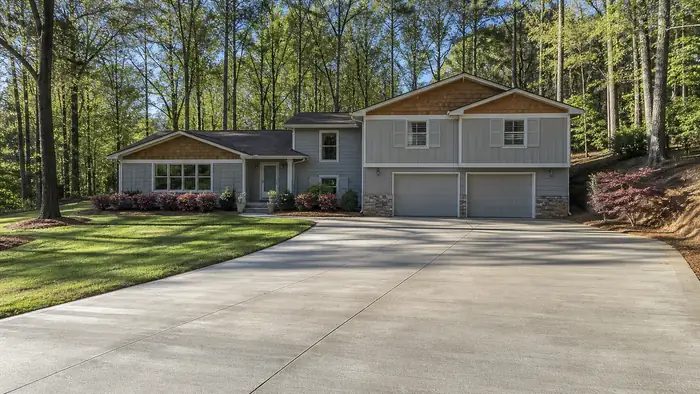
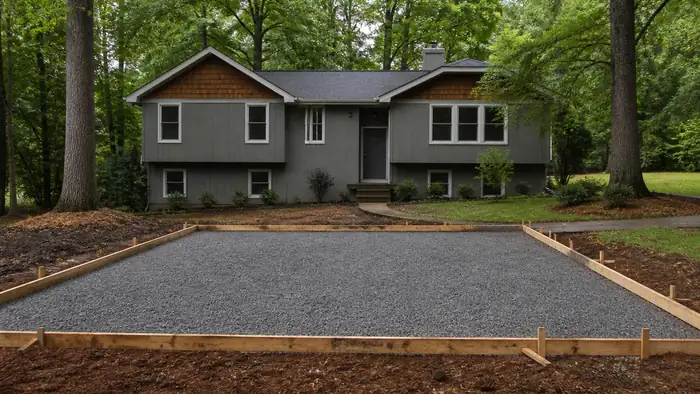
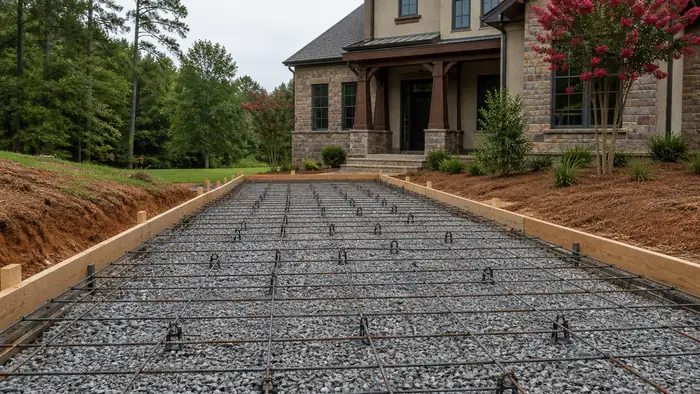
Wooden forms and rebar grid set and tied, ready for concrete at a grey split-level home in Lawrenceville, GA, in late afternoon light.

Step 4: Forming, Steel and the Pour

Forms go in set to the elevations we measured, with the fall pitched away from the structure. Patios and sidewalks generally run four inches with wire mesh or rebar on chairs, kept up in the slab instead of lying on the ground where it does nothing. Driveways get poured thicker with rebar mats. On pour day we place, screed and bull float, then wait. Stamping happens on the concrete's schedule, not ours.

Freshly finished concrete slab curing under a clean broom texture at a buff-brick ranch home in Lawrenceville, GA, after a rain shower.

Step 5: Finishing, Curing and Final Walkthrough

Release color goes down, mats get set in sequence and tamped, and we detail the edges and touch up the grout lines by hand once the mats come off. Control joints get cut early, placed to follow the pattern where we can. Curing takes days, and sealer waits until the slab is ready for it. Then we walk it with you: joints, color, drainage, and how to care for concrete installation like this through its first year.

What Decides the Price

Identical patios can land far apart on price, and the reason is almost always something you can walk outside and look at. We bid the same way in Lawrenceville, Snellville, Suwanee, Duluth and Sugar Hill, and anywhere else we work in metro Atlanta. Here is what moves the number.

What changes the priceWhich wayWhy
An old slab already in placecosts moreIt gets broken out, loaded and hauled off before any new concrete goes down.
A truck that can back within a chute lengthcosts lessConcrete runs straight from the drum into the forms instead of down a line of wheelbarrows.
Gate, fence or narrow side yard between street and pourcosts morePumping or buggying the mix in adds equipment and hands.
Rebar in place of wire meshcosts moreSlabs carrying vehicle weight want heavier reinforcement than a patio does.
Thickness the slab calls forcosts moreA driveway takes more concrete per square foot than flatwork nobody parks on.
Roots, stumps or soft fill under the padcosts moreThe subgrade comes out and gets replaced with compacted base.
Ground that already sheds water away from the housecosts lessNo regrading and no drain to set before the pour.
Borders, extra release colors, multiple patternscosts moreEach one adds labor during the stamping window.

Comparing bids, pull out slab thickness, reinforcement type and spacing, base depth, and whether demo and haul-off are included. A lower number often describes a thinner slab. Have everyone price the same one.

Questions About Stamped Concrete Patterns

What does stamped concrete cost compared with plain in Lawrenceville?

Stamped costs more than a plain broom-finished slab. The concrete itself is the same; the difference is labor, color, texture mats, release agent and sealer, plus the timing pressure of stamping a slab before it sets up. Pattern complexity and the number of colors move the number. We walk the area, measure it, and give you a figure for your slab rather than a per-foot guess over the phone.

How often does stamped concrete need resealing in Georgia?

Most stamped patios and driveways want a fresh coat every two to three years. Sun exposure drives it. A patio under tree cover holds its sealer longer than an open driveway that bakes all afternoon. You will see it going: color looks flat and dry, water stops beading, the surface starts picking up stains. Clean the slab, let it dry fully, then reseal.

Can you stamp over an existing slab in Lawrenceville?

No, not with real stamped concrete. Stamping happens in wet concrete, so an existing slab cannot be stamped. What we can do is pour a bonded overlay on top and stamp that, provided the slab underneath is sound: no working cracks, no settlement, no spalling. Plenty of homes here were built around 1987, and those older slabs need an honest look before anyone pours over them.

How does stamped concrete hold its color in Georgia sun?

It holds well when the color goes in right. Integral color mixed through the concrete stays through the depth of the slab, so surface wear does not expose gray. Color hardener broadcast on top gives a denser, harder surface and richer tone. Either way, the sealer carries the UV protection, and that is the part that wears out. Keep sealer on it and the color stays put.

Is stamped concrete slippery in Lawrenceville rain?

It can be, mostly because of the sealer rather than the concrete. A glossy film-forming sealer on a smooth pattern gets slick wet. We mix a fine grit additive into the sealer coat on walkways, pool decks and any sloped approach, which breaks up that film without changing how the surface looks. Deeper textures like slate and stone patterns also shed water better than shallow ones.

What stamped patterns are popular around Lawrenceville, Georgia?

Ashlar slate is the one we pour most, in a running-bond or random layout, usually in tans and grays that sit close to the brick and siding on houses out this way. Old-world cobble and running-bond brick borders show up on driveways and sidewalk installation, often with a plain field inside a stamped edge. Wood plank has picked up on covered porches.

Get a Free Estimate

Get a FREE Quote

We warranty all of our work because we believe in what we do.

Tap to call +1 470-229-2076