+1 470-229-2076
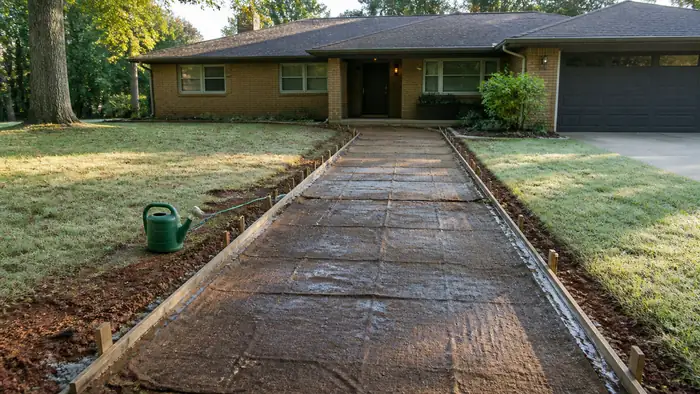
Concrete walkway meeting the driveway apron and front steps at a buff-brick ranch home in Lawrenceville, GA, under bright midday cloud.

Walkway & Sidewalk Installation in Lawrenceville, GA

We are a concrete contractor in Lawrenceville, Georgia, and walkways and sidewalks make up a good share of what we pour. A front walk takes more foot traffic than any other slab on a residential property, and it is the first thing a person sees on the way to your door. We build them plain and broom finished, in colored or stamped concrete, and in exposed aggregate. Straight runs from the drive to the porch. Curved paths around a side yard to a patio or a gate. Plenty of homeowners want a new walk to sit right next to a driveway that is already down, and we can hold a finish close to what is there.

Permits for this work go through the City of Lawrenceville, and we handle that paperwork instead of leaving it on your plate. Much of the housing stock here dates to around 1987, so a lot of original walks have been in the ground for decades. Cracked. Settled. Lifting at the joints, or too narrow for two people to walk side by side. We tear those out and replace them, and we pour new sidewalk for additions, remodels and houses going up for the first time, on the same terms we work anywhere from here out to Suwanee. Call for a free estimate.

Call +1 470-229-2076

Licensed, Bonded, and Insured ยท A combined 15 years of experience

Get a FREE Quote

We warranty all of our work because we believe in what we do.

What Walkway & Sidewalk Installation Involves

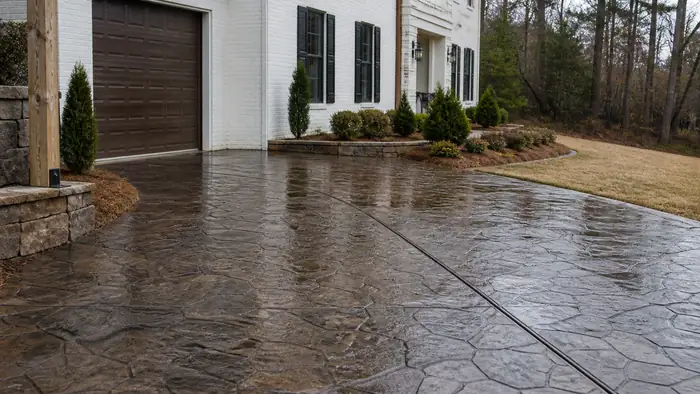
Curving concrete walkway crossing a front yard at a painted-white-brick two-story home in Lawrenceville, GA, in late afternoon light.

Concrete walkway

A concrete walkway is flatwork, so most of the outcome is decided before the pour. We strip sod and topsoil, cut down to firm subgrade, and compact a gravel base so the slab sits on something that will not settle. Four inches of concrete is standard for foot traffic, with wire mesh or rebar tied in where the run is long or the ground has been disturbed. Control joints go in at spacing that matches the slab thickness, because that is where the cracking wants to happen anyway.

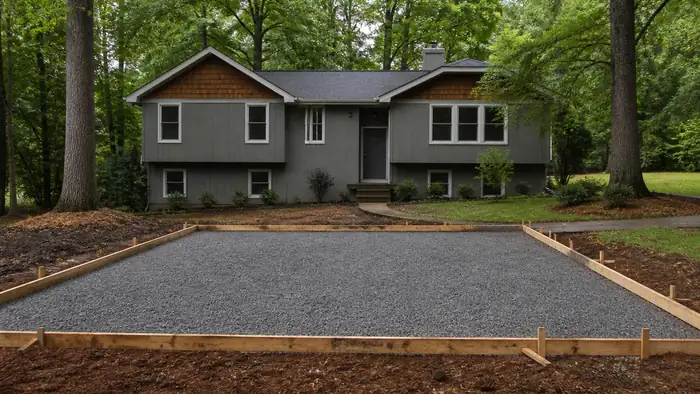
New concrete sidewalk being formed along a street with a driveway ramp at a grey split-level home in Lawrenceville, GA, in clear late-morning sun.

Sidewalk installation

Sidewalk installation along a street or a shared frontage carries requirements a backyard slab does not: width, cross slope for drainage, and a consistent grade from one property line to the next. We form to those lines, set the base, and pour a concrete sidewalk with a broom finish for traction. Where a driveway crosses, the slab gets thickened and reinforced to take vehicle weight, since a four inch panel under a truck tire breaks at the joint.

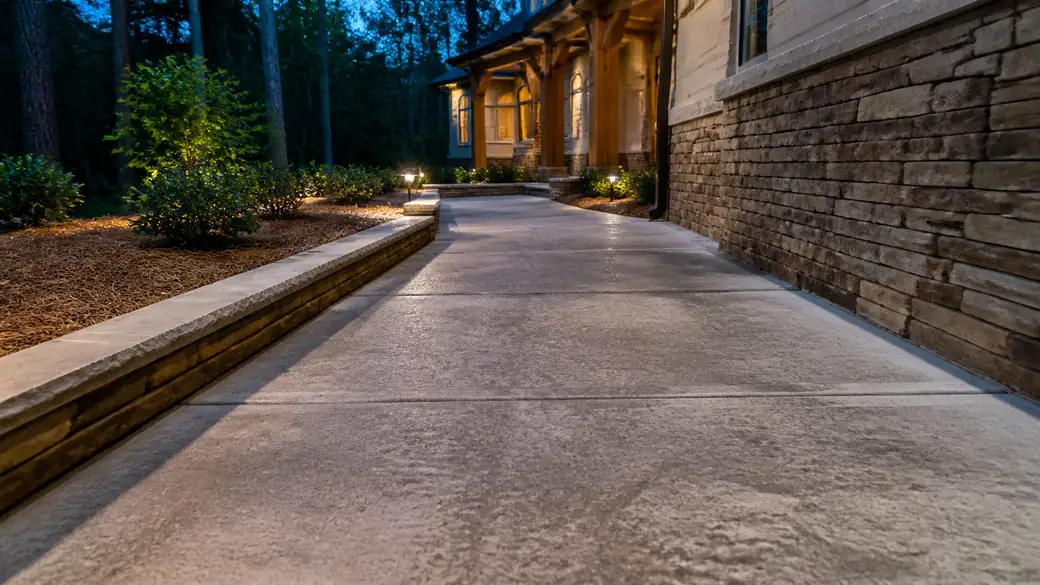
Narrow exposed-aggregate concrete garden path bordered by plantings at a charcoal farmhouse-modern home in Lawrenceville, GA, in late afternoon light.

Concrete path

A concrete path through a yard runs where people already walk, which is usually not a straight line. We lay out the route with flexible forms, hold a steady width, and pitch the surface slightly so water sheets off instead of standing on it. Finish is a choice: broom for grip, exposed aggregate for texture underfoot, or stamped concrete and colored concrete when the path should read as part of the landscaping rather than a utility run.

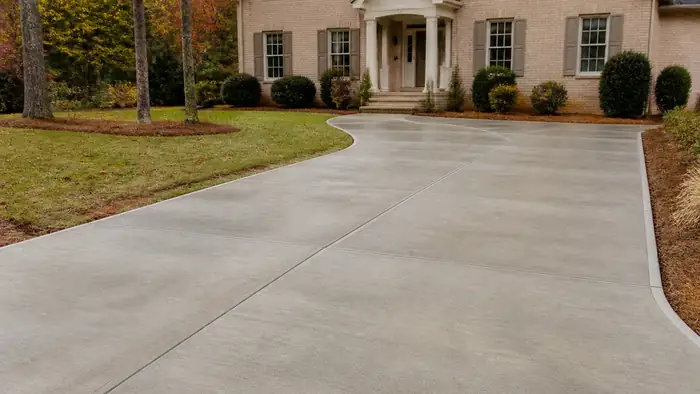
Concrete walkways connecting a driveway, front door and side gate at a tan-brick colonial in Lawrenceville, GA, after a rain shower.

Walkways and pathways

Walkways and pathways connect things, so we look at the whole route before quoting anything. Front door to driveway, side gate to patio, parking area to entrance on commercial concrete work. Each stretch may need different thickness, different reinforcement, and different transitions where new concrete meets an existing slab. As a concrete contractor we tie those joints properly, isolating new work from old so the two move independently instead of cracking each other apart.

Walkway & Sidewalk Installation in metro Atlanta

Most of the houses we pour for went up around the same stretch of years. The median home in Lawrenceville was built in 1987, which means the original front walk has been in the ground a long while. Concrete that old has usually done its job. It has also picked up hairline cracks, sunken panels, and a slope that sends water back toward the porch instead of away from it. Replacing that walk is ordinary concrete work, not a rescue operation, and it changes the front of a house more than people expect.

Newer flatwork behaves differently because of what sits underneath it. We compact the subgrade, set forms to a grade that actually drains, and run wire mesh or rebar sized to the span and the traffic the walk will carry. Control joints go in at a spacing that gives the slab somewhere to crack, which is the entire point of putting them there. Where a sidewalk ties into a driveway, an isolation joint keeps the two slabs from fighting each other as they move.

Finish is the part homeowners picture first. A broom finish is the plain answer, it wears evenly, and it suits most of the houses on these streets. Stamped concrete, colored concrete, and exposed aggregate all take more hand work at the pour, and each one sits better against a house of this vintage than a bare gray strip does. We handle residential walks and commercial concrete with the same crew, in Lawrenceville and out toward Duluth. Call for a free estimate.

How the Work Runs

String lines and grade stakes laid out across a yard before a pour at a tan-brick colonial in Lawrenceville, GA, under bright midday cloud.

Step 1: Site Evaluation

We walk the route with you and look at what the walkway has to do. Where water goes, how the ground falls, whether tree roots are already lifting what is there. We check the slab thickness at any existing edge and probe the soil under it. Width matters too: a path two people can pass on runs wider than one people search for by habit. We measure, note utilities, and photograph the whole run.

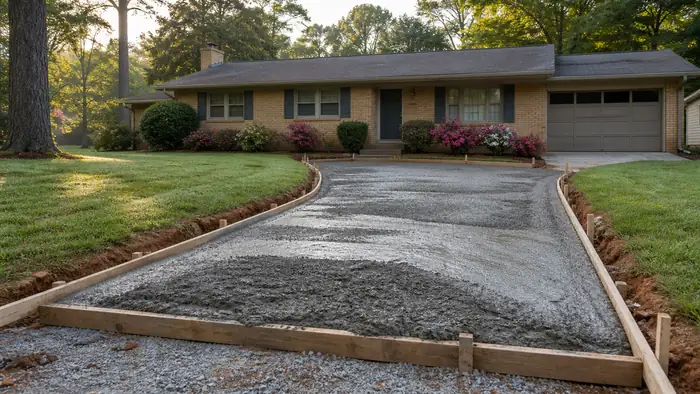
Concrete driveway and walk at a home, the kind of job an estimate covers at a red-brick ranch home in Lawrenceville, GA, under bright midday cloud.

Step 2: Written Estimate and Permits

You get the scope in writing: square footage, slab thickness, reinforcement, finish, control joint layout, and how we handle the tie-in to any existing concrete driveway or stoop. If a permit applies, we pull it before we break ground. Written estimates stop the common argument later, which is almost always about what the edge treatment was supposed to be or where the path was meant to end.

Broken-out concrete removed and the base rebuilt before a new pour at a charcoal farmhouse-modern home in Lawrenceville, GA, in early morning light.

Step 3: Demolition and Base Prep

Old concrete comes out in sections, gets loaded, and hauled off. Then the real work: we excavate to depth, cut back soft or organic soil, and bring the subgrade to a compacted graded base. Most failed sidewalks we replace failed here, not in the mix. Loose fill under a slab settles, the slab spans the void, and it cracks. Compaction in lifts is what prevents that.

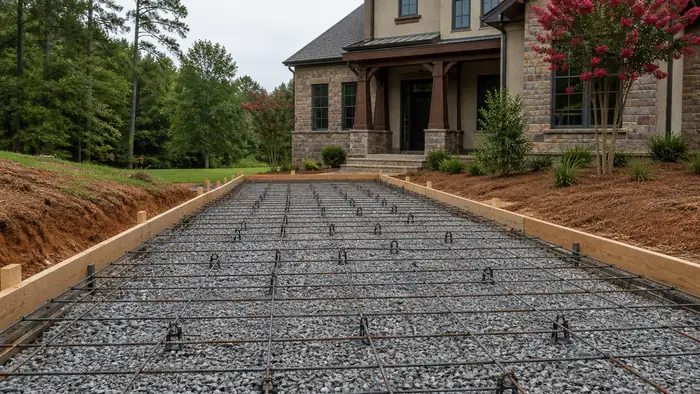
Wooden forms and rebar grid set and tied, ready for concrete at a grey split-level home in Lawrenceville, GA, in late afternoon light.

Step 4: Forming, Steel and the Pour

Forms go in staked and strung to line, set to the fall we want so water runs off the surface and away from the house. Walkways carry wire mesh or rebar depending on span and what crosses them. Both sit up on chairs, in the slab, not on the ground. We pour to a consistent thickness, screed, and bull float before bleed water comes up.

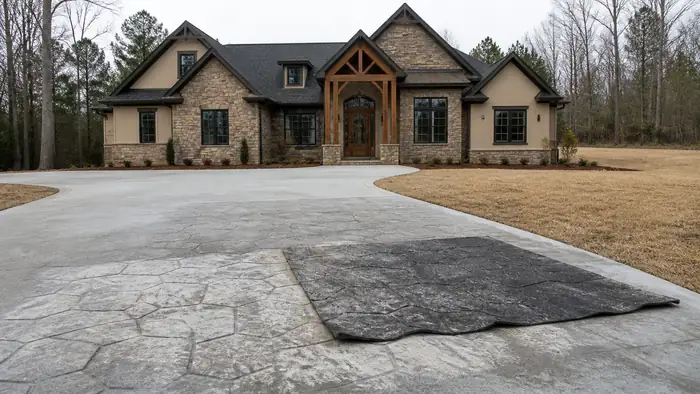
Freshly finished concrete slab curing under a clean broom texture at a buff-brick ranch home in Lawrenceville, GA, after a rain shower.

Step 5: Finishing, Curing and Final Walkthrough

Broom finish is standard on sidewalks because it holds traction wet. Stamped or exposed aggregate takes longer and gets sealed. We tool the edges, cut control joints at the right spacing, and cure the concrete rather than letting it dry fast. Then we walk it with you. Concrete installation like this stays closed to foot traffic for days and to vehicles longer, and we tell you exactly how long.

What Decides the Price

Two walkways of the same length can land at different numbers, and most of the reasons are visible from your back door before anyone quotes the job. We price the work the site asks for. Here is what moves it.

What changes the priceWhich wayWhy
An old slab, brick or pavers already in the pathcosts moreIt has to be broken out, loaded and hauled off before any new concrete goes down
How close the truck can park to the pourcosts less when closeA long run means wheelbarrows or a pump instead of chuting straight into the forms
Thickness the use calls forcosts more when thickerA walkway that trucks or trailer tires cross needs more depth than one that only takes foot traffic
Rebar instead of wire meshcosts moreHeavier reinforcement is more steel and more time tying it off the ground
Tree roots, stumps and buried irrigation in the trenchcosts moreEach one gets cut, rerouted or dug around by hand
Ground that stays soft or drains toward the housecosts moreGrading, base stone and pitch away from the foundation all get added
Curves, steps and landingscosts moreFormwork takes longer than a straight run
Stamped or colored finish over a broom finishcosts moreMore material, more hands and more finishing time on the same slab

Ask each bidder to write down slab thickness, reinforcement, base depth and whether tear-out and haul-off are included. Bids that leave those blank are not describing the same job.

Questions About Walkway & Sidewalk Installation

How long does a Lawrenceville walkway take from pour to walkable?

Most walks take foot traffic the day after the pour, and we tell you when yours is ready rather than leaving you to guess at it. Cool, damp weather slows the set. Heavier use, like carrying furniture across it, waits longer than that. Forms come off first, then we finish the joints. We do this work in Lawrenceville, Snellville, Suwanee, Duluth and Sugar Hill on the same terms.

Do you have to meet accessibility rules for a walkway in Lawrenceville?

No, not for a private walk running between your own door and driveway. Commercial concrete and anything crossing the public right of way are held to accessibility standards, and we build those to spec: consistent width, gentle slope, no lip at the transitions. We check what applies to your particular job before the forms go in. Plenty of homeowners want those dimensions anyway, because they make a walk easier to use.

Can you pour a walkway over tree roots on a Lawrenceville lot?

Yes, though never directly on top of live roots. Concrete poured over a growing root lifts within a few seasons, and then you own a trip hazard instead of a walk. We look at what the tree is doing, then route the path around the root zone, step it, or cut the smaller roots cleanly where the tree can take it. Sometimes the answer is simply moving the walk over.

What stops a sidewalk lifting and becoming a trip hazard in Georgia?

Base work, mostly. A compacted subgrade that drains, uniform slab thickness, and joints cut at sensible spacing so the concrete cracks where we tell it to rather than wherever it likes. Wire mesh or rebar keeps the pieces tied together if the ground does move. Roots cause most of the lifting we see, so we handle those before the pour. Bad drainage under a slab undoes good flatwork.

How wide should a front walkway be on a Lawrenceville property?

Wide enough for two people to walk side by side without one of them dropping back. Narrower than that reads as a service path, and it feels tight the first time somebody carries a box up to the door. We scale the walk to the house as well: a wide entry and a deep porch want more walk, not less. Curved runs need a little more width than straight ones.

Who is responsible for the public sidewalk outside a Lawrenceville property?

That depends on the stretch, and the two halves of the question have separate answers. The concrete sidewalk out front usually sits within the public right of way, while upkeep often falls to the adjoining owner. Before we touch anything past your property line, we confirm who holds authority over that section and what approval the work requires. Inside your line, the walk is yours and so are the decisions.

Get a Free Estimate

Get a FREE Quote

We warranty all of our work because we believe in what we do.

Tap to call +1 470-229-2076