+1 470-229-2076
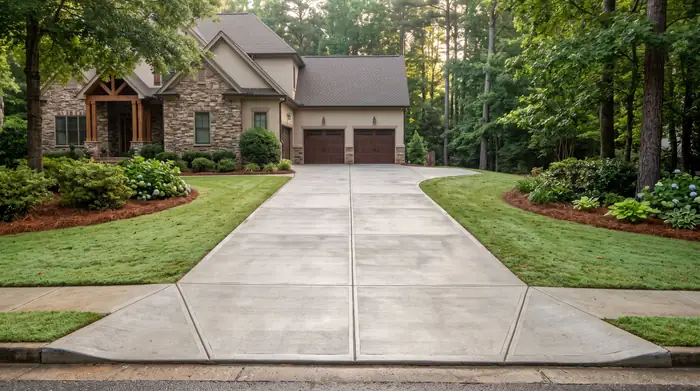
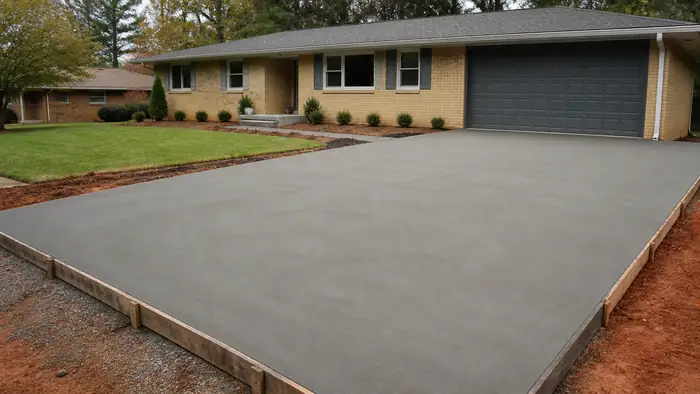
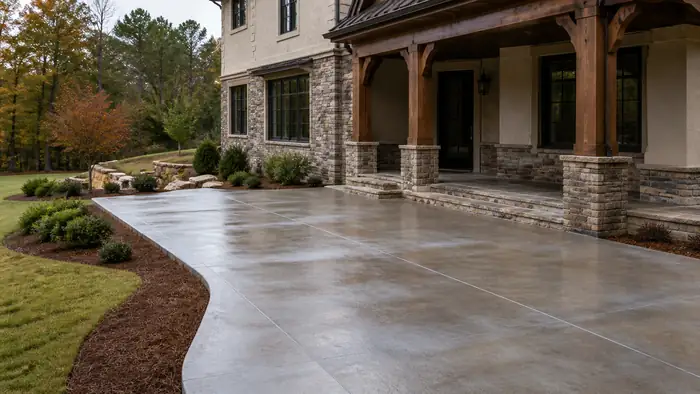
Wide view of finished concrete flatwork across the front of a home at a buff-brick ranch home in Lawrenceville, GA, in clear late-morning sun.

Commercial Concrete for Offices & Corporate Properties in Lawrenceville, GA

We pour concrete for offices, corporate campuses and the properties around them in Lawrenceville, Georgia. That covers parking areas and their aprons, loading zones, dumpster pads, entry landings, ADA ramps and the sidewalk that carries a person from a parking space to the front door. Most of a commercial site should be plain broom finish, and we say so. Some of it is stamped concrete at an entrance or a courtyard, where the surface is the first thing a tenant or a visiting client actually sees. We do the flatwork and everything holding it up: forms, grade, rebar or wire mesh, pour, finish, cure.

Commercial sites stay occupied while the work happens. People park, take deliveries and walk in and out on a schedule that does not pause for a concrete contractor, so we keep a clear route to every door. Bad commercial concrete tends to fail for dull reasons: a thin slab, no reinforcement where the trucks turn, joints cut too late, subgrade nobody compacted. None of that shows on the day it gets finished. It shows in year three, at the corner where every delivery truck cuts the turn short. We make those calls deliberately. If you manage an office property in Lawrenceville or out toward Duluth, call for a free estimate.

Call +1 470-229-2076

Licensed, Bonded, and Insured ยท A combined 15 years of experience

Get a FREE Quote

We warranty all of our work because we believe in what we do.

What Commercial Concrete for Offices & Corporate Properties Involves

Commercial concrete on an office or corporate property covers everything people walk on, park on, and roll a hand truck across. Parking areas, aprons, loading and dumpster pads, entry landings, and the concrete sidewalk running from the lot to the front door. Some of it is plain flatwork. Some of it is stamped concrete or colored concrete at the entry, where the surface is part of what a tenant sees first. ADA items belong here too: ramps, level landings, and truncated dome panels where a walk meets pavement. Tear-out of the failed sections and hauling the old concrete off is part of it.

Underneath, a commercial slab is built heavier than the flatwork on a house. Delivery trucks and loaded dumpsters call for thicker sections, a compacted base, and rebar set on chairs rather than wire mesh alone. Mix and reinforcement get chosen for the load each area actually takes. Control joints are cut early and laid out so the cracks land where we put them. Pitch matters as much as thickness, because water that stands on a pad works its way into every joint. Finishes follow use: broom texture for traction on a sidewalk, exposed aggregate where grip and appearance both count.

Failures usually start below what anyone can see. A concrete sidewalk poured over soft fill will rock and lip at the joints within a few years, and no finish work fixes that later. Rebar dropped on the ground instead of tied up in the slab does nothing. Spalling often traces back to a surface troweled while bleed water was still sitting on it. Panels opened to truck traffic before the concrete has strength crack through the middle, not at the joints. Concrete installation is unforgiving that way.

Getting it right on an occupied property is mostly sequencing and forming. We pour in sections so a tenant keeps a door, a walk, and a way to the parking they use. Forms get set to hold the grade we want, not the grade the old slab settled to. Barricades stay up through cure. As a concrete contractor we handle commercial concrete in Lawrenceville and the surrounding metro Atlanta towns, Snellville, Suwanee, Duluth and Sugar Hill, on the same terms in each. Call for a free estimate.

Commercial Concrete for Offices & Corporate Properties in metro Atlanta

Office parks, medical buildings and corporate campuses across metro Atlanta sit on concrete that carries more traffic than any residential slab. We pour and replace that flatwork: entry walkways, loading aprons, dumpster pads, sidewalks and parking lot slabs. Lawrenceville's median home dates to 1987, and much of the commercial building around it went up on the same schedule. Concrete from that era has been in service a long while. It shows. Most of what we handle is repair and replacement rather than new construction.

Age shows up in specific ways. Slabs settle at the joints, curled edges catch a heel, and control joints cut too shallow have wandered into random cracks. Where downspouts and irrigation run across a walk, the subgrade washes out and the panel loses its support. We look at what is under the concrete before we plan a replacement, because a slab that broke once for a drainage reason breaks again if you only change the top. The fix has to reach the cause.

Doing it right on a working property means the tenants keep their doors. We stage the pours so entrances stay open, form and tie rebar or wire mesh to suit the load, and set thickness and jointing for trucks rather than cars. Exposed aggregate and stamped, colored concrete hold up in these settings when the base under them is right. Cure time is what it is, and we say so plainly. Call for a free estimate on commercial concrete work anywhere from Lawrenceville out toward Duluth.

How the Work Runs

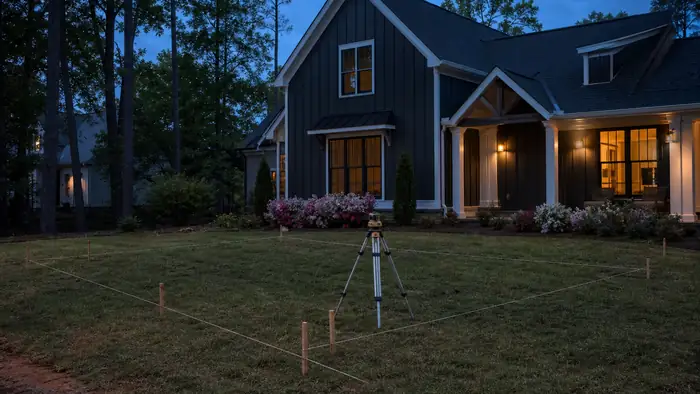
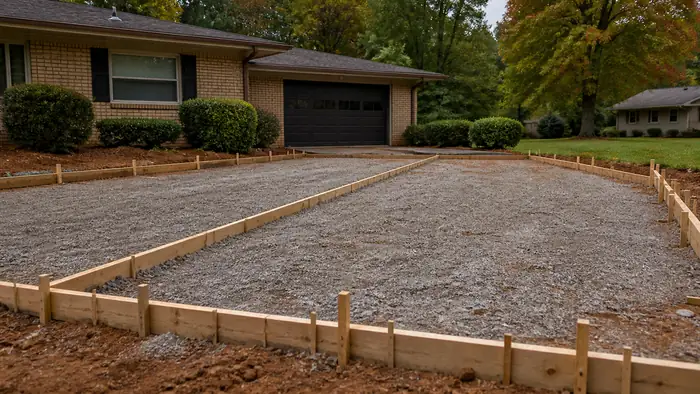
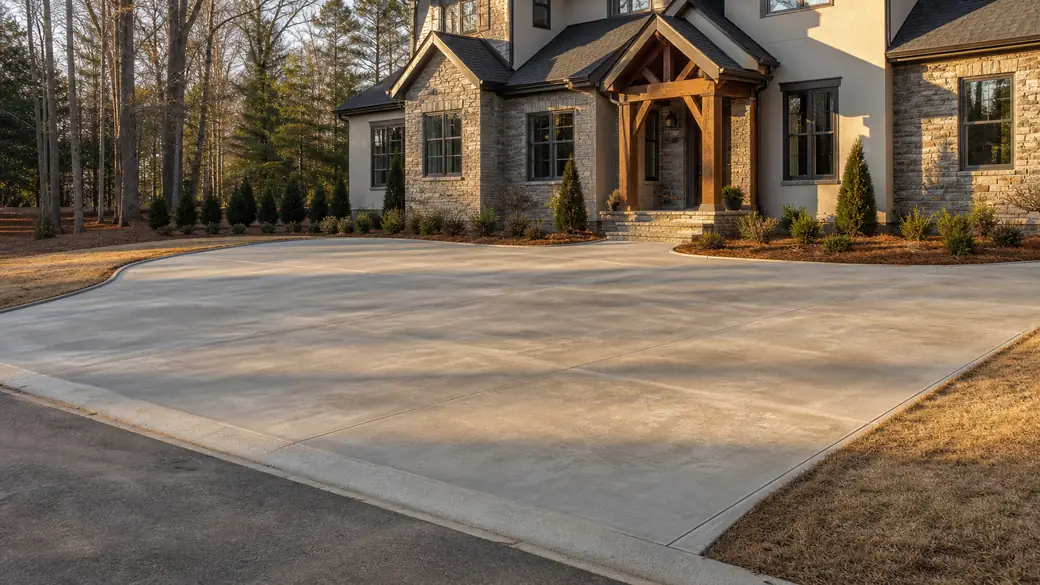
String lines and grade stakes laid out across a yard before a pour at a tan-brick colonial in Lawrenceville, GA, under bright midday cloud.

Step 1: Site Evaluation

We walk the property and look at what is already there: existing slab thickness, cracking patterns, how water leaves the lot, where trucks and delivery vans turn. Office parking areas take heavier loads than a home driveway, so we check subgrade condition and any settling near curbs and entrances. We measure the work area, mark utilities, and note tie-in points at sidewalks, ramps and door thresholds.

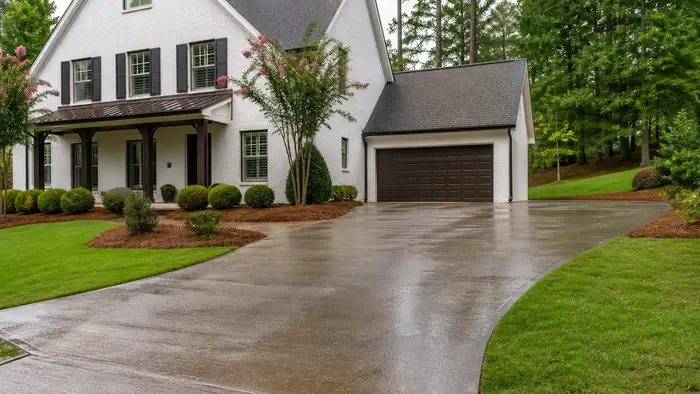
Concrete driveway and walk at a home, the kind of job an estimate covers at a red-brick ranch home in Lawrenceville, GA, under bright midday cloud.

Step 2: Written Estimate and Permits

You get the scope in writing: square footage, slab thickness, reinforcement, finish, jointing plan and how long each area stays closed. We handle the permit paperwork and any drawings that go with it. Phasing matters on an occupied property, so the estimate spells out which sections come out first and how tenants and staff reach the building while that concrete installation is underway.

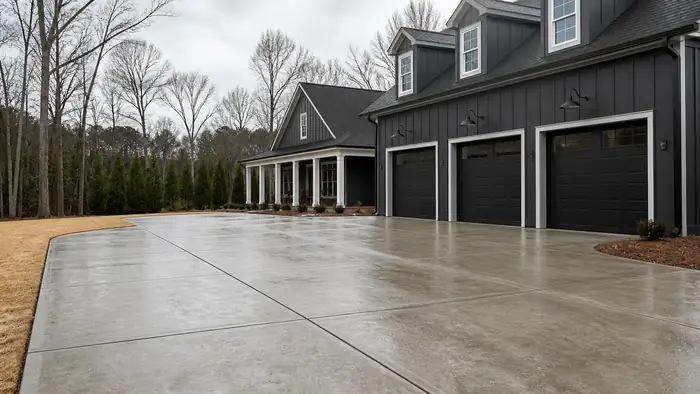
Broken-out concrete removed and the base rebuilt before a new pour at a charcoal farmhouse-modern home in Lawrenceville, GA, in early morning light.

Step 3: Demolition and Base Prep

Old concrete comes out by saw cut at a clean joint line, not a ragged break, so the new pour has a straight edge to meet. We haul the broken material off, then cut or fill subgrade to grade and compact it in lifts. Soft spots get dug out and replaced with graded aggregate base. Most failed driveways and sidewalks we replace failed underneath, not on the surface.

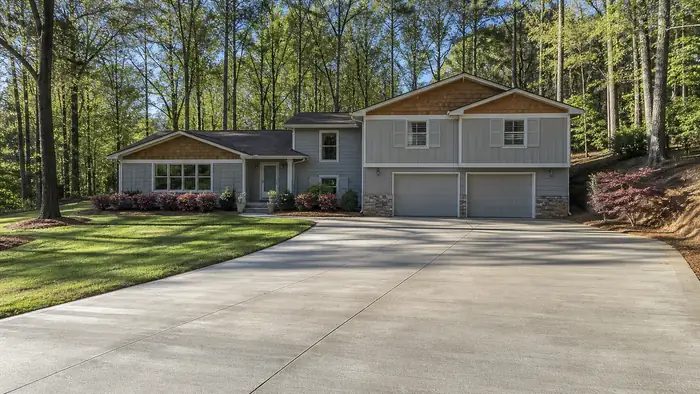
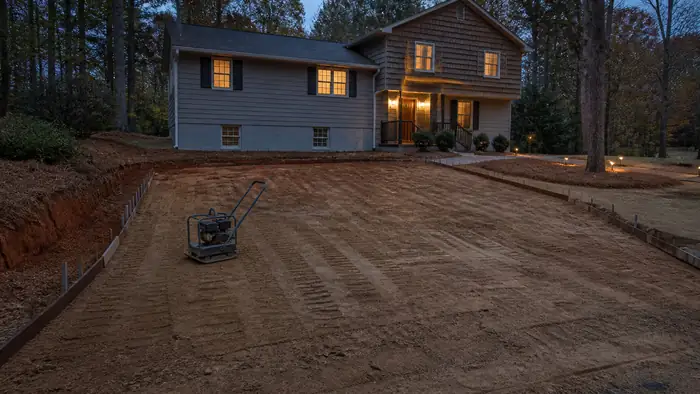
Wooden forms and rebar grid set and tied, ready for concrete at a grey split-level home in Lawrenceville, GA, in late afternoon light.

Step 4: Forming, Steel and the Pour

Forms go in on string line so the finished surface drains where it should, usually away from the building and toward existing inlets. Approach lanes and dumpster pads get rebar on chairs; light-duty walks get wire mesh held up off the base. We pour to spec thickness, screed, and bull float before bleed water sits. Trucks are staged so no cold joint forms mid-panel.

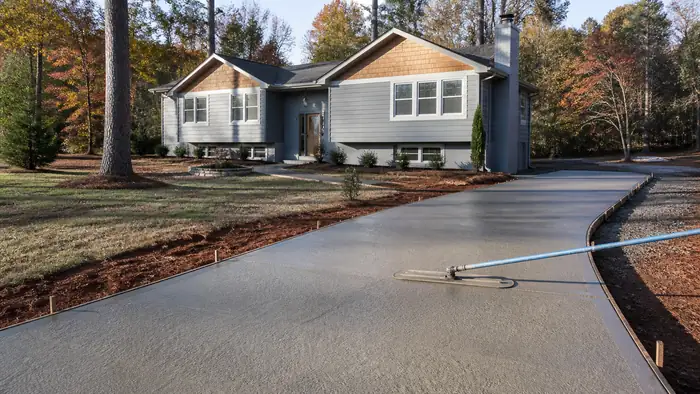
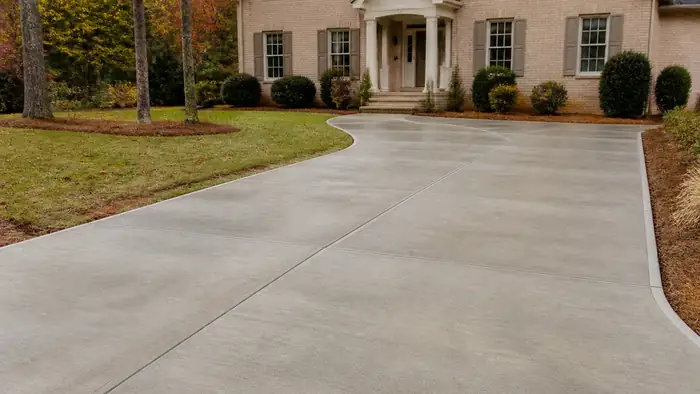
Freshly finished concrete slab curing under a clean broom texture at a buff-brick ranch home in Lawrenceville, GA, after a rain shower.

Step 5: Finishing, Curing and Final Walkthrough

Finish depends on the area. Broom texture across a concrete driveway and parking bays for traction, a tighter finish on interior-adjacent flatwork, exposed aggregate or stamped and colored work at entries where appearance matters. Control joints get cut early, before shrinkage picks its own crack line. Curing compound goes on the same day. We walk the job with you, cover foot traffic timing versus vehicle loading, and point out joints to watch.

What Decides the Price

Most of what a commercial concrete job costs is settled before a truck ever shows up. Walk the lot and you can read most of it yourself. These are the things that move the number on an office or corporate property.

What changes the priceWhich wayWhy
What sits under the existing slabCosts moreSoft or unwashed fill has to come out and be recompacted before we place anything.
How close a mixer parks to the pourCosts lessA chute reach is cheaper than pumping or wheeling concrete past a building.
Slab thickness the traffic calls forCosts moreDelivery trucks and dumpster pads need real thickness, not sidewalk thickness.
Rebar instead of wire meshCosts moreBar on chairs means more steel and more hours tying it.
Old concrete that comes out firstCosts moreBreakout, loading and haul-off are their own day of work.
Which direction the site drainsCosts moreWater running at the building means reslope, and sometimes a drain.
Stamped, colored or exposed aggregate finishesCosts moreEach adds steps after placement.

Compare bids on slab thickness, steel size and spacing, base depth, control joint layout, and whether haul-off is included. A low number usually leaves one of those out.

Questions About Commercial Concrete for Offices & Corporate Properties

How do you phase the work so a Lawrenceville office stays open?

We break the site into sections and pour in a sequence that always leaves one entrance, one accessible route and enough parking usable. Tenants get the walking route posted before we start. Fresh concrete stays barricaded until it can take traffic. On larger properties we work in strips instead of closing a whole drive lane or a whole lot at once.

Can you match existing hardscape across an office park in metro Atlanta?

Yes, within limits. Color, texture and joint pattern can be matched closely on new flatwork, and stamped or exposed aggregate sections can be repeated from what is already down. Exact color matching to concrete poured years ago is not realistic, since cement and aggregate sources change and old slabs weather. We pour a sample panel first so you approve the match before the main placement.

Do you carry the insurance a Lawrenceville property manager will ask for?

Bring it up on the first call. Property managers usually want vendor documentation on file before anyone mobilizes, and the requirements vary by building, by lease and by management company. Tell us the certificate holder, the wording your lease calls for and who receives the paperwork. That side of it gets handled before scheduling rather than the week of the pour.

How do you handle accessibility compliance at an office in Lawrenceville?

Slopes, cross slopes, landings and transitions get shot with a laser level and checked against the drawings before the pour, not after. Curb ramps with detectable warnings and accessible parking aisles are laid out on the ground and walked with you first. Concrete that cures out of tolerance has to come back out, so the time goes into the layout.

Can you work outside business hours at a Lawrenceville office?

Yes. Nights and weekends are normal on occupied commercial property, and main entrance work often has to run that way. Tell us your quiet hours, dock rules and any limits on truck access, and the schedule gets built around them. Concrete still needs its cure time regardless of when it goes down, so an overnight pour does not mean an open lot at eight the next morning.

What notice do you need for Lawrenceville office work?

More than a residential driveway takes. Permits run through the City of Lawrenceville, tenants need notice, and a lot that stays open needs a phasing plan everyone has seen. Ready mix has to be scheduled, and larger commercial pours book further out than small ones. Call early with your dates, even if the scope is still loose, and the calendar works better for everyone.

Get a Free Estimate

Get a FREE Quote

We warranty all of our work because we believe in what we do.

Tap to call +1 470-229-2076